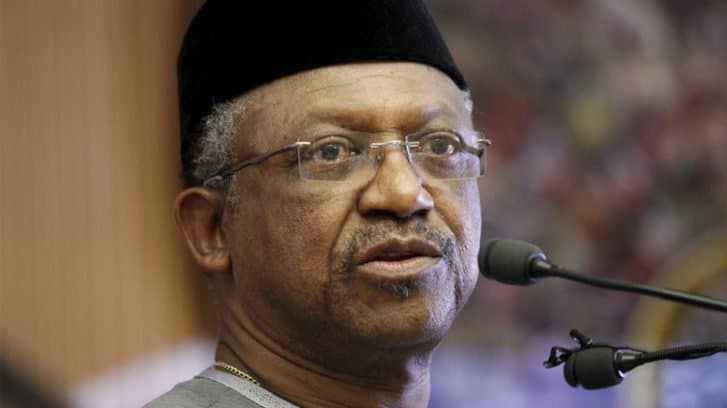
Minister of Health, Dr. Osagie Ehanire
Nigeria, along with the rest of Africa, was declared polio-free by the World Health Organisation on Tuesday, marking the eradication of a second virus from the continent, since smallpox 40 years ago.
“The chances of a resurgence are chances that we can control if we build up our routine immunisation, which we intend to do,” Ehanire said.
“We are now at about 70 per cent. We know that the remaining 30 per cent is more difficult. So we are developing strategies to expand the coverage up to 90 per cent.
“The difficult areas will be hard-to-reach areas and areas that you will likely not find transport. So we have acquired motorcycles that will be able to carry vaccinators all the way to what we call the ‘last mile’.”
The health minister added that the primary healthcare structure is being expanded to provide services such as routine immunisation.
“And if we have a platform of functional primary healthcare centres, routine immunisation, well established and the surveillance principle is set up – we are carrying out very strict acute flaccid paralysis surveillance – then we should have control of the polio eradication and be able to maintain it.”
“Today is a historic day for Africa,” said Professor Rose Gana Fomban Leke, whose commission certified that no polio cases had occurred on the continent for the past four years, the threshold for eradication.
Since 1996, eradication efforts “have prevented up to 1.8 million children from crippling life-long paralysis and saved approximately 180,000 lives,” the UN agency said.
Poliomyelitis — the medical term for polio — is an acutely infectious and contagious virus which attacks the spinal cord and causes irreversible paralysis in children.
It was endemic around the world until a vaccine was found in the 1950s, though this remained out of reach for many poorer countries in Asia and Africa.
In 1988, when the WHO, UNICEF and Rotary launched the worldwide campaign to eradicate the disease, there were 350,000 cases globally. In 1996, there were more than 70,000 cases in Africa alone.
Thanks to a global effort and financial backing — some $19 billion over 30 years — only Afghanistan and Pakistan have recorded cases this year: 87 in total.
Poliovirus is typically spread in the faeces of an infected person and is picked up through contaminated water or food.
Vaccinating people to prevent them from becoming infected thus breaks the cycle of transmission and eventually eradicates the virus in the wild.
The last case of polio in Africa was detected in 2016 in Nigeria, where vaccination had been violently opposed by jihadists who claimed it was a plot to sterilise Muslims.
More than 20 workers involved in the campaign lost their lives.
“This is a momentous milestone for Africa. Now future generations of African children can live free of wild polio,” said Matshidiso Moeti, the WHO’s regional director for Africa.
“This historic achievement was only possible thanks to the leadership and commitment of governments, communities, global polio eradication partners and philanthropists,” Moeti said.
“I pay special tribute to the frontline health workers and vaccinators, some of whom lost their lives, for this noble cause.”
The declaration, made at a ministerial-level virtual conference on health issues in Africa, coincided with an announcement in Democratic Republic of Congo that a 25-month epidemic of measles that killed more than 7,000 children was now over, thanks to a massive immunisation effort.
Togo, meanwhile, said it had become the first African country to stop transmission of human African trypanosomiasis — the insect-borne disease known as sleeping sickness.
Health workers in Nigeria were jubilant at the polio announcement.
“Happiness is an understatement. We’ve been on this marathon for over 30 years,” said Tunji Funsho, a Nigerian doctor and local anti-polio coordinator for Rotary International.
“It’s a real achievement, I feel joy and relief at the same time.”
Nigeria, a country with 200 million inhabitants, was still among the polio trouble-spots in the early 2000s.
In its northern Muslim-majority areas, authorities were forced to stop vaccination campaigns in 2003 and 2004 by Islamic extremists.
It took a huge effort in tandem with traditional chiefs and religious leaders to convince populations that the vaccine was safe.
“People trust their local traditional leaders who live with them more than the political leaders,” said Grema Mundube, a community leader in the town of Monguno, in the far north of Nigeria.
“Once we spoke to them and they saw us immunising our children they gradually accepted the vaccine,” he told AFP.
However, the emergence of violent Islamist group Boko Haram in 2009 caused another rupture in the programme. In 2016, four new cases were discovered in Borno state in the northeast in the heart of the conflict.
“At the time, we couldn’t reach two-thirds of the children of Borno state — 400,000 children couldn’t access the vaccine,” said Dr Funsho.
In “partially accessible” areas, vaccination teams worked under the protection of the Nigerian army and local self-defence militias.
 For areas fully controlled by the jihadists, the WHO and its partners sought to intercept people coming in and out along market and transport routes in a bid to spread medical information and recruit “health informants” who could tell them about any polio cases.
Today, it is estimated that only 30,000 children are still “inaccessible”, but this number is considered too low by scientists to allow for an epidemic to break out.
The next step is to ensure that Africa is shielded from any polio cases from Pakistan or Afghanistan and continue vaccinations of children to ensure that communities are safe.