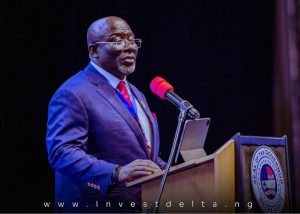
Peter Obi addresses Diaspora Nigerians

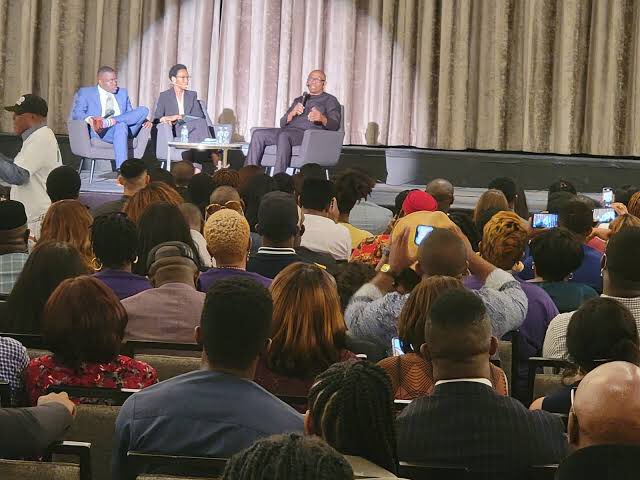
As a Nigerian with considerable interest in public affairs, the Grand Ballroom of New York City’s Hilton Midtown Hotel, the venue of “Afro-Economics & Government Policy: A Conversation with Governor Peter Obi,” was my destination last Sunday.
The engagement followed others in the United States, some of which had been mismanaged by local organisers who chose to charge a gate fee. Not New York, which was free to every registered attendee, thanks to the Columbia University’s Africa Business Club and Black Law Students Association.
The Hilton Grand Ballroom is a cavernous facility capable of accommodating 3,000 persons. For a city with nearly 700 hotels pre-COVID, Hilton bills the facility as the city’s largest ballroom. At the height of the event, it was about two-thirds full.
On arrival, I was exactly half an hour ahead of schedule. I was therefore even more impressed to find over 100 other Nigerians ahead of me at the door, some of them from faraway states.
On the evidence of the New York event, I report that Labour Party presidential candidate Obi is not a myth or a hoax, contrary to what some snake-oil merchants suggest.
He is no product merely of social media, or merely an Igbo man seeking an Igbo presidency. The Nigerians I saw, heard, and interacted with were from various parts of Nigeria.
Who is Obi? He may be a Nigerian who wants the leadership of Nigeria to alter her story, history and trajectory, but he is the candidate of time and chance.
That makes him a formidable candidate, and on the evidence of last Sunday, I now fully understand those videos of widespread excitement each time he is identified in public, which offend the Nigeria political establishment (structure, if you like).
I have previously written in this column that Peter Obi, the metaphor, is the rephrasing of the question for the APC and PDP conglomerate.
Most Nigerians admit: Nigeria is a pathetic failure. Obi’s advocacy is a commonsense proposal to re-engineer the country beginning from its leadership recruitment.
The background here is no mystery: Nigeria is at its lowest ebb of morale and coherence since her independence in October 1960. Since then, she has suffered relentlessly at the hands of ruthless politicians and a mostly-rotten military machine which dresses up some of its most brutal, greedy and pretentious in civilian attire and dumps them on the nation.
The danger is that Nigeria is now rotting at a precipitous pace, the nation hurtling towards disintegration with nothing working for most people except those who wield power, their cronies and their families. What this means is what the rest of the world can see: a nation of tremendous potential that is running out of time.
It is the popular outrage against this mess that is fueling Mr Obi and his message: to reset Nigeria.
At The Conversation, he took questions from a panel of two, and then from a pile that had been written by the audience at the beginning of the programme. Throughout, it is significant that not once did he read from a prepared text. He did not have an army of aides whispering clarifications of questions or explaining elementary concepts. He avoided no questions.
Was I satisfied with every answer he provided? No. There were a couple in which I felt he was under-prepared. But was I satisfied with him? Absolutely. It was the first time since 1983 when, as a young journalist, I joined a panel to interview the late Chief Obafemi Awolowo, that I encountered a Nigerian politician at a very high level who spoke with confidence, control, and conviction. He was on the floor for a couple of hours, pausing only to drink water. He did not go to the bathroom or pause for a doctor to monitor his vitals.
You could tell not simply that Obi is literate, but that he is educated and that should you seek his certificates, he will give them. You could tell that he is not intimidated by books or facts, and that should he see a library, he would walk in not as a tourist but as a reader.
You could tell not simply that he is educated, but that he wants to extend that privilege to Nigerians in their own country. He explained his philosophy, including why it is outrageous that in a country in which there is supposedly a government, the ASUU strike has been permitted to keep students at home for over half of 2022.
He addressed the correlation between education and poverty, advocating the first as the antidote to the second. He pointed out how, by merely implementing the United Nations Millennium Development Goals, such nations as India and China lowered their poverty rates.
Who should be the next Nigerian leader? He warned that the forthcoming election “will be about character we can trust, competence, capacity, commitment to do the right thing,” dismissing the absurdity about the presidency being conceivably someone’s “turn.” The election, he affirmed, is a political contest and “not a chieftaincy title,” and “will not be about connection.”
On corruption, Mr Obi drew attention to the importance of leadership by example. “Corruption kills entrepreneurship, professionalism, and hard work,” he said, stressing that it must be fought through the personal example of the leader, his family and those around them.
He called on Nigerians not to vote based on sentiments of religion or ethnicity because the same challenges confront Nigerians everywhere. “Don’t vote for me because I am from the South-East,” he said. “If you go to the North, it is not safer than the South. It will not be about religion (either); Muslims don’t buy bread cheaper than the Christians.”
Members of the PDP and APC have often dismissed Obi’s popularity on the grounds that his party lacks a structure. Responding, Mr Obi said, “The structure they talk about is the structure of criminality and that is what I’m coming to dismantle.”
Predictably, the crowd roared because everyone knows how APC and the PDP have rigged their way into those offices over the years with arrogance, using money, the security agencies, thugs, and even the electoral commission.
What is Obi, then? If you think of him merely as a contestant for public office, you miss the point. Obi is a conversation, a confession, and an opportunity to rethink. He is the epochal conversation Nigeria has not had with itself since the rails fell off following the civil war in 1970. He is a confession that this conversation—demanded far more by the #EndSARS generation than the Grand Ballroom demographic—is not optional.
I recommend this template, as a non-campaign engagement at home or abroad to hear and be heard. Office-seekers who are comfortable with ideas, or whose power is not in buying support with money or aides who love unearned riches more than they do their families, should try it.
Let us talk about what constitutes hope for Nigeria. Let us hear your ideas. That is what Peter Obi is doing. And he is not renting his crowds