
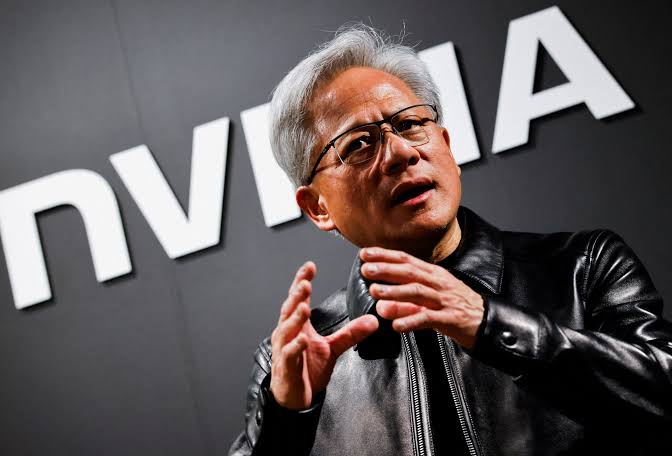
Jensen Huang
NVIDIA is an American technology company founded in 1993 by Jensen Huang, Chris Malachowsky and Curtis Priem. Initially known for designing graphics processingunits (GPUs) for computer gaming
There are important lessons for Nigeria in the extraordinary drama surrounding NVIDIA, its co-founder and Chief Executive Officer, Jensen Huang, his sudden resignation, and his eventual reinstatement following the intervention of United States President Donald Trump. Beyond the personalities involved, this episode raises fundamental questions about corporate governance, national interest, economic patriotism, leadership succession and the relationship between government and business.
NVIDIA is an American technology company founded in 1993 by Jensen Huang, Chris Malachowsky and Curtis Priem. Initially known for designing graphics processing units (GPUs) for computer gaming, the company has evolved into one of the most influential technology corporations in the world.
Its graphics processors and associated computing platforms have become indispensable to artificial intelligence, advanced computing, autonomous vehicles, scientific research and data centres. NVIDIA’s technology is central to the global AI revolution, making it one of the world’s most valuable corporations.
At the centre of this remarkable transformation is Jensen Huang, a Taiwanese-born American entrepreneur who co-founded the company and has led it through more than three decades of technological evolution. His leadership transformed NVIDIA from a graphics-chip manufacturer into a global powerhouse whose products underpin much of the artificial intelligence industry.
Huang is therefore not simply a successful businessman. He represents the kind of entrepreneurial leadership that can change the economic fortunes of a country.
Huang’s resignation on November 12, 2026, followed revelations concerning alleged extramarital relationships, including one involving a woman whom American intelligence officials suspected of having connections with Chinese intelligence.
There were also reports of another relationship involving an NVIDIA employee who reportedly worked under him.
These allegations raised serious questions about corporate ethics, executive conduct, potential conflicts of interest and national security. NVIDIA’s board had initiated an investigation, and pressure mounted as the controversy intensified.
Although Huang formally resigned, it is important to distinguish between a resignation under mounting pressure and a publicly established decision by the board to dismiss him.
The controversy was particularly sensitive because NVIDIA’s business involves advanced semiconductor technology that has strategic implications for America’s competition with China.
Donald Trump was unwilling to accept Huang’s departure as the final chapter.
He reportedly intervened directly with NVIDIA’s board, arguing that Huang’s contribution to American technological leadership was too important to sacrifice.
There were several considerations behind Trump’s intervention.
First, NVIDIA is central to America’s ambition to maintain global leadership in artificial intelligence. Losing the man who built and steered the company could have created uncertainty at a critical moment.
Second, Huang’s departure unsettled financial markets. NVIDIA’s importance to the technology sector meant that concerns about its leadership reverberated throughout the wider stock market.
Third, there were fears that China or another international competitor could attract Huang’s expertise.
Trump also believed that the allegations, serious as they were, should not automatically erase decades of professional achievement, particularly when the government had not established that Huang had committed a crime.
On November 23, NVIDIA announced his reinstatement. Trump subsequently took credit for persuading the board to reverse its earlier position.
Trump’s description of Huang as a national treasure was an acknowledgement of the strategic economic value of his achievements.
In the modern world, technological leadership is increasingly synonymous with national power. Semiconductor technology, artificial intelligence, data infrastructure and advanced computing are not merely commercial commodities. They influence military capabilities, industrial productivity, economic competitiveness and geopolitical influence.
Huang has helped place America at the forefront of this technological transformation.
Trump’s argument was essentially that the United States could not afford to lose an entrepreneur whose knowledge, experience and leadership had become so important to its economic and technological ambitions.
But the description also raises an important question: should an individual become so indispensable that ordinary standards of corporate accountability are relaxed?
Is there moral ambiguity in Huang’s reinstatement? Certainly, there are legitimate questions.
On one hand, it is possible to recognise Huang’s extraordinary contribution to NVIDIA while insisting that allegations concerning his personal conduct and possible security implications must be properly investigated.
On the other hand, reinstating a chief executive after allegations serious enough to precipitate his resignation may create the impression that corporate rules are different for extraordinarily successful individuals.
Would an ordinary employee enjoy the same opportunity? Would a less influential chief executive receive presidential intervention?
There is also the national security dimension. The allegations involving a suspected Chinese intelligence connection require careful investigation, irrespective of Huang’s commercial achievements.
The reinstatement does not amount to proof of innocence, nor should the allegations be treated as established guilt.
The appropriate balance is to protect the company’s institutional interests while preserving independent investigations, transparent corporate governance and accountability.
This is where the NVIDIA experience becomes particularly relevant to Nigeria.
Nigeria has spent decades lamenting the absence of globally competitive indigenous corporations. We have watched countries build powerful companies in technology, manufacturing, telecommunications, automobile production, pharmaceuticals and financial services, while our own economy remains heavily dependent on imported goods and services. The government watched as Volkswagen of Nigeria (VON) alongside Peugeot Automobiles Nigeria (PAN) collapsed under a very tariff structure and economic environment that did not protect local businesses. The same applies to Leyland in Ibadan and Anamco in Enugu. If they had been supported using Nigeria’s automotive policy, perhaps we could have beyond assembling to having made in Nigeria vehicles.
That could have affected the perception of Ajaokuta Steel and the plants across the country. We allowed western advisers with dubious intentions to guide policy makers into making economically disastrous decisions.
Innoson Vehicle Manufacturing (IVM) has been in the news for the daring and never-say-due attitude of its founder, but it has not got adequate support and patronage of its products from the government and its organs. When the National Assembly was urged to source luxury SUVs from Innoson, our federal lawmakers unabashedly cooked up hogwash reasons to prefer Japanese products.
The lesson is that successful companies do not emerge merely because governments announce industrial policies or establish intervention programmes. They require sustained investment, technological innovation, competent management, research, infrastructure and a business environment that rewards enterprise.
Nigeria must deliberately identify, nurture and support companies capable of becoming global champions.
Our government should create an environment in which Nigerian companies can access affordable financing, reliable electricity, skilled manpower, research facilities, modern infrastructure and international markets.
We must also move beyond celebrating individual businessmen to building enduring corporate institutions.
The NVIDIA experience demonstrates the economic consequences of losing an exceptional corporate leader. But it equally demonstrates the dangers of allowing a company to become excessively dependent on one individual.
Nigeria should therefore encourage succession planning, professional management, independent boards and strong institutional structures.
Government support must not become government control, political patronage or protection from accountability. Corporate champions should be encouraged to compete, innovate and expand, not become privileged monopolies sustained by public resources.
Trump’s intervention has attracted criticism from both Democrats and Republicans, although their concerns are not necessarily identical.
Some lawmakers question the wisdom of presidential interference in the internal affairs of a publicly traded company. Others are concerned that national security considerations may have been subordinated to commercial and political interests.
There are also questions about the appearance of preferential treatment, the independence of NVIDIA’s board and the relationship between political influence and corporate decision-making.
The criticism is therefore not simply about whether Huang deserves another opportunity. It is about whether a president should use the influence of his office to determine the leadership of a private corporation, particularly one facing sensitive national security questions.
The NVIDIA story offers Nigeria a compelling lesson in economic development.
Countries that become economically powerful do not merely produce successful entrepreneurs; they create institutions that enable entrepreneurs to flourish, protect their investments and translate individual ingenuity into national prosperity.
Nigeria needs its own NVIDIA, its own global technology champions and its own generation of internationally competitive industrial enterprises.
But we must understand that building such companies requires more than finding a Nigerian Jensen Huang. It requires building the ecosystem in which the next Jensen Huang can emerge, succeed and create thousands of opportunities.
Trump’s intervention may be defended as an attempt to protect America’s technological interests, but it also raises questions about accountability and the limits of political influence.
Nigeria should take both lessons seriously: protect exceptional enterprise, but never sacrifice the institutions and principles that make sustainable enterprise possible.
The central lesson of the Nvidia–Jensen Huang controversy for Nigeria is that nations must learn to protect and nurture institutions capable of creating extraordinary economic value, while ensuring that no individual, however successful, becomes bigger than the institution itself.
Ultimately, a nation becomes powerful not simply because it has exceptional individuals, but because it knows how to turn their exceptional abilities into lasting national institutions.