
Nigeria has officially become the 108th party to the landmark United Nations High Seas Treaty, formally known as the Agreement on Marine Biological Diversity of Areas Beyond National Jurisdiction (BBNJ), marking a significant step in the country’s efforts to tap into its vast maritime wealth.
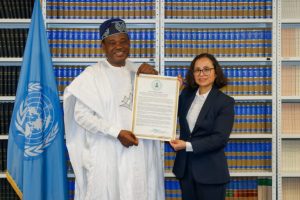
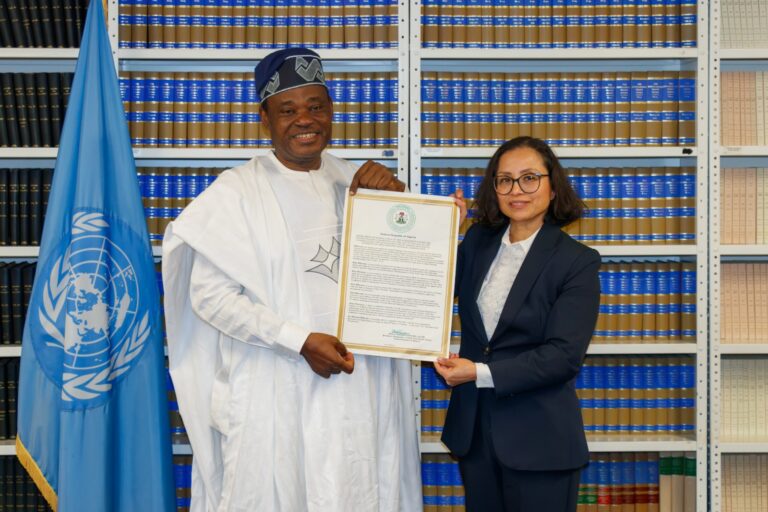
Nigeria’s Permanent Representative to the United Nations, Amb. Ibrahim Jimoh, formally deposited the country’s instrument of ratification, personally signed by President Bola Tinubu at the UN Headquarters in New York.
Receiving the document, the Officer-in-Charge of the UN Treaty Section, Ms. Evelyn Sánchez, congratulated Nigeria on the milestone. “You are now party number 108 to the BBNJ Agreement,” Sánchez said, noting that the UN would formally notify other member parties of Nigeria’s accession and its official entry-into-force date.
Speaking to the News Agency of Nigeria (NAN) after the ceremony, Amb. Jimoh stated that the ratification underscores President Tinubu’s drive to aggressively position Nigeria within the emerging global blue economy and diversify revenue streams beyond traditional onshore resources.
“The whole idea is President Tinubu’s desire to develop the blue ocean economy,” Jimoh said, emphasizing the urgency of harnessing opportunities in marine biodiversity, ocean science, and offshore energy. “You know the wealth of the earth is under the ocean.”
Jimoh linked the ratification to Nigeria’s broader maritime strategy, which includes capitalising on its extended continental shelf beyond the standard 200-nautical-mile limit.
Nigeria previously secured recommendations from the UN Commission on the Limits of the Continental Shelf covering roughly 16,300 square kilometres of additional seabed and subsoil, an area the Presidency estimates to be about five times the size of Lagos State, holding potential reserves of hydrocarbons, gas, solid minerals, and sedentary marine species.
While clarifying that Nigeria’s extended continental-shelf rights are legally distinct from the BBNJ framework which governs the conservation and sustainable use of marine genetic resources, environmental impact assessments, and marine technology transfer in international waters, Jimoh stressed that unlocking Nigeria’s maritime domain requires heavy investment in science and technology.
“We have to buy geophysical equipment to be able to know what is in all this sea, and then we can appropriately tackle those resources. I think that’s the future; that’s the wealth of tomorrow,” he noted, calling for increased funding in ocean mapping and scientific surveys.
Describing the ratification as both “significant and symbolic,” the envoy affirmed that Nigeria will collaborate closely with the international community in global ocean governance to ensure the blue economy translates into foreign investment, job creation, scientific advancement, and long-term national wealth. (NAN)