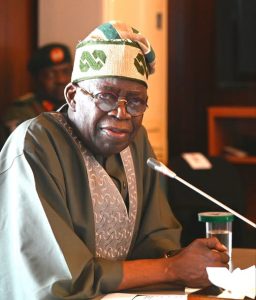
President Tinubu
Why this “giantification” and “colossalization” of a minuscule and miniature presidency? Instead of listing President Bola Ahmed Tinubu’s achievements and the campaign promises he has fulfilled, and allow the citizens to rate him based on his verifiable record, some of his incensed (yes, as in furious) supporters are making him out to be superhuman.
The national insecurity of terrorism and kidnapping was Nigeria’s biggest challenge in 2023 when Tinubu became President. Almost four years later on Friday November 16, 2026, Mr. Dele Alake, Spokesperson for the All Progressives Congress – Presidential Campaign Council, said that over 15, 000 terrorists have been killed and 130,000 others have surrendered in three years, as though the terrorists did not kill our gallant soldiers and policemen and sundry civilians they kidnapped. Instead of saying how many states or Local Government Areas have been liberated from terrorists, he announced a NEW five-year plan to wipe out terrorism, that would end with Tinubu’s second tenure. But in a September 30, 2023 speech at the Nigerian Defence Academy passing-out parade Tinubu vowed to eliminate terrorism, criminality and poverty – because military action must be paired with social measures.
Claims apart, has kidnapping rate been reduced if not eliminated – as Tinubu had promised? Unfortunately, Security monitors, SBM intelligence reports cited by the BBC and International Centre for Investigative Reporting (ICIR) said that kidnapping upped from 3,620 incidents in 2023 to 7,825 people kidnapped in 1,713 incidents between July 2025 and June 2026 – in just a year. 20,115 people were snatched across the country between July 2023 and June 2026 – a 66% increase in the last 12 months. Yearly ransom payments rose more than seven-fold from N1.05 billion in 2023/2024 to N7.78 billion in 2025/2026 when group kidnappings became the new method.
Election is around and Team-Tinubu should be reelected or rejected based on his national security and economic records as happened to Goodluck Jonathan, against Muhammadu Buhari, and the Peoples Democratic Party lost power to All Progresives Congress.
In how many Local Government Areas or states have Tinubu erased terrorists and normalized citizens’ lives. Promises are fine but an egg can’t go on being good forever; it must either hatch or go bad.
Second, what has been the result of Tinubu’s economic salvation efforts in 2026, three years plus a few months (almost a full tenure) in office and power – and the appraisal of his administration (it is also called an election) is less than 60 days away? Instead of stout results and achievements we are being given more promises, promises, promises.
Sad to say, even Tinubu’s greatest supporters still grant that multi-faceted hunger still stalks the land in 2026 and worse still, they accept that his removal of petrol subsidy worsened the peoples’ sufferings. Still, they stoutly state that Tinubu had to take harsh measures to stop the economy from collapsing but advance no timelines for succour to come. Surprisingly, though they justify the President’s petrol subsidy removal because importers were hoodwinking Nigeria through over-invoicing and other sundry acts of corruption, none of them has wondered why Tinubu did not even bother to straighten the crooked petrol subsidy ways and punish the criminals. Also, they have over-looked the option open to Tinubu to make Nigeria’s refineries productive and corrupt-free. Worst of all, the petrol that comes into Nigeria now has been said to originate, not directly from any identifiable country or refineries but is blended offshore near Malta.
On July 22, 2024, the Cable online newspaper published this: “The businessman, Aliko Dangote, said at the House of Representatives that “Some of the NNPC people and some traders have opened a blending plant somewhere off Malta. The diesel produced locally at 650 parts per million (ppm) and 700 ppm is of better quality than imported fuel. Many vehicle issues can be traced back to the “substandard” imported fuel.
The House of Representatives joint committee on petroleum resources (downstream and midstream) had launched a probe into claims that local refineries, including the Dangote Petroleum Refinery, produced inferior products and investigating the allegations that the international oil companies (IOCs) in Nigeria are frustrating the survival of the Dangote refinery. Actually, the Nigerian Midstream and Downstream Petroleum Regulatory Authority (NMDPRA) and Dangote refinery had been embroiled in a dispute and on July 18, Farouk Ahmed, NMDPRA’s chief executive officer had said local refineries, including the Dangote refinery, were producing inferior products compared to the ones imported. The oil regulator also accused Dangote of monopoly”.
PUNCH newspaper reported on July 26, 2024 that Nigeria actually imported fuel from Malta; $59.98m in 2014, $117.01m in 2015 and $13.32 in 2016 and the importations stopped from 2017 to 2022 resumed in 2023 with a “geometric leap in 2023 when the country imported fuel worth $2.08bn”. Jonathan was President in 2013 when the Malta magic started but stopped for some six years that fell under Buhari but resumed and increased exponentially in 2023. Please draw your conclusions!
So, how did the poor petrol quality issue end? According to the Cable, “Heineken Lokpobiri, minister of state petroleum resources (oil), intervened in the ‘ongoing issues’ after having a meeting with Aliko Dangote, chairman and chief executive officer (CEO) of Dangote Group and Farouk Ahmed, CEO of Nigerian Midstream and Downstream Petroleum Regulatory Authority (NMDPRA). Gbenga Komolafe, CEO of the Nigerian Upstream Petroleum Regulatory Commission (NUPRC), and Mele Kyari, group CEO of the Nigerian National Petroleum Corporation (NNPC) Limited were also at the meeting”. That was the last Nigeria heard about the drastic disclosures. Nobody was punished…the truth didn’t emerge, despite the lawmakers stand in July 2024 that product test results would be publicized.
The Cable online explained: “An oil blending plant has no refining capability but can be used to blend re-refined oil (a used motor oil that has been treated to remove dirt, fuel, and water) with additives to create finished lubricant products”. A real expert in the field, Isoil Impianti which developed from Isothermic Swiss which Carlo Blumer and Pierluigi Guazzoni founded in 1958 holds that:
“Traders ship intermediate petroleum products and off-spec fuels to Malta from major refining hubs. Common inputs include straight-run gasoline, reformate, heavy naphtha (which make up roughly 35% of shipments into the area), and high-sulfur or off-spec distillates. (The) blending is purely mechanical. Components are mixed either inside onshore tank terminals (such as the facilities at Marsaxlokk) or directly at sea through ship-to-ship (STS) transfers, where tankers pump different grades of hydrocarbons into a single receiving vessel.
- Adjusting fuel specifications. Operators use precise flow meters and chemical additives (such as oxygenates, octane boosters, or ethanol) to alter the properties of the base liquid. By adjusting the ratios, blenders control key metrics like the octane rating, vapor pressure, and sulfur content.
Different regions enforce different environmental and engine standards. While European markets require ultra-low sulfur and strict emissions compliance, traders in Malta frequently blend lower-cost components like naphtha into gasoline to create “African Spec” fuel. This lower-grade blend meets the more lenient import thresholds of West African markets—such as Nigeria—before being loaded onto vessels for export”.
This serious allegation should have bothered the National Assembly and the law authorities and President Tinubu for two reasons; corruption as Nigerians pay high petrol prices for low quality petrol. Second, low quality petrol destroys engines. Now, who knows which petrol stations sell Sulphur-saturated Malta-blended petrol, though Nigeria’s Bonny Light is of the “sweet” Sulphur – free variant? Nobody! And how much do importers buy the sulphuric blend they sell to us at premium price? That Malta-blend controversy has been swept under the carpet. Corruption was a major problem Tinubu was elected to combat in 2023…but the Malta-blend petrol controversy outcome is not the way to end corruption.
Simply because America’s President Roosevelt championed and introduced large-scale projects to stimulate nation-wide employment after the Great Depression of the 1930s, some applaud Tinubu as Nigeria’s Roosevelt because he started the Coastal Road and the Apapa Port rehabilitation and upgrade. By the way, the popular Roosevelt served more than two terms of four years; he won four presidential elections, serving 12 years from 1933 – 1945 when he died in office, so some people may be campaigning for Tinubu’s life-presidency. Who will tell such people that they are only advertising their ignorance of developmental issues? First, instead of two mega projects costing colossal sums, smaller but numerous labour-intensive ones dotted across the federation would better spread employment and income nationally. David Umahi, minister of works said on Arise TV, a standard carriageway on the 750-Lagos-Calabar Coastal Highway costs $5.5 million or N7, 468, 489, 105.00 (N7.4 billion) per kilometer which equals N5.55 trillion for the entire road. If that contract was awarded in 2025, it would have swallowed 10% of the budgeted N54.99 trillion. But the Federal Government under President Bola Tinubu first announced the award of the Lagos-Calabar Coastal Highway contract to Hitech Construction Company Ltd in September 2023, before the Federal Executive Council (FEC) approval of the first phase in early 2024. Umahi defended the contract award to Hitech Construction through direct procurement rather than open competitive bidding, saying it broke no law. He didn’t call it a noble transparency example, though.
That quantum of fund would have been better spent in constructing or repairing both urban and rural roads in the 36 states plus Abuja FCT and the ripple effects of pumping that gargantuan amount into the economy would spread nationally. Earmark that money to repair two roads in each state plus Abuja and that would have sent in N743.11 billion into each state.
As 25 states had 2025 budgets less than N743.11 billion, starting with Kano’s N719.7bn to the least, Yobe’s N320, each state should have been able to construct or repair from five to 10 roads with N74311 billion and the Federal Government could even have controlled the contract rollout and the payment. So, the money being poured into the Coastal Road would have been able to fund up to 370 road repairs if not constructions across the country at 10 roads multiplied by 37. As the money would never have been released at once, the projects across the country would have been gradual but continuous. And it would have spread job creation voluminously and evenly especially if labour-intensive projects as manual construction of gutters were focused on in the rural roads.
It is unfortunate that because Chief James Onanefe Ibori, 1999 – 2007 Delta State Governor, gave little attention to bull-horn governance, many don’t know that he also jumpstarted his state’s economy. He didn’t publicize his projects maximally (read; inducing journalists to report them and also paying to be given newspaper awards) and so far not a single book has been written about the trails he blazed. To fight unemployment at the local level, he started the walling of primary and secondary schools across Delta state on assumption of office. Such contracts went to local companies and they employed local labour and thus money seeped into the remote villages as well as the cities. The contractors requisitioned cement, iron rods, planks and other materials from the villages while the labourers bought sundry necessities and victuals and kept transporters and sectorial operators busy. That was the first money that reached Delta state grassroots as dividends of democracy.
PS, I deliberately didn’t write the promised “Wrong, Magnus Onyibe: Roosevelt’s Subsidy Ended USA’s Great Depression (2)” because nobody disputed any of my theses. If any antithesis appears, I will revisit that topic.
Tony Eluemunor, a Ford Foundation scholar and 1991 Fellow of the Nieman Foundation for Journalism at Harvard University (where he focused on Development and Population studies), is an authority on the Nigerian Presidency.