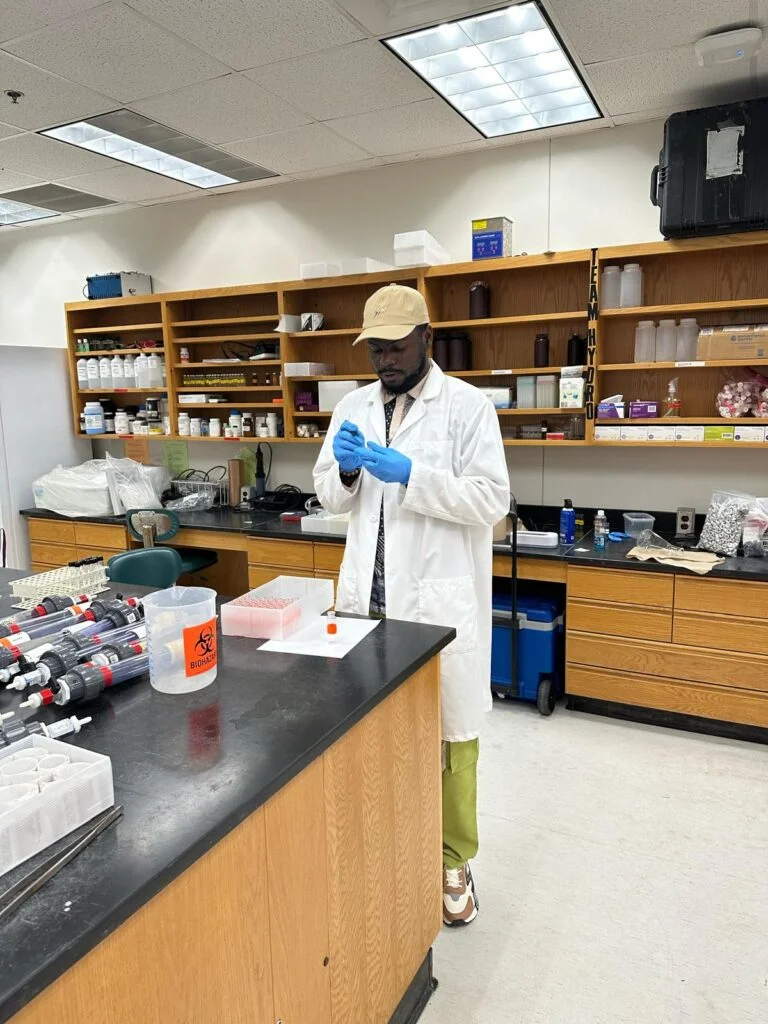

A Nigerian doctoral researcher at Texas A&M University–Corpus Christi (TAMU-CC), Ifeanyi Anyanwu, has led environmental investigations into drinking water quality in underserved coastal communities in South Texas.
According to the research report it focused on unincorporated communities known as colonias, typically low-income settlements that often lack centralised water infrastructure and rely on private wells.
The study noted that because these systems are privately owned, they are not consistently monitored under federal drinking water regulations, resulting in limited baseline data on groundwater quality.
“Residents commonly depend on shallow boreholes that may be vulnerable to surface contamination during flood events, particularly in coastal regions prone to seasonal storms,” he said.
Anyanwu added that the research became imperative because Per- And Polyfluoroalkyl Substances (PFAS) contamination has received increasing attention in the United States environmental policy due to its persistence and potential health impact.
“Federal agency such as the Environmental Protection Agency (EPA) has introduced regulatory limits and funding initiatives to address contamination in public water systems.
“However, such programmes primarily target regulated municipal systems; and private wells such as those used in colonias are typically outside federal monitoring frameworks, leaving potential exposure pathways less understood.
“Many federal initiatives are designed for regulated public systems; without baseline data for private wells, it is difficult to assess exposure risks or prioritise intervention in these communities,” Anyanwu noted.
The Nigerian researcher said the research seeks to investigate how extreme rainfall events, including hurricanes, tropical storms, and flash floods mobilise contaminants such as PFAS, arsenic, lead, and microbial pathogens into the shallow aquifers used for drinking water.
“When flooding hits these communities, infiltrating water can mobilise and transport surface contaminants into shallow aquifers. In these communities, there is little or no baseline data on groundwater quality. Our work aims to establish that baseline,” Anyanwu said.
Anyanwu, a Ph.D. student in Coastal and Marine System Science, leads the U.S. National Science Foundation (NSF) project funded at up to US$1.6 million.
He said the study incorporates machine learning (ML) techniques, including Extreme Gradient Boosting, Artificial Neural Networks, Deep Neural Networks, and Random Forest models, to analyse relationships between rainfall, flooding, and groundwater contamination patterns.
“These models are used to develop predictive tools that estimate when and where contamination risks may increase following extreme weather events.
“A key outcome of the project is the proposed Water Resilience Index (WRI), a framework intended to assess aquifer vulnerability in flood-prone and resource-limited regions and the tool is designed to support decision-making by water resource managers and funding agencies,” he said.
The Nigerian researcher said the recent extreme weather events in Texas have highlighted the vulnerability of communities to flooding and its secondary impacts.
“While immediate flooding damage is visible, as seen in The July 2025 Texas Hill Country Floods, long term effects such as groundwater contamination are less frequently documented.
“Flooding events draw attention to surface impact, but subsurface contamination can persist long after water recedes. Understanding these processes is essential to long-term water security,” Anyanwu highlighted.
“Hydrogeological processes are consistent across regions, but data availability differs. In areas where monitoring is limited, generating reliable data becomes the first step toward informed decision-making,” Anyanwu mentioned.
The project integrates non-invasive advanced hydro-geophysical method, including Cone Penetration Testing (CPT), Hydraulic Profiling Tool (HPT), and Nuclear Magnetic Resonance (NMR) to characterise aquifer properties.
These measurements are combined with groundwater sampling for PFOS, PFOA, short-chain and other long-chain PFAS variants, arsenic, lead, cadmium, radionuclides, and microbial indicators such as Enterococcus.(NAN)