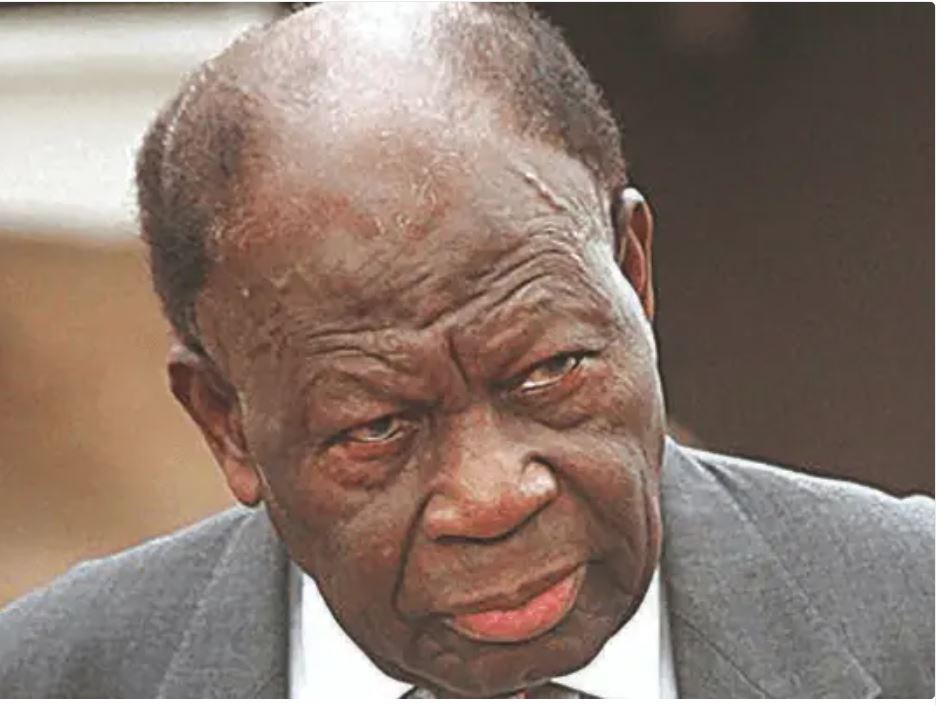
the late Pa Akintola-Williams

By Bruce Malogo
He died Monday, September 11, 2023. He was aged 104 years. Two weeks after his ninetieth birthday, I called him to ask for a profile interview. I was editor at The Sun Newspapers. He agreed – reluctantly. It was to mark his birthday, I’d told him. He gave me time, 10am, and the venue, his residence.
I knew his type. He belonged to those who are unyielding in their resolve – in an admirable way. A man of “rule and line,” as Charles Dickens would put it in his novel, Hard Times. In this instance, I was acquainted with the fact that he was pedantic in matters of social etiquette. Therefore, to appear late for the appointment would be akin to committing suicide. So, on that day, I left home comfortably early and appeared at his gate expectedly promptly.
He resided in Ikoyi, that enclave for men of means and muscles. You’d expect Mr Akintola Williams, like majority of his tribe to reside in some place that reminds you of prison yard. Of course, his residence was walled in by a high fence, it was not your traditional, vulgar structure that could draw ranks with the maximum wing of the Kirikiri Prisons. From the street, you’d see through into the sprawling premises. The walls of the perimeter fence were done with hollow bricks. The entrance had two gates, but it seemed that only one allowed people go in and out. It was permanently ajar, it appeared. Not only that. It was your regular gate, made of iron bars; no flat sheets or plates. Even the bars looked flimsy.
So I had no trouble assessing his home on Ilabere Avenue.
I asked my driver to pull over on the opposite side of the street, across his house. I walked casually, yet cautiously to the gate, pushed it gently and it opened. A fellow in regular outfits, obviously a security man, the type everyone calls “Maiguard,” emerged from the gatehouse and said in a calm, almost inaudible voice, “Yes?” I stopped. “Ah, sorry. Please I want to see Daddy,” I said with a ring of guilt in my tone. It was that type of sorry feeling you get when you have behaved badly or shown bad manners. I couldn’t make out from where, but the man held up a piece of paper to me. On it was written ‘Mr Bruce Malogo. 10am.’ “Yes, it’s me,” I told him. “Ok, come!” he led me. I dogged behind him. As we walked, that piece of paper flashed in my mind’s eyes, and I muttered to myself with a sarcastic smile: “My name, and time. Some men!”
Upstairs, I was ushered into the man’s expansive office. You had to make a journey from the door of the office to where he sat, hunched over a table in a corner like a Buddhist monk. By the way, his office was in the same premises as his residence. Right from the door, I offered my greetings. He responded. I made the trip to his table and took his outstretched hand in welcome. Protocols over in seconds.
I wasn’t expecting his opening line: “I don’t think it is wise to grant you this interview,” he shot at me. It was indeed a potshot. Hearing that, my shoulders fell! At the same time, I thought I heard a thud inside my chest. I managed a “Pardon me, sir?” He turned a bit pensive, trying, I supposed, to put his rationale in a way that it would be less painful or disappointing, or both. “It will not be fair to the man who is working on my biography,” he said and paused for what seemed like eternity. “I have seen what you did for my friend, Arthur (Chief Mbanefo). It is quite extensive and I have congratulated him. But going through this with you will alter what we are doing (his biography).” This latter part came like in a slow motion — deliberate, direct, cutting. My temporal muscles began to throb and I felt warm sweat coursed down from my armpits.
Truth is, there was much at stake in this. So much more was expected from this interview beyond the proposition of making it a birthday marker. The other thing was this: The interview had been slated for a weekend flagship feature in my paper. There was no alternative to consider, no contingence. It was that interview or nothing. Meaning that, if this session failed, the paper would have to go without the feature. In some other situation, that would be, well, hard to deal with. In the present situation, it would be unthinkable; forbidden, is more like it.
I licked my drying lips, sat up straight and began to speak with all the pluck I could conjure and the confidence I could muster. I was telling him why we must have the interview; why it would also be in the interest of his biographer. As I was speaking, he was looking at me, or he might as well be looking through me. His concentration was earnest; he was soaking in all I was saying. When I was done, he said: “Well, you have not convinced me hundred percent, but you have convinced me enough to have this interview.” I congratulated myself; feeling relieved, triumphant. “How long will this take?” he demanded. “Usually not less than one hour,” I told him, lamely. “No, forty minutes!” he commanded. In an instance such as this, even half of that duration would be considered magnanimous. “That’s all right, sir,” I said with undisguised enthusiasm.
Then we began.
By the time I asked the last question, we had spent close to two hours. At the end, I apologized for taking “much of your time, sir.” He responded with a broad smile. For a moment, I noticed that the smile had relieved the creases in the mid-section of his face, making his entire face supple, pliant. “No, no, no!” he protested. “You made it so easy and simple for me. I enjoyed it.” Then he collapsed backward, hurling his back against the backseat of his black sturdy chair. I was watching him, and waiting with contented smile. He blew into the air and said, “You know what?” I said “What, sir?” He gave that easy, sweet smile that is peculiar to old people: “Perhaps I should have been a journalist!” And we burst into throaty, roaring laughter.
POSTSCRIPT:
You would notice that I used the most unpretentious, stripped down prefix, “Mr.” for him. That was how he wanted to be addressed – Mr Akintola Williams. Nothing more. And, well, if another title of lesser degree or stature were to exist, he would have worn that comfortably and with delight.
Truth is that, given his achievements and high acclaim, it would have been easy for the man Akintola Williams to ornate himself with a mélange of titles – conventional and contrived, traditional and trumped up. But his aversion to totems wouldn’t permit. This much he admitted to me. I had asked him why, with his Olympian accomplishments and the far reaches of his influence, he chose to go about with simple “Mr.” His face contorted, and for a minute it looked like he would pounce on me. “You expect me to go about answering Chief or Dr or whatever? For what? Why? Those are not necessary; they are encumbrances,” he blurted out. He then signed off thus: “There are important things in life, my good friend.”
Malogo is a journalist and member of The Nigeria Guild of Editors