Skip to content
July 20, 2026
  • Home
  • About us
  • Contact us
  • Newsletter
  • Privacy Policy
Political Economist

Political Economist

A liberal News reporting Politics, Sports, Business, Commentaries

  • Home
  • National News
    • Metro News
      • metro
    • Society
    • Crime and Justice
  • Special Reports
    • Investigation
    • Features
    • Interviews
  • Opinion
    • Commentaries
    • Perspectives
  • Press Releases
  • International News
  • Business & Economy
  • Politics
Watch Online
  • Home
  • Business & Economy
  • IMF highlights risks of domestic borrowing in sub-Saharan Africa
  • Business & Economy

IMF highlights risks of domestic borrowing in sub-Saharan Africa

Admin October 16, 2025
imf

IMF logo

October 16, 2025

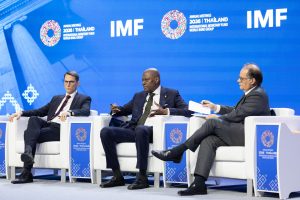
Sub-Saharan African governments are paying more to borrow at home than abroad as they turn increasingly to domestic banks to plug financing gaps, deepening risks for lenders and squeezing private investment, the International Monetary Fund said on Thursday.

“The domestic cost of capital remains elevated across the region,” the IMF said in its Regional Economic Outlook, which was released during the annual meetings of the global lender and World Bank in Washington.

“Local financial markets are underdeveloped – characterized by shallow depth, fragmentation, illiquidity and high transaction costs and lending spreads.”

The IMF warned that new domestic public borrowing is “significantly more expensive than external borrowing” in many countries. Heavy reliance on banks is raising funding costs further and “crowding out private-sector investment.”

Domestic bank holdings of sovereign debt are “large and growing faster in sub-Saharan Africa than in the rest of the world,” it added, creating a “vicious potential feedback loop” in which weakening government finances threaten banks’ soundness, curbing credit and heightening fiscal stress.

Abebe Aemro Selassie, the director of the IMF’s African Department, told Reuters the shift to local funding was a double-edged sword.

“About half of total public debt is owed to domestic banks,” he said. “Access to external financing has not been readily available in recent years, but it is also a positive sign because, fundamentally, we want countries to be able to borrow in their own currency.”

Still, he cautioned that excessive domestic borrowing “can also create problems in the banking sector” if governments struggle to service debt.

MANY COUNTRIES TRYING TO AVOID DEBT TRAPS
African countries have been very cautiously returning to international markets since 2024, after many were effectively locked out in 2022 due to a surge in borrowing costs and increased economic risks.

The cost of borrowing has fallen from crisis highs, but many governments are still servicing past debts and seeking to avoid new debt traps.

Policymakers are now experimenting with a mix of domestic bond issuance, private placements, and multilateral loans to fund budgets and development projects.

Beyond fiscal repair, the IMF called for stronger debt-management frameworks and credible, transparent data to attract long-term investment. It also urged more realistic expectations for “innovative” funding models such as blended-finance vehicles and debt-for-development swaps.

Total blended-finance flows to sub-Saharan Africa remain small – about $6 billion per year, the report found.
Transactions such as Ivory Coast’s 2024 debt-for-education swap and Gabon’s 2023 debt-for-nature swap are still rare and “comparatively small, typically below $1 billion per year globally.”

Selassie said mobilizing private and domestic resources would be vital as aid declines.

“One of the things that could be considered is trying to entice more private financing,” he said.

“This is a very complex area … but it’s an important way to start supplementing domestic savings.”

REUTERS
  • Facebook
  • Share on X
  • LinkedIn
  • WhatsApp
  • Email
  • Copy Link
Tags: Abebe Aemro Selassie IMF

Post navigation

Previous Navy hands over 4,000 litres of products suspected to be AGO to NSCDC
Next AFRICA-FX- Nigeria’s naira seen weakening further, Ghana’s cedi to extend rally

Related Stories

West Africa’s ECOWAS bloc signs agreement backing Nigeria-Morocco atlantic gas pipeline, statement reports regional heads
  • Business & Economy

West Africa’s ECOWAS bloc signs agreement backing Nigeria-Morocco atlantic gas pipeline, statement reports

July 20, 2026
NLNG honours Professor Barth Nnaji for his contribution to science and innovation
  • Business & Economy

NLNG honours Professor Barth Nnaji for his contribution to science and innovation

July 20, 2026
IPMAN to FG: Stop issuing licences for petroleum products import Fuel crisis
  • Business & Economy

IPMAN to FG: Stop issuing licences for petroleum products import

July 20, 2026
logo

Political Economist is a liberal news magazine with global affiliations.

At Political Economist, we promote free enterprise and act as a catalyst for the growth of knowledge economy. We are proudly pan-Nigeria yet richly spiced with African and global news. We offer a fair and balanced news reportage presented by our team of well-heeled professional journalists. <

About us

  • 5 Olutosin Ajayi Street, By CPM Church, Ajao Estate, Lagos State, Nigeria
  • +234 805 680 1124
  • info@politicaleconomistng.com

Follow

Subscribe to notifications

You may have missed

Olisa Agbakoba to chair GOCOP 2026 conference in Lagos
  • National News

Olisa Agbakoba to chair GOCOP 2026 conference in Lagos

July 20, 2026
Court sentences 2 Ansaru commanders to life imprisonment Federal High Court
  • National News

Court sentences 2 Ansaru commanders to life imprisonment

July 20, 2026
Nigeria’s Erebor elected ATU confab preparatory committee chair
  • International News

Nigeria’s Erebor elected ATU confab preparatory committee chair

July 20, 2026
Reps Committee commences consideration of revised State Police establishment bill spokesman
  • National News

Reps Committee commences consideration of revised State Police establishment bill

July 20, 2026
  • Home
  • About us
  • Contact us
  • Newsletter
  • Privacy Policy
Copyright © All rights reserved. | DarkNews by AF themes.