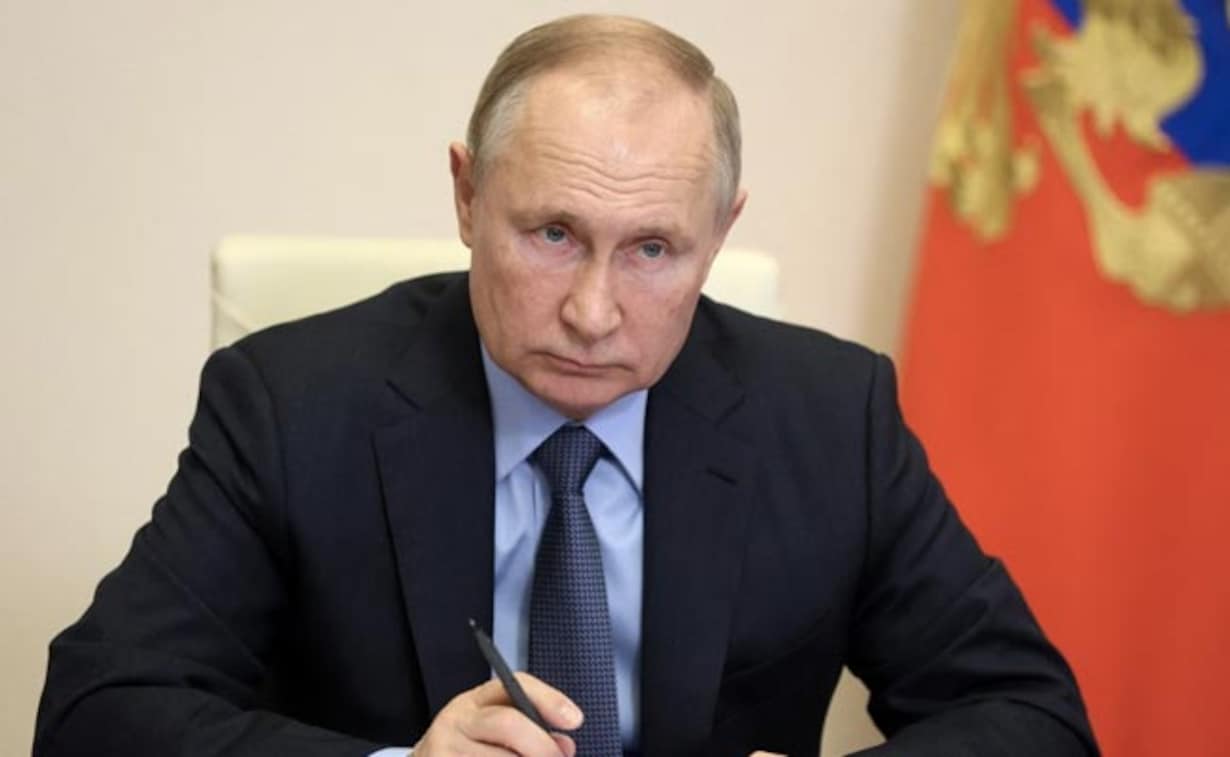
Vladimir Putin
April 12, 2022
Russia can afford to wage a long war in Ukraine despite being hammered by Western sanctions aimed at crippling its ability to sustain the campaign, defence experts and economists say.
As the war grinds on, rising casualties and the need to rotate fresh troops into battle may prove more pressing challenges than the financial cost.
“This type of low-tech war can be financed almost entirely in roubles, which means they can continue pouring troops and heavy artillery into Ukraine at least until there’s a more general collapse of the economy,” said Jacob Kirkegaard, economist at the Peterson Institute for International Economics in Washington.
Johan Norberg, senior analyst at the Swedish Defence Research Agency, said: “The sanctions will not affect this war in the short run, because Russia’s military is fighting with tanks it had already built and soldiers it had already trained.”
Sanctions are expected to shrink the economy by more than 11% this year, the World Bank says, but revenues from energy exports are actually increasing. The Russian finance ministry said on April 5 that Moscow expects to earn $9.6 billion in additional revenue from energy sales in April alone thanks to high oil prices, which remain around $100 a barrel.
There is no doubt, however, that Russia’s vaunted military machine has taken a huge and costly hit.
The United States assesses that Russia has lost about 15-20% of its combat power during its invasion of Ukraine, a senior U.S. defence official said.
That includes everything from tanks, armoured vehicles, artillery systems, fighter and bomber aircraft and helicopters to surface-to-air and ballistic missiles, the official said, speaking on condition of anonymity.
LOST TANKS
According to Oryx, a closely watched military blog which tallies both sides’ losses based on verifiable visual evidence, Russia had lost at least 2,770 items of military equipment as of Tuesday, including at least 476 tanks that had been destroyed, damaged, abandoned or captured.
That, said Yohann Michel of the International Institute for Strategic Studies (IISS), is more than the combined tank strength of NATO members France (222) and Britain (227).
Russia, which had around 3,000 tanks before the war, according to IISS figures, is not about to run out. But experts said some of those are likely to be old, in poor condition or held for spare parts, so the effective number available for combat is lower.
Mathieu Boulegue, a specialist in the Russian military at Chatham House, said Moscow had so far held back its most modern weaponry, which it is reluctant to lose, and relied heavily on an abundance of more expendable Soviet-era hardware.
He said it could take “a decade or two at least” to rebuild equipment levels to where they were before the war – a task complicated by a host of factors including design and innovation challenges, corruption, the indebted state of defence companies and a lack of access to Western microelectronics because of sanctions.
DEFENCE BURDEN
Russian military spending will need to rise both because of the war with Ukraine and the resulting sharp increase in tension with NATO, which has sent thousands more troops to eastern Europe, said Richard Connolly, an associate fellow at RUSI in London and director of the Eastern Advisory Group consultancy.
He said defence spending as a share of GDP could rise significantly from its current level of around 4%, potentially doubling in the next few years.
Connolly said ordinary Russians would feel the impact but the state could comfortably pay for the war effort, even if its economy is plunged into recession. If necessary it could commandeer resources like fuel from state-owned companies.
The more pressing question, he said, was the level of casualties and the difficulty of sustaining a war involving up to 150,000 troops at a time.
Eventually, Connolly said, it may have to take the politically unpopular decision to dip into its reserves, which the IISS estimates to number 2 million men under 50 with military service within the past five years.
“If you’ve got 150,000 committed to Ukraine, you’ve got half of your effective army currently in combat operations, many of which have experienced significant losses,” Connolly said.
“So they’re going to need to replace, they’re going to need to rotate them. They’re using their entire army, basically – or they will be if this goes on for very much longer.”
REUTERS