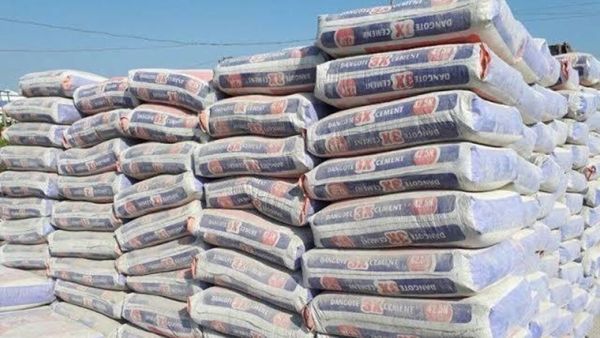
Dangote cement on display
The market survey revealed a possible manipulation of prices of cement in the Nigerian market in a manner that defies economic logic.
Findings from an industry-wide investigation conducted by the Federal Competition and Consumer Protection Commission (FCCPC) showed that despite having the largest market, Nigerians pay more for cement than consumers in other major Africa markets.
The market survey revealed a possible manipulation of prices of cement in the Nigerian market in a manner that defies economic logic.
This is the preliminary summation of the 40-page field reports collated following a three-month cross-border study by the Anticompetitive Practices Department (ACP) of the Commission, undertaken in response to widespread public complaints over the high cost of cement, a common staple in the country’s construction industry.
Concerns were raised over the comparatively high retail price of cement in Nigeria compared with other markets, despite the country’s substantial limestone deposits, significant domestic production capacity and reported surplus installed capacity relative to domestic consumption.
Significantly, all the major cement manufacturers in the country cooperated with the Commission by making their records available except one of them.
Publicly available estimates indicate that three major undertakings account for more than 90 percent of installed production capacity in the country.
The ACP investigations extended to markets in Sub-Saharan Africa like Kenya, Tanzania and South Africa as well as Egypt, Morocco and Algeria.
Metrics adopted included the availability of limestone, the basic raw material for cement production, as well as other variables such as population, production capacity and consumption.
In Kenya, for instance, the 58.6 million population (76% lower than Nigeria’s) has domestic cement demand of approximately 9.3m MTPA (metric tonne per annum) in 2025. Retail price in Nairobi is $5.40 (N7,344). Kenya is endowed with limestone.
In Tanzania, with population of 66.3m (72% lower than Nigeria’s) and the domestic cement demand is 9.3m MTPA (2025), a bag of cement sells for $4.80 (N6,528).
In Togo, a bag sells for $6.75 (N9,180). Significantly, Togo does not have limestone deposit.
Comparatively, in Nigeria, market intelligence reviewed by the Commission shows that the retail price of a 50kg bag of cement rose significantly during the first half of 2026.
A bag reportedly selling for between N9,300 and N9,700 in January was selling for between N10,500 and N13,000 by mid-year. By July, prices of between N13,000 and N15,000 were reported in some parts of the country. At an average of N14,000 per bag, this translates to over $10, the highest among top African countries.
The Commission’s survey indicates that Nigeria has installed cement production capacity of more than 60 to 65 million metric tonnes annually, while estimated domestic consumption is approximately 25 to 30 million metric tonnes. Nigeria is also a net exporter of cement to neighbouring markets.
Of particular concern to the Commission is that this level of production capacity has not resulted in the downward pressure on domestic prices that might ordinarily be expected in a competitive market with substantial excess capacity.
Information provided by industry participants has identified energy costs, depreciation of the Naira and its effect on imported machinery and spare parts, as well as transportation and logistics costs, among the factors contributing to cement prices. The Commission is testing these explanations against verified information on costs, production, pricing and market conditions.
However, the weight of preliminary findings provides sufficient grounds for the investigation to continue.
Next is to determine whether prevailing cement prices can be explained by legitimate costs and market conditions, or whether there is evidence of coordinated conduct, abuse of market power, restriction of domestic supply, anti-competitive distribution practices or other conduct contrary to the provisions of the FCCPA.
Accordingly, the FCCPC has issued Notices of Commencement of Investigation and Summons to Produce to the key players in the sector. The companies are required to provide information and records relating to, among other matters, their pricing methodologies, production and capacity utilisation, exports and relevant commercial relationships.
Explaining the basis for the Commission’s intervention, the Executive Vice Chairman/Chief Executive Officer of the FCCPC, Mr. Tunji Bello, said the investigation reflects the Commission’s responsibility to examine market conditions that have significant consequences for consumers and the wider economy.
“Cement occupies a strategic place in the Nigerian economy. Its price affects the cost of building a home, developing commercial property, delivering public infrastructure and, ultimately, the cost of doing business. When concerns persist about how such an important market is functioning, the Commission has a duty to look beyond assumptions and establish the facts,” Bello said.
He explained that competition scrutiny is not intended to dictate the commercial decisions of businesses. Rather, its purpose is to determine whether the market is functioning competitively and whether consumers are receiving the benefits that effective competition should provide.
“Businesses are entitled to make legitimate commercial decisions and earn returns on their investments. Competition law does not prevent that. Its purpose is to protect the competitive process, so that prices, output and other market outcomes are determined by genuine competition rather than conduct that unlawfully restricts it. That distinction is important to the work we are undertaking,” he said.