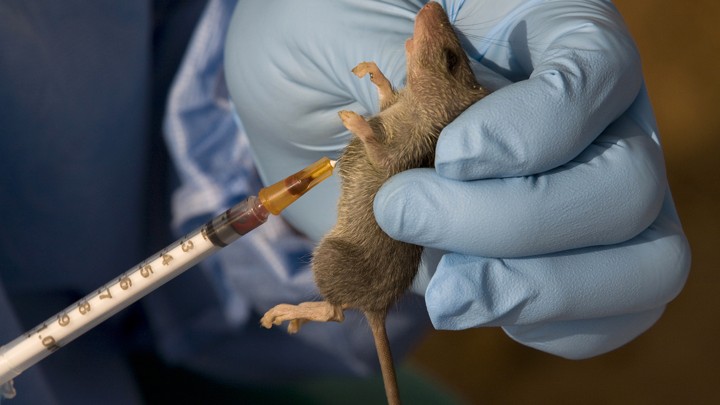
An ecologist extracts a sample of blood from a Mastomys Natalensis rodent in the village of Jormu in southeastern Sierra Leone February 8, 2011. Lassa fever, named after the Nigerian town where it was first identified in 1969, is among a U.S. list of "category A" diseases -- deemed to have the potential for major public health impact -- alongside anthrax and botulism. The disease is carried by the Mastomys Natalensis rodent, found across sub-Saharan Africa and often eaten as a source of protein. It infects an estimated 300,000-500,000 people each year, and kills about 5,000. Picture taken February 8, 2011. To match Reuters-Feature BIOTERROR-AFRICA/ REUTERS/Simon Akam (SIERRA LEONE - Tags: HEALTH SOCIETY ANIMALS) - GM1E72F07HC01
The Nigeria Centre for Disease Control and Prevention (NCDC) has reported 14 new confirmed lassa fever cases in week 33, bringing cumulative infections to 1,035.
The latest cases were recorded between Aug. 10 and Aug. 16, in Ondo, Bauchi, Edo and Benue states, according to the situation report made available in Abuja on Tuesday.
According to the agency, cumulative deaths increased to 252, while the case fatality rate rose to 24.4 per cent, higher than the 18.6 per cent recorded in 2025.
“The 14 new cases represented an increase from four cases reported during epidemiological week 32, when cases were recorded in Ondo and Edo states.
“In week 32, cumulative infections reached 1,021, with 240 deaths and a case fatality rate of 23.5 per cent,” it said.
The agency said that the week 32 figure represented a decline from 17 confirmed cases recorded during epidemiological week 31, indicating fluctuations in weekly transmission.
“By week 33, 23 states had reported at least one confirmed lassa fever case across 117 local government areas.
“Bauchi, Ondo, Taraba, Benue and Edo states accounted for 87 per cent of all confirmed cases recorded cumulatively by week 33.
“The five states also accounted for 86 per cent of confirmed cases in week 32, maintaining their position as the major affected states.
“People aged 21 to 30 years remain the predominant age group affected by lassa fever during both reporting weeks,” the agency said.
According to the NCDC, no new healthcare worker infection was recorded during week 32, while week 33 also recorded no newly affected healthcare worker.
It said that the agency would continue surveillance and response activities as lassa fever remained a significant public health concern across affected states.