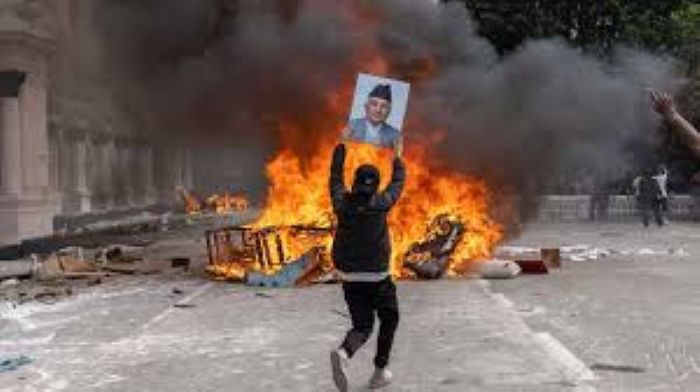
Nepal GenZ protest PHOTO: Google
Nigeria’s political leadership should become more responsive to the people’s needs and sensibilities, writes MONDAY PHILIPS EKPE

PHOTO: Google
There’s a tricky difference between message and lesson. While the former is simply a symbol or body of symbols targeted at another entity, the latter comes with either the willingness or readiness of the audience(s) to receive. Since I’m not sure of the desire or preparedness of the Nigerian ruling elite to at least come to terms with the unprecedented realities unravelling in Nepal, it’s better I stick to discussing the stark, frightening messages proceeding from there.
On September 4, 2025, that country’s Supreme Court upheld the government’s decision to put into effect two legal instruments namely, the 2023 Social Media Directive and 2025 Social Media Bill. The laws sought to compel all the local and international information and communication technology platforms to register with the regulatory authorities in a move interpreted as a strategy for further tightening official censorship. What was packaged as a demonstration of rule of law turned out to be an inadvertent kicking of the proverbial sleeping dog. The draconian penalties for breaching those statutes easily gave the government away as habouring sinister, ultra-suppressing motives. Any offending company was to pay $71,000 while individuals would part ways with $3,600. In a country with an average income of $1,456, that was clearly an overreach.
But the politicians were too self-absorbed to think of the consequences of their actions. On September 8, a peaceful protest was organised to let those in power know what the people thought about the legislations and court ruling that were threatening to challenge their own claims to decent citizenship. Unknown to the powerful, organisers of the march and, maybe, a chunk of the downtrodden, a cataclysmic event was underway. The undercurrents of deprivation, maladministration, corruption, nepotism, youth discontent, recklessness in high places and collective anger were about to find expression.
And when they did, every Nepalese – from the street crawlers to the men and women of means and power – was significantly affected. In 48 hours, the demonstrations that started in the capital, Kathmandu, quickly spread to many other parts of the Himalayan country. The mostly Gen Z protesters did not only topple the central government and destroy its infrastructure, at least 300 local government offices were either severely damaged or torched. The nation’s deadliest sweeping violence in many decades has left behind dozens of casualties and massively vandalised structures in many places. The financial estimates of the material losses stand at over $21billion, close to half of Nepal’s gross domestic product (GDP). That’s huge. Not to mention the images of some of the erstwhile dignitaries being brutalised and dehumanised by the rampaging mobs.
Truly, insensitivity has its own rewards. Yes, no one should nurse thoughts of mayhem being visited on the society for whatever reasons; not even on the perceived abusers of the common good who should, instead, be subjected to legitimate redress processes. But then, power intoxication doesn’t leave room for careful considerations, especially in matters that affect those who appear incapable of confronting head-on their predators and choking conditions. If only the riders of the high horses and the lordships on their exalted benches in Nepal had known that they were actually fiddling with a trigger, they wouldn’t have pulled it.
That action and its outcomes were probably inevitable. Some officials’ cup had become full and their fate inescapable. Like what obtains elsewhere, the daily life of most Nepalese has now been woven around the internet. And with a disproportionately large youth population, the level of dependency is better imagined. About 80 percent of the internet traffic there goes through social media platforms like Facebook, Instagram, Linkedln and X (formerly Twitter) with approximately 14 million, four million, two million, and 400 thousand active users respectively. So, whether for productivity or fun, the citizens would be substantially demobilised in the absence of respectable access to the net. Ordinarily, these statistics were formidable enough to elicit some caution, if not empathy, from their leaders. But no!
That hubris which often deadens the minds and hearts of rulers, including those who fancy themselves as leaders, kept them on the road to ruin. The long-suffering people of Nepal had endured years of mis-governance and the flaunting of ill-gotten wealth by those they had entrusted with their commonwealth and the country’s sovereignty. When the time for reckoning came, it didn’t follow any script. This point is often ignored by those in positions of authority, sadly. The masses and their reactions can’t always be taken for granted.
Once you realise that humanity is like a single tree with numerous branches, you’ll make peace with the possibility of human manifestations being replicated anywhere without regard for time and space. Call them popular uprisings or revolutions, the breaking points are hard to predetermine because, as recorded in history, most of the things that set them off are innocuous. The invasion of the French Bastille in 1789 was ignited by Queen Marie Antoinette’s retort that the people should eat cake if bread was too expensive. American Revolution was set off by the vindictive British laws in response to the Boston Tea Party. Ukraine’s 2004 Orange Revolution was set in motion by electoral frauds. Same for Russia’s 2011 Snow Revolution and the massive demonstrations that swept through Belarus in 2021. The 2011 Arab Springs was sparked off by Mohamed Bouazizi, a young Tunisian, who set himself ablaze to protest the prevailing unbearable cost of living.
These instances and more may sound distant to average members of the Nigerian political class and others who have resigned to the vagaries of today’s existential blues. For long, factors like religion, region and ethnicity have “put a knife on the things that bind us together”, actively nurtured and maintained by the oppressors and their agents. But that may not subsist forever. The growing army of jobless and disillusioned people, many of whom have escaped into the virtual, cyber spaces at the moment very much like their Nepali counterparts, should give Nigerian patriots some concern. Government’s policies, no matter how well-intentioned, are yet to make appreciable impact on most Nigerians. They too may have had it to their necks. You never know.
Ekpe, PhD, is a member of THISDAY Editorial Board