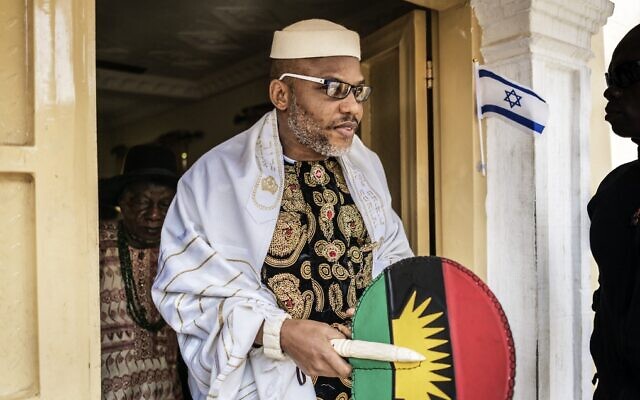
(FILES) In this file photo taken on May 26, 2017 Political activist and leader of the Indigenous People of Biafra (IPOB) movement, Nnamdi Kanu, wears a Jewish prayer shawl as he leave his house in Umuahia, southeast Nigeria, to meet veterans of the Nigerian civil war, whose 50th anniversary will be commemorated on May 30. - A Nigerian separatist leader, Nnamdi Kanu, whose whereabouts were unknown, has been arrested to face trial, the country's justice minister said on June 29, 2021. (Photo by MARCO LONGARI / AFP)
July 21, 2021
Britain has asked Nigeria to explain where and how Nnamdi Kanu, a separatist leader who holds British citizenship, was arrested after Kanu’s lawyer alleged he had been detained and mistreated in Kenya before being sent back to Nigeria.
Kanu, leader of the Indigenous People of Biafra (IPOB) group which wants part of southeastern Nigeria to secede, was on the run outside Nigeria for four years until he was brought to court in Abuja on June 29 and told he would face trial.
“We are seeking clarification from the Nigerian government about the circumstances of the arrest and detention of Nnamdi Kanu,” said Tariq Ahmad, a junior minister at Britain’s Foreign Office.
The Nigerian authorities have refused to say where Kanu was arrested, while Kenya’s ambassador to Nigeria has denied his country was involved.
Responding to a question about Kanu’s case from a lawmaker, Ahmad said Britain had requested consular access to Kanu and stood ready to provide consular assistance.
A spokesman for Nigeria’s Department of State Services, the security agency that is holding Kanu, could not immediately be reached for comment on Tuesday, a public holiday in Nigeria.
Kanu’s lawyer, Ifeanyi Ejiofor, alleged he was abducted by Kenya’s special police force and held for eight days before being turned over to Nigerian authorities.
IPOB wants a swathe of the southeast to split from Nigeria. The region attempted to secede in 1967 under the name Republic of Biafra, triggering a three-year civil war in which more than a million people died, mostly from starvation.
The Biafran enclave was reabsorbed into Nigeria after the war, but despite an official “no victor no vanquished” policy adopted at the time, discontent has continued to simmer in the region.
REUTERS