In 2025, the value of global trade in goods and services reached a record $34.65 trillion.
Let me begin by looking briefly at the state of the global economy and international trade, not just because I am Director-General of the World Trade Organization, but because it is within this broader global context that Delta State must pursue its economic ambitions.
We are living in challenging times. The rules-based trading system that has governed global commerce for the past 80 years since the end of the Second World War is under unprecedented strain. Rising geopolitical tensions, unilateral tariff actions, rapid technological change and climate shocks have created uncertainty for governments and businesses alike.
Yet, despite these disruptions, global trade has remained remarkably resilient. In 2025, the value of global trade in goods and services reached a record $34.65 trillion. World merchandise trade expanded by 4.6 per cent, driven largely by surging demand for artificial intelligence-related products, which more than offset the effects of higher tariffs and trade policy uncertainty.
Africa has also shared in this growth. Merchandise export volumes increased by 3.5 per cent, while services trade grew by 7.3 per cent, supported by exports of minerals, metals, fuels and agricultural commodities such as cocoa. Globally, services trade expanded by 5.3 per cent, with digitally delivered services growing by almost six per cent.
The message from these figures is clear. Beneath the difficult headlines lies a stable core of opportunity. Those opportunities exist for Delta State, Nigeria and Africa, and they are far greater today than they were 10 or 15 years ago. The real question is whether we will seize them or allow them to pass us by.
Since the COVID-19 pandemic, the world has recognised the dangers of excessive dependence on a few countries for critical products and services.
There is overdependence on the United States for digital services and consumer demand, and on China for critical minerals. These vulnerabilities have encouraged governments and companies to diversify supply chains and reduce geopolitical risks.
This presents a historic opportunity for countries like Nigeria. At the WTO, we describe this trend as re-globalisation—building more diversified and resilient global value chains by expanding investment into countries that have traditionally been on the margins of global trade.
Africa has also created opportunities for itself through the African Continental Free Trade Area (AfCFTA). With a market of over 1.4 billion people, harmonised standards and improved regional integration, Africa is becoming increasingly attractive to investors seeking both continental and global markets.
These twin opportunities—global supply chain diversification and African economic integration—should be at the heart of Delta State’s development strategy. We must think beyond Nigeria and position Delta State to compete internationally.
As a proud daughter of Delta State, I firmly believe the state possesses everything required to become Nigeria’s next major industrial hub, standing alongside Lagos, Kano and Port Harcourt as a key driver of national economic growth. A stronger Delta economy would also help reduce the growing pressure on existing commercial centres.
The state’s advantages are clear: abundant natural gas, strategic transport infrastructure, fertile agricultural land, solid mineral deposits, seaports and export terminals, as well as 49 tertiary institutions producing talented young people eager for opportunities at home.
Delta State also enjoys commendable fiscal strength. According to BudgIT’s 2025 State of States report, Delta ranked sixth nationally in overall fiscal performance and second in debt sustainability. I was particularly pleased to hear the Governor emphasise that the state would not rely on borrowing. Fiscal discipline is essential because sustainable development depends on prudent management of public resources.
However, natural resources and budget allocations alone do not create prosperity. Execution is what matters. Infrastructure must be maintained, institutions strengthened and investments carefully prioritised.
I therefore support the state’s emphasis on developing Special Economic Zones (SEZs). A recent World Bank report identifies SEZs as one of the most effective industrial policy tools for governments with limited fiscal space. Properly developed, they provide quality infrastructure, efficient regulation and integrated services that attract investors.
Delta’s gas resources provide a significant advantage, but success will require close collaboration with the Federal Government to ensure reliable electricity, transport, digital connectivity and streamlined regulatory services. I also encourage the state to study successful models such as the Lekki Free Zone, where thousands of young Nigerians have secured meaningful employment because infrastructure and investor support systems function efficiently.
Beyond industrial parks, Delta State must identify a small number of priority value chains where it enjoys genuine comparative advantage. Rather than spreading resources too thinly, the state should focus on two or three agricultural commodities and develop them across the entire value chain—from production and processing to quality standards, financing and export markets.
The blue economy represents another enormous opportunity. Delta’s coastline and inland waterways can support aquaculture, fish landing sites, cold storage facilities, jetties and marine logistics services. Nigeria imports approximately 573,388 metric tonnes of fish and fish products annually, valued at about $866 million. Delta State can position itself to replace a significant portion of those imports through domestic production.
However, developing the blue economy is not about allowing foreign trawlers to overfish our waters. At the WTO, we are working to discourage harmful fishing subsidies that deplete marine resources and disadvantage local fishing communities. I encourage Delta State to participate in the fisheries management assessment currently being implemented with the Nigerian Institute for Oceanography and Marine Research and the Federal Ministry of Industry, Trade and Investment.
The state’s ports and export terminals also present opportunities for ship repair, marine logistics and maritime services. With targeted investment, Delta can become one of Nigeria’s leading marine logistics hubs while creating thousands of quality jobs for young people.
Oil and gas will remain critical, but infrastructure gaps must be addressed. Gas pipeline connectivity is essential to support industrial parks, power generation and mineral processing. Without reliable gas supply, many of the state’s industrial ambitions cannot be realised.
Digital infrastructure must also become a priority. Global trade is increasingly digital, and artificial intelligence is transforming commerce worldwide. Reliable broadband connectivity will enable young entrepreneurs, women-owned businesses and technology companies to compete in the digital economy.
Ladies and gentlemen, the opportunities before Delta State are truly exciting. The challenge now is to deploy resources wisely, maintain strategic focus and execute effectively.
I remain optimistic because three powerful trends are converging: the global diversification of supply chains, Africa’s economic integration through the AfCFTA, and the growing recognition that Nigeria’s economic transformation will be driven not only from Abuja but also by dynamic states such as Delta.
As the renowned Delta-born author Ben Okri reminds us, we must never neglect the treasure in our own backyard. The true wealth of Delta State is not merely its oil and gas resources but its people.
With perseverance, strategic leadership and sustained investment, Delta State can transform itself from a resource-rich economy into a diversified, inclusive and resilient industrial powerhouse.
Your Excellency, Mr. Governor, Your Excellency, the Vice President, distinguished guests and my fellow Deltans, I wish us all success as we work together to realise this vision.
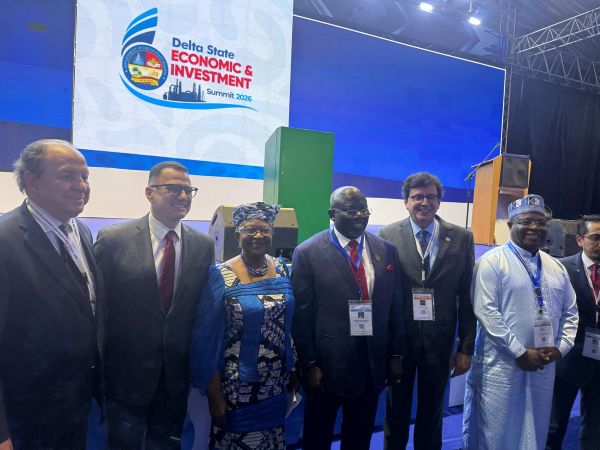
Speech by Dr. Ngozi Okonjo-Iweala, at the Delta State Economic and Investment Summit, Asaba