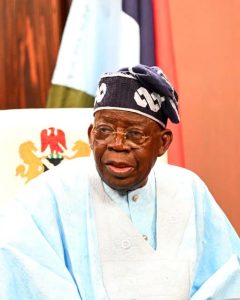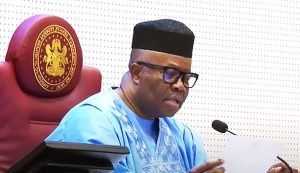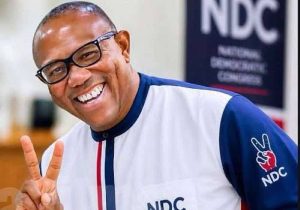
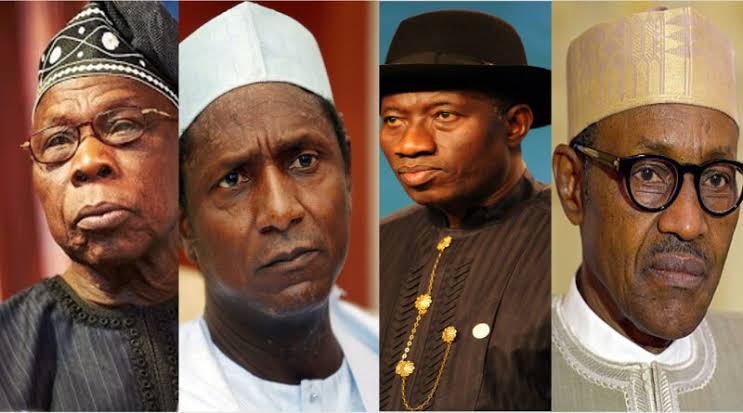
Obasanjo, Yar’Adua, Jonathan and Buhari
Leading any entity requires more than ambition and opportunity. Nigeria must now rediscover the relevant values, writes MONDAY PHILIPS EKPE

Quagmire. When that word was first used in 1566, it simply meant a ground that couldn’t be trusted to support anything of sizable weight or volume. Stand on it and it’s sure to give way. Slippery, soft, shifty, sneaky. Thereafter, it absorbed several connotations until it morphed into a lexical item with more robust meanings: a precarious situation, predicament, hole, bind, box, something unreliable or worrying. Any random poll amongst Nigerians on the primary dilemma they’re in today would finger political leadership, especially. Try the much you can to explain to them the complicity of followers in the incompetence, mediocrity or callousness of their own leaders, they won’t budge. Blame here is often single dimensional.
“It’s our so-called leaders o!” It’s hard to think or argue otherwise, quite frankly. Now, one man has taken up the challenge to critically look at the present and prospective occupants of political drivers’ seats as the nation prepares for yet another general election cycle. Robert Abdullahi-Johnson, PhD, author, publisher and former university lecturer, has just released some thought-provoking books (unveiled in Abuja on Thursday, June 18). Leadership Renaissance in Nigeria, in particular, is set to be on the front seat of discussions on leadership-related issues in a country destined by nature and geography to, at least, lead Africa with dignity.
But, before recovering its seemingly lost claims to continental leadership, Nigeria must first keep a date with its own shadows, the demons that have sought to sabotage its tremendous potentialities. Dr Johnson’s choice of “Renaissance” in the title suggests renewal, revival and resurgence. Some sort of rebirth. Meaning, the nation once had vibrant, visionary leaderships. And that the condition of our rulership or statecraft at the moment can’t lead us to fulfilment of any proud reckoning.
One can’t seriously contradict those hypotheses. True, never in our political history did we have saints as leaders. As it is common with humanity, they were people with their own idiosyncrasies and shortcomings which sometimes ran counter to the public good. In our collective pursuit of nationhood, some of them chased narrow, sectional interests instead. Yet, generally, compared with what obtains now, most of them were way ahead in the practice of representative governance. Their differences notwithstanding, titans of the First Republic managed their regions’ socio-economic and political rivalries fairly successfully.
The Second Republic which lasted just a little above four years also had its own flowers. Alhaji Waziri Ibrahim decamped from the Nigerian People’s Party (NPP) led by Dr Nnamdi Azikiwe to form the Great Nigeria People’s Party (GNPP) and became its presidential flagbearer. His slogan, Politics Without Bitterness, ought to have since become a national menu in the hope that it might checkmate today’s murky, venomous, diatribe-ridden politics.
Even General Sani Abacha, arguably Nigeria’s most vilified and roundly demonised ruler, did parade his own pluses. Against the wishes of some people, history may still be kind to him on some grounds. His reprehensible human rights record and the country’s pariah status under him didn’t stop Abacha from presiding over one of the country’s glorious moments of fostering regional peace and security. Not to mention relative domestic economic stability.
Then came the dawn of the current democratic dispensation. Considering the fact that Nigeria had just escaped from the longest grip of military governments, President Olusegun Obasanjo’s administration from 1999 to 2007 probably stood no chance of performing better than it did. That it remains a reference point and also unequalled in critical indices after many years indicate our dire need of pragmatic, purposeful leadership at various levels of government. So, Johnson’s intervention is timely.
Many of his thoughts are indeed worth pondering over. On religion, ironically among the nation’s albatrosses: “Nigeria will be a better nation when the power of love replaces the love of power. Leadership in Nigeria since independence has often been shaped less by competence, capability and merit, and more by considerations of ethnicity, religion, regional balance and power rotation between north and south, as well as between Muslims and Christians. This has contributed to the manipulation of religion for political purposes, the rise of ‘stomach infrastructure’ politics, religious discrimination, widespread ignorance, underdevelopment, poverty and growing insecurity….
“Neither Islam nor Christianity is inherently anti-progress or averse to development. This is evident in the levels of advancement seen in countries and societies such as the United Arab Emirates, Saudi Arabia, Malaysia, Rome, United Kingdom, and the United States. It is a serious indictment that our elite will go to these countries to educate their children and nurse their sick, then come back home to set us on a path of destroying one another and our meagre infrastructure in the name of differences in our faiths. Dual theology made us less productive; it has awakened varied and conflicting cultures, often resulting in community clashes, which hitherto were peaceful neighbours.”
On indolent leaders: “Political leadership should not be entrusted to individuals who possess a ‘bakwomi’ mentality, those marked by indifference, complacency, and a lack of urgency in the face of failure. Such leaders are not disturbed when goals are missed or targets are repeatedly unmet, make empty promises, and remain comfortably in office for years without meaningful results or accountability. It is equally troubling when individuals in authority sit through critical national or international assignments that portray Nigeria negatively, yet show little concern or drive to initiate change or improve outcomes.”
On intolerance: “The pain of our current democratic experience is that we have democracy without democrats. For many Nigerian political leaders, democracy is expressing your views and insisting that it is the only valid viewpoint. Tolerance for opposing or counter views is very limited, if at all available.”
The writer’s “Oracle for Leaders” – philosophical, emphatic and conclusive – is rendered thus: “Human history gives lengthy endorsement to the fact that no generation can rise above the level of its leadership. Nations rise and fall according to the effectiveness of their governments. These truths are also applied to businesses, organisations, churches, families, and individuals. When leadership falters, followers are hunted, scattered and become easy preys for predators; and when leaders are destroyed, the enemy prevails. It is imperative, therefore, that men and women, young and old, called to be leaders must be leaders of integrity.”
Over to the longsuffering masses of Nigeria. With some push, their quagmires, mainly self-inflicted and elite-induced, would give way to strong personal and institutional foundations that could engender and sustain genuine progress.
Dr Ekpe is a member of THISDAY Editorial Board
X: @monday_ekpe2