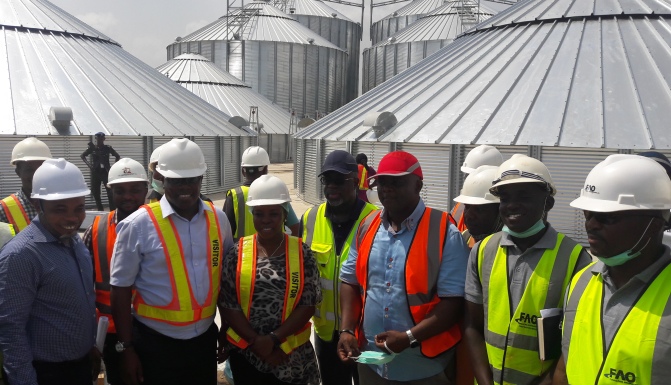
(L-R) Mr Henry Ossai, MD, HenryKarl Construction Limited, Mr Gbolahan Lawal, Lagos State Commissioner for Agriculture and Ms Abisola Onasanya, Special Adviser to Lagos State Governor on Agriculture, during an inspection tour to the ongoing Lagos State Rice Mill, Imota, Ikorodu, on Monday. (NAN Photo)
Mr. Jacob Akinsanya, Director of the Lagos State Rice Mill in Imota, says inadequate supply of rice paddy is the major challenge limiting optimal production at the facility.
Akinsanya disclosed this during a courtesy visit by the Nigerian Association of Technologists in Engineering (NATE) to the rice mill on Wednesday in Imota, Lagos.
Akinsanya, who was represented by Mr. Hassan Oladipo, Deputy Director, Engineering and Production, said the mill had functional equipment, adequate manpower and the capacity to produce large quantities of rice.
Rice paddy refers to harvested rice grains still enclosed in their husks, which must be processed before becoming the polished rice commonly consumed.
Akinsanya said inadequate paddy supply forced the facility to suspend operations around May, in spite of its production capacity.
“This facility has an experienced workforce, but the shortage of raw materials forced it to halt production between April and May 2026,” he said.
He said the mill, which began operations in 2023, has two production lines, with each line capable of producing about 300 tonnes of rice daily.
According to him, the facility has the capacity to process rice paddy produced across the entire South-West if sufficient raw materials are made available.
“If this facility operates optimally, it could process raw materials if rice is planted across the entire South-West,” he said.
Akinsanya said the mill operates a continuous drying system, which requires a steady supply of paddy to maintain efficient production.
He said the facility required about 5,000 tonnes of paddy to sustain production for two weeks, adding that the volume will require about 200 trailers to transport the raw materials.
According to him, the shortage stemmed mainly from falling rice production and insecurity in parts of the country, both of which had affected paddy availability and transportation.
He noted that restarting the plant after a prolonged shutdown was also challenging because the machinery required about three to four days to stabilise before full scale production could resume.
He said the facility had the capacity to meet the rice needs of several states if sufficient paddy was made available for processing.
Akinsanya added that efforts were being made to address power supply challenges through the establishment of a dedicated electricity line to ensure more reliable operations.
He said the facility’s machinery was still in good working condition, but noted that lack of adequate raw materials was the major challenge to sustained production.
In his remarks, Mr. Kayode Ibidapo, National General Secretary of NATE, said the visit was aimed at assessing the rice production process and identifying areas where the association could provide support.
According to Ibidapo, rice is a major Nigerian staple, so increasing production is vital to food sufficiency and to reducing strain on the nation’s food supply.
He commended the management of the mill for its production capacity, equipment and manpower, but said inadequate paddy supply was preventing the facility from operating at full capacity.
He called for more collaboration among the Lagos State Government, relevant agencies and stakeholders in the agricultural sector to improve access to paddy.
Ibidapo also urged the government to invest more in rice cultivation and provide adequate land for farmers, particularly in areas with potential for expanded production.
“Increased investment in rice production will provide the raw materials required to keep the mill running and enable it to supply rice beyond Lagos to other states,” he said.
He said the facility was one of the largest rice mills in Africa and had the capacity to contribute significantly to food production across the South-West if given the necessary support.
“This facility is the largest in Africa and it is capable of producing food for the entire South-West if given the right attention,” he said.
Ibidapo urged the management to sustain its efforts while calling on government and other stakeholders to intensify measures to address the challenges confronting rice production and processing.
He also called for stronger action against terrorism, banditry and kidnapping, which he said had negatively affected agricultural activities and contributed to the shortage of rice paddy.
Ibidapo said the security challenges had made it difficult for farmers to cultivate and transport agricultural produce, thereby worsening the shortage of raw materials available to processing facilities.
He said the visit had given NATE a clearer understanding of the challenges facing the facility and would help the association identify areas for collaboration with government and other stakeholders.
Ibidapo said such collaboration would help strengthen rice production, improve processing capacity and contribute to greater food security in the country.