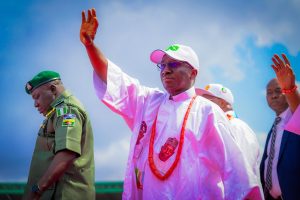

Prof. Joash Amupitan INEC Chairman
The recent controversy over suspected AI-generated photographs and questionable identities in the preliminary voters’ register presents another serious challenge
INEC Chairman
The Independent National Electoral Commission (INEC) is operating in an environment of accumulated suspicion. From the political parties to civil society groups and even the younger generation, the atmosphere of pessimism is stifling.
The controversy surrounding the 2023 presidential election, particularly the failure to deliver on expectations regarding real-time electronic transmission of results, remains a reference point in public discussions about the commission’s credibility.
The recent controversy over suspected AI-generated photographs and questionable identities in the preliminary voters’ register presents another serious challenge. A voters’ register is the foundation upon which an election is built. If its integrity is compromised, the credibility of the entire electoral process becomes questionable.
More disturbing is INEC’s admission that some of its registration personnel allegedly exploited their access credentials to introduce irregular records, including AI-generated photographs. This is not simply a technological failure. It raises fundamental questions about institutional supervision, internal controls and the integrity of personnel entrusted with managing sensitive electoral information.
INEC Chairman, Professor Joash Amupitan, subsequently disclosed that 54 persons across 10 states had been identified as allegedly complicit. The commission also announced that it had removed 1,608,660 confirmed invalid registrations following its review of the preliminary register. These are significant corrective measures, but Nigerians need more than announcements. They need to know who was responsible, how the manipulation occurred, whether any political interests were involved and what safeguards will prevent a recurrence.
INEC has therefore taken some steps towards addressing the controversy, but the question of adequacy remains. Identifying suspects, removing questionable entries and promising disciplinary action are necessary beginnings, not the conclusion of accountability. The commission cannot be the sole investigator, judge and final authority on a controversy involving the alleged misconduct of its own personnel. An independent investigation, with credible civil society and technical participation, would strengthen confidence in the outcome.
The perception of independence is as important as independence itself. This explains why controversies surrounding Amupitan’s perceived political leanings deserve careful attention.
Allegations concerning a social media account purportedly associated with the INEC chairman, which reportedly expressed support for the APC, have generated public debate. Amupitan has denied operating the account, while INEC has described the allegations as fabricated. He has also stated that an independent forensic report was obtained and that the matter was referred to security agencies for investigation. These competing positions make transparent, independently verifiable findings particularly important.
Similarly, reports and images circulating after the chairman’s November 12 Chatham House engagement in London generated controversy over an alleged Renewed Hope-branded cap. However, the widely circulated photograph of the man wearing the pro-cap did not show Amupitan but an APC UK figure, Tunde Doherty. It is important not to attribute an action to the INEC chairman on the basis of a misidentified photograph. Nevertheless, the incident illustrates how quickly questions about partisan association can become damaging to an electoral institution.
The commission must appreciate that public confidence is influenced not only by proven misconduct but also by the appearance of political proximity. Its chairman and senior officials must exercise exceptional caution in their public engagements and associations.
To restore the confidence of Nigerians in the institution as an unbiased umpire, INEC must subject the voters’ register controversy to an independent and transparent investigation. Findings should be published, implicated officials appropriately sanctioned and, where criminal conduct is established, prosecuted. Nigerians deserve an auditable explanation of the register-cleaning exercise.
Second, the commission must strengthen its technological infrastructure. AI-assisted manipulation, biometric duplication and unauthorised database access require robust safeguards, regular security audits and clearly defined accountability mechanisms. Its proposed AI policy should be published for public scrutiny.
In addition, INEC must demonstrate operational independence. Its leadership should avoid partisan appearances, communicate transparently and ensure that every political party receives equal treatment. Allegations against its officials should receive impartial investigation, irrespective of the political interests involved.
Again, the commission must rebuild confidence in electronic accreditation, transmission and collation of results. Its proposed technical safeguards should be independently tested, demonstrated to stakeholders and subjected to public scrutiny before election day. Political parties, civil society organisations and the media should have meaningful opportunities to observe these processes.
Equally importantly, INEC must improve its communication with citizens. Silence, defensive responses and dismissive reactions to legitimate questions only deepen suspicion. Nigerians should not have to rely on social media investigations to discover irregularities in an institution that should proactively protect electoral integrity.
Ultimately, trust cannot be demanded; it must be earned. INEC must understand that its constitutional independence is not a shield against public scrutiny but an obligation to demonstrate impartiality and accountability.
In the 2023 elections, Nigerians, especially the younger generation, bought wholeheartedly Professor Mahmoud Yakubu, then INEC chairman’s assurance that votes will count to heart and came out en mass to vote. However, the zillion technical glitches used to explain the discrepancies associated with the National Assembly election held simultaneously with the presidential votes cast a pall on the electoral umpire’s credibility. The 2027 general elections present an opportunity to rebuild confidence, but that opportunity will not be secured through assurances, press conferences or appeals for citizens to believe the commission. It will depend on verifiable reforms, transparent decisions and consistent institutional conduct.
Nigeria needs an electoral umpire that is not merely independent in law but demonstrably independent in the eyes of citizens. That is the burden of trust INEC must carry, and the responsibility it must discharge before asking Nigerians to place their democratic future in its hands.