Obi -Tinubu-and-Atiku
Jan. 21, 2023
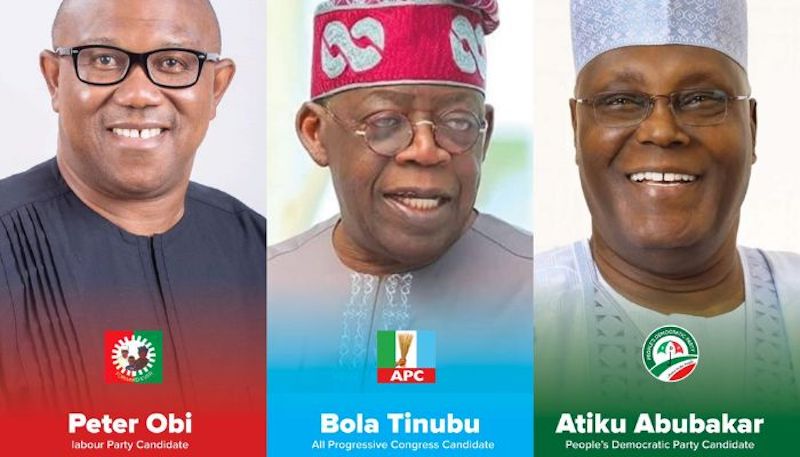
It’s election campaign season in Nigeria and we’ve witnessed candidates churn out their campaign promises.
From security to the economy to healthcare, they highlight the aspects that they deem important enough to address, the problems plaguing them, and what they would do to tackle the problems if elected.
However, as expected (and sadly so), critical areas such as the environment, especially issues of climate change and climate justice have been left to take the back seat amidst the candidates’ lofty promises.
This disregard for environmental issues did not begin in this election cycle. In fact, at the 2019 general elections in Nigeria (when climate change had also become a major issue in Africa), political candidates made no reference to climate change.
To be fair though, recent comments by two leading candidates in this election cycle indicate a positive change in the climate discourse compared to the previous elections.
In an eight-post tweet made on September 11, 2022, by Mr. Abubakar Atiku, the PDP presidential election candidate, he acknowledge that the floods in some parts of the country are effects of climate change. He further acknowledged how farmers and the poor are disproportionately affected by such climate impacts.
Similarly, on September 21, 2022, the presidential election candidate of the Labour Party, Mr. Peter Obi, while sympathizing with victims of the floods in Jigawa State, pointed out likely reoccurrences of such disastrous events due to climate change.
Judging from both tweets, one could easily deduce that both candidates are aware of the devastating effects of climate change in communities. However, neither of them (both in rhetoric and their manifestos) seem to have any concrete plans regarding the mitigation of future occurrences nor adaptation plans for the present and future incidents.
Political candidates need to understand that tackling insecurity/conflicts, food insecurity, limited access to clean and affordable water, poor power supply and infrastructures, etc., can not be achieved without addressing climate change issues in the country. They are two sides of a coin.
For one, all of the presidential candidates have insecurity as one of the major issues they want to curb in Nigeria. What they fail to realize is that climate change is also a key factor in the conflicts in some parts of the country.
You will agree that there is increased migration of herders from Northern to Southern Nigeria and the reason for this points to the changing climate. This is leading to farmer-herder conflict, further resulting in violence and displacement.
Over 1,300 people were casualties of farmer-herder clashes in 2018 alone, while a thousand others were displaced, according to the Crisis Group. This is largely due to the struggle for limited land resources as more herders migrate to southern communities for arable land to feed and rear their livestock.
Secondly, candidates loosely throw around words such as “ending poverty and hunger”, “ensuring food security”, etc. How can they achieve all three if they cannot see that by not factoring climate change into their plans, there won’t be arable land and this means less crop production?
Studies have shown that, in recent years, fluctuating weather patterns coupled with extreme weather events are responsible for low farmer yield. This is because it is disrupting natural systems and these impacts are putting a strain on communities as well.
Seeing as some developmental challenges in Nigeria today are hinged on climatic conditions, the next president of Nigeria must be the candidate that prioritizes the provision of holistic solutions that incorporate climate change mitigation/adaptation approaches while formulating and enacting policies that facilitate a just transition to a sustainable Nigeria.
As candidates canvass for votes from community to community, citizens must task them with commitments to climate change.
Citizens, especially those in communities impacted by climate change, must ensure that they collect their Permanent Voters Cards (PVCs) and look beyond empty campaign promises to rally support for candidates that have a comprehensive framework for climate change.
The media as well as political debate organizers also have a role to play. Hard questions should be asked on how candidates intend to incorporate climate change into their plans when elected, considering they do not have climate change in their plans as of now.
Climate change issues are too important to be left in the hands of deniers. This is why it must be a defining issue in this election.
COURTESY: Climateaction.africa