
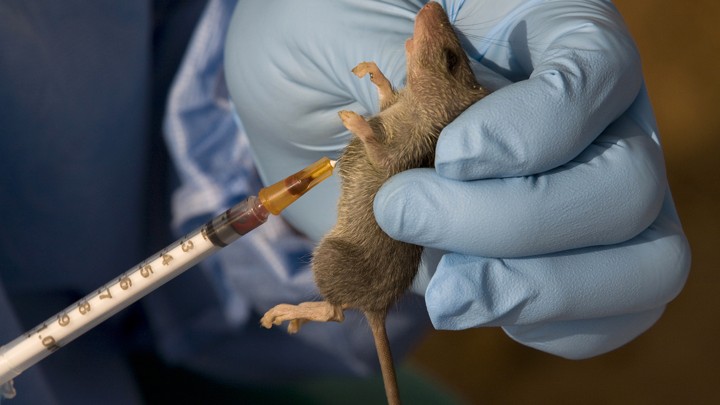
An ecologist extracts a sample of blood from a Mastomys Natalensis rodent in the village of Jormu in southeastern Sierra Leone February 8, 2011. Lassa fever, named after the Nigerian town where it was first identified in 1969, is among a U.S. list of "category A" diseases -- deemed to have the potential for major public health impact -- alongside anthrax and botulism. The disease is carried by the Mastomys Natalensis rodent, found across sub-Saharan Africa and often eaten as a source of protein. It infects an estimated 300,000-500,000 people each year, and kills about 5,000. Picture taken February 8, 2011. To match Reuters-Feature BIOTERROR-AFRICA/ REUTERS/Simon Akam (SIERRA LEONE - Tags: HEALTH SOCIETY ANIMALS) - GM1E72F07HC01
The Nigeria Centre for Disease Control and Prevention (NCDC) says it has deployed dialysis machines to five states to support the management of severe Lassa fever cases.
The Director General of NCDC, Dr. Jide Idris, said this on Friday in Abuja, during a press briefing on recent outbreak of Lassa fever in some states.
Idris disclosed that the machines were distributed to Edo, Kaduna, Lagos, Nasarawa and Plateau States as part of efforts to improve case management outcomes.
He explained that the dialysis equipment was procured through corporate support and donor collaboration, noting that the machines were distributed based on burden and treatment needs.
According to him, dialysis is critical in managing complicated Lassa fever cases, particularly where patients develop kidney-related complications.
The NCDC boss emphasised that outbreak response remained a shared responsibility between Federal and state authorities.
“States must prioritise health and strengthen their systems. We can provide support, but implementation at the state level is key,” he said.
On concerns on rising fatalities, the director general attributed exposure risks in hot spot communities to environmental and behavioural factors, particularly in high-burden areas where rodent-human contact was common.
He added that Nigeria continued to monitor performance indicators under the 7-1-7 surveillance benchmark, which required detection of suspected cases within seven days, reporting within 24 hours and response within seven days.
On Nigeria’s preparedness to host the upcoming global Antimicrobial Resistance (AMR) conference, he said the country was making arrangements to receive international stakeholders and showcase national efforts in combating AMR.
He clarified that “non-communicable diseases fall outside the mandate of the NCDC,” noting that the agency was focused on infectious disease surveillance, prevention and response.
The director general reiterated the need for stronger collaboration between federal and state actors to reduce fatalities and strengthen outbreak preparedness nationwide. (NAN)