Cyber Politics

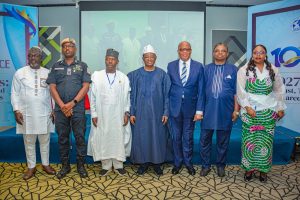
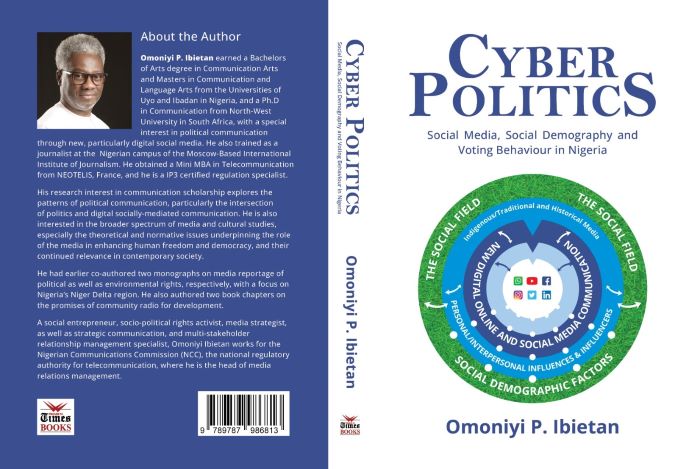
The Executive Vice Chairman of the Nigerian Communications Commission (NCC), Dr Aminu Maida has underscored the impact of the book Cyber Politics: Social Media, Social Demography, and Voting Behaviour in Nigeria, authored by Dr. Omoniyi Ibietan, on elections monitoring and reporting in Nigeria.
Maida made the remark at the special Book Reading and Further Reviews of the book held at the University of Ibadan on Friday.
The EVC’s remarks were also echoed by three scholars in communications, one of whom is Prof. Umaru A. Pate, a Professor of Media and Society; President, Association of Communication Scholars and Professionals of Nigeria (ACSPN) and Vice Chancellor, Federal University, Kashere, Gombe State.
Both Prof. Abiodun Salawu of North-West University, South Africa and Prof. Peter Esuh, Dean, Faculty of Communication and Media Studies, University of Uyo also commended the courage of Ibietan to dare cutting through the fuzzy space of elections in Nigeria and Africa, hailing the book as rich resource in psephology (study of elections) on the continent.
The NCC EVC recalled that despite an earlier period in which there were deliberations on the possible roles and impacts of digital platforms, such as the social media, on political participation and elections, “the increased access to the Internet and broadband, alongside the wider uptake of social media as essential to human reality, have made the interface between these platforms and elections a lot clearer. This has especially been evident in the last few electoral cycles, whether in the United States, Europe, or Nigeria.”
He referenced the 2008 Presidential election “which could be regarded as the watershed moment for a new form of voting behaviour, evolving with the widespread usage of platforms like Facebook, MySpace, YouTube, podcasting and mobile messaging in the communication of political interests with citizens.”
According to Dr Maida, “Ibietan’s path-breaking book, broaches a radical new territory in bridging psephology (i.e. the study of elections) and communications scholarship through an examination of the interface between social media networks and voting behaviour in the country. It draws its insights from a deeply methodical study of Nigeria’s 2015 presidential election, unearthing the intersections of social and demographic factors, digital social mediation and the remarkable impact of these variables on the voting behaviour of the electorate.”
Professor Pate surmised: “I am enriched by the arguments and conclusions in the book. The book has increased my understanding of the relationship between the ever-growing social media and politics in the country. This is very important for obvious reasons, some of which relate to the popularity and influence of the new media, particularly among the most active components of the population.
“While welcoming the book as a positive addition to the growing body of literature in the area especially as it gives the Nigerian context, I am strongly recommending it as a worthy book for all students of communication studies, political science and allied fields. Our political tacticians and gladiators and other scholars of the interface between society and information and communication technologies will find the text appropriate and generously useful in helping them to deeply understand the strategies and impact of the social media in Nigerian politics.”
Professor Esuh connected the dots between the book, technology and elections. “It is well-known that technological innovation redesigns the global geopolitical and socio-economic landscape while enabling unfettered access to information and possibilities in real-time. While the internet and, by extension, communication platforms have provided the foundation for most of these possibilities, it is essential to be conscious of the potential impact of other emerging technologies such as Artificial Intelligence (AI), Augmented Reality (AR), Internet of Things (IoT), Robotics, Big Data, Block Chain and Advanced Analytics on societal trends. Important foundational lessons can be learned from the impact of social media on societal outcomes, as demonstrated by Dr. Ibietan’s book,” he said.
Prof. Abiodun Salawu who is one of Ibietan’s academic guardians said of the author and the book: “Another of his (Ibietan’s) strength was that he was able to do effective academic writing. This made reading his work not tortuous but exhilarating. He was dedicated to the work that he took a year leave from his place of work to come over to Mahikeng in South Africa to exclusively focus on the study. I can say that the study was effectively done within this one year. With the thesis turned into a book, I believe the ideas, findings and recommendations contained therein are now made available to a wider readership.”