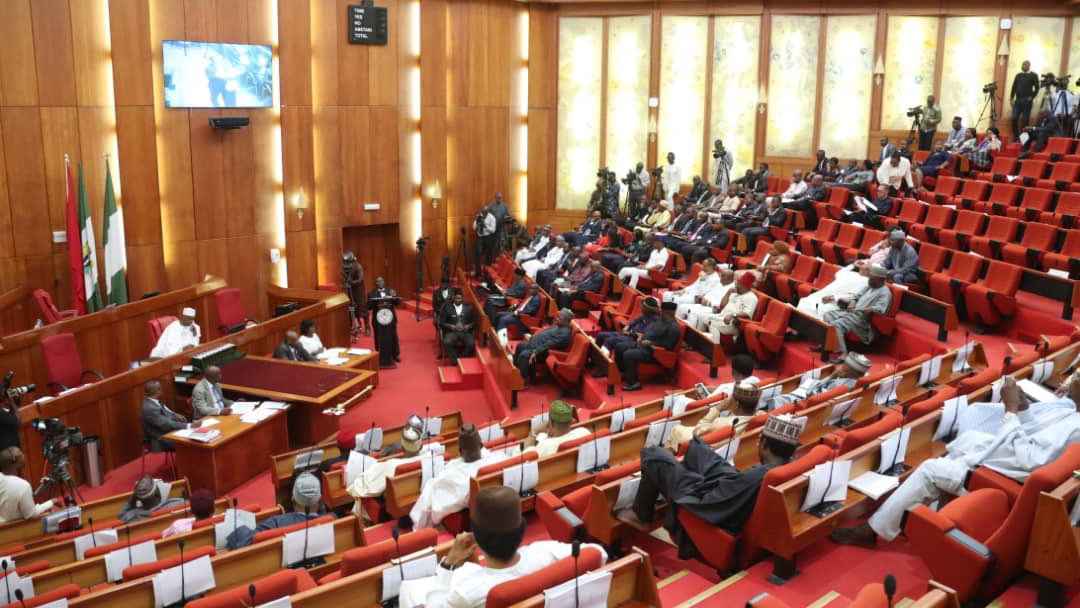
Senators in session
The National Assembly is set to expand public access to legislative information by translating Nigerian laws into local languages, including Igbo, Hausa, and Yoruba, as part of a broader drive to digitize and safeguard parliamentary records.
The Executive Secretary of the National Assembly Library Trust Fund, Mr. Henry Nwawuba, disclosed this on Monday in Abuja during the opening of the 2026 National Assembly Library Week, themed “Parliamentary Memory: Connecting Records, Legislation and the People.”
Nwawuba stated that the Trust Fund is upgrading its E-Library infrastructure, developing a mobile application, and building electronic repositories to improve access to key legislative materials, such as Order Papers, Votes and Proceedings, Committee reports, and Acts of Parliament.
He announced plans to introduce a “Bills Tracker” to enable citizens to monitor legislation through various stages, alongside infographics, video explainers, and local language translations designed to simplify laws for the public.
“The planned translation of laws into local languages will broaden access to legislative information and enable more citizens to understand laws that affect their daily lives,” Nwawuba said.
He added that the initiative aims to curb the spread of unauthorised or fake legislative documents and deepen citizen participation through public policy dialogues.
In his remarks, Senate President Godswill Akpabio, represented by Senator Osita Ngwu, urged lawmakers to make greater use of the library to ground legislative decision-making in reliable evidence, particularly amid rising misinformation, disinformation, and the rapid adoption of artificial intelligence.
Similarly, the Speaker of the House of Representatives, Abbas Tajudeen represented by House Leader Prof. Julius Ihonvbere stressed that the strength of a legislature rests not only on the laws it enacts, but on how effectively it preserves institutional memory for future generations.
He noted that while AI and technology can enhance research, their adoption must prioritize accuracy and security.
The Clerk to the National Assembly, Kamoru Ogunlana, emphasised that full independence requires the capacity to generate, preserve, and authenticate internal records.
Highlighting challenges with document verification, Ogunlana warned against altered or outdated documents circulating in the public domain.
He noted that the continued reliance on the Laws of the Federation of Nigeria (LFN) 2004 illustrates the ongoing challenge of maintaining a continuously updated, authoritative body of federal legislation.
“While digitization makes parliamentary information easier to access, search, and disseminate, it can also expose records to cyberattacks, manipulation, and impersonation of official sources,” Ogunlana warned, calling for robust cybersecurity measures, secure authentication, and specialized staff training.
Also speaking at the event, the President of the Nigerian Library Association, Dr. Lawal Umar, advocated for sustained funding and deeper collaboration between the National Assembly and state Houses of Assembly.
In his goodwill message, the Secretary-General of the Conference of Speakers of African Legislatures, Amb. Debo Oyewale, emphasised that parliaments across the continent must share best practices in preserving legislative history and building resilient information institutions. (NAN)