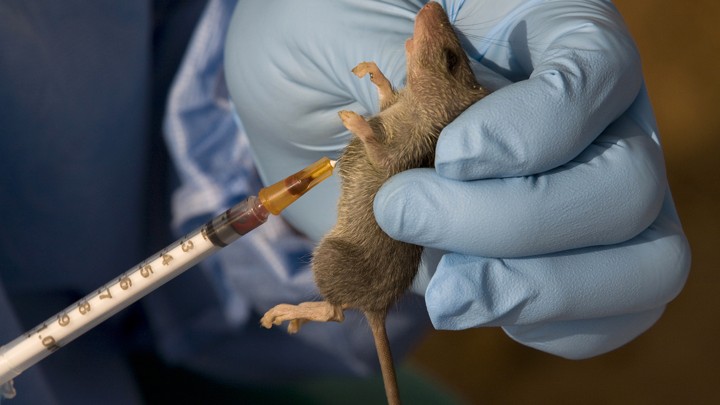
An ecologist extracts a sample of blood from a Mastomys Natalensis rodent in the village of Jormu in southeastern Sierra Leone February 8, 2011. Lassa fever, named after the Nigerian town where it was first identified in 1969, is among a U.S. list of "category A" diseases -- deemed to have the potential for major public health impact -- alongside anthrax and botulism. The disease is carried by the Mastomys Natalensis rodent, found across sub-Saharan Africa and often eaten as a source of protein. It infects an estimated 300,000-500,000 people each year, and kills about 5,000. Picture taken February 8, 2011. To match Reuters-Feature BIOTERROR-AFRICA/ REUTERS/Simon Akam (SIERRA LEONE - Tags: HEALTH SOCIETY ANIMALS) - GM1E72F07HC01
The Ogun Government has denied report of a confirmed case of Lassa Fever in the state.
The Commissioner for Health, Dr. Tomi Coker, denied the report in a statement on Thursday in Abeokuta.
Coker said that the Nigeria Centre for Disease Control (NCDC) had erroneously listed Ogun as one of the affected states, saying that was not true.
“The affected states as indicated by the NCDC include neighbouring Ondo , Edo, as well as Ebonyi, Plateau, Taraba and Bauchi States,’’ Coker said.
The commissioner said that the state government had put health officials on red alert in the event of any suspected case.
She added that health officials would maintain a high index of suspicion for Lassa Fever and treat all cases of fever symptoms with caution.
Coker described Lassa Fever as an endemic acute viral hemorrhage illness usually transmitted from rodents to human through ingestion of food or materials contaminated by excreta or urine of infected rodents.
She added, “The disease is also transmitted from human to human, through direct contact with blood tissues, secretions and excretion of infected humans.’’
Coker, however, allayed the fear of residents and advised them to avoid contact with rodents and ensure personal, as well as environmental hygiene.
She directed that all suspected cases of Lassa Fever should be reported to the Local Government Area Disease Surveillance Notification Officer (DSNO) or call cell phone nos: 09099140121 and 09099140122. (NAN)