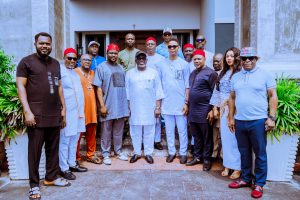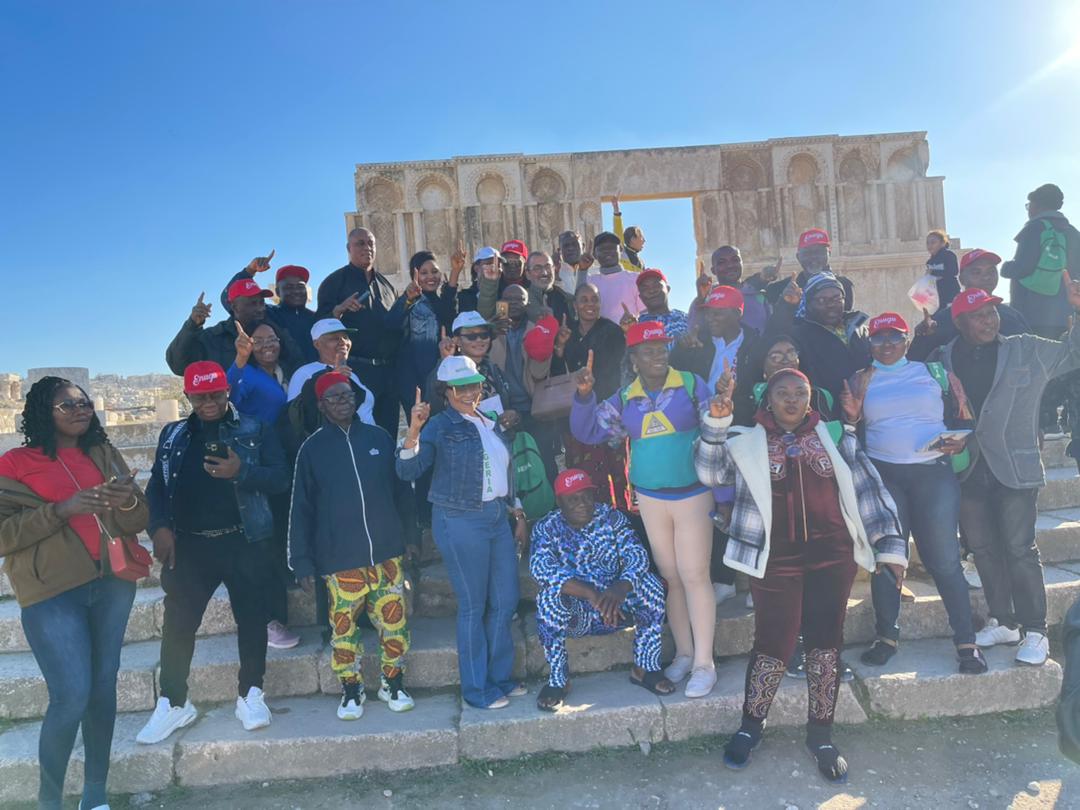
File photo: Enugu pilgrims in Jordan

For the second time in eight years, Nigeria’s economy has been shut down for a week on account of religion-induced holidays.
First was in July 2016 under then President Muhammadu Buhari when the sighting of the moon became a tool to cripple the country with three of the five-day work week declared work-free rather than the two days earlier advertised.
At a time the economy is reeling from the ruins of the Buhari years of locust and the fall out of President Bola Ahmed Tinubu’s knee jerk approach to economic reforms, the government was rightly advocating the adoption of a new work ethic to lift the nation from the cliffhanger. Or so it seemed. Last week, however, the advocacy unravelled as a mere academic exercise when the Minister of Interior on April 7 declared Tuesday and Wednesday public holidays to mark the end of the Muslim month fasting.
The holy month of Ramadan is peculiar in the Islamic world. It is entirely devoted to fasting and relies on actual sighting of the moon for its commencement and conclusion. In the modern age where science and technology has enabled the world to project the precise day, time and areas that would experience the eclipse as recently happened in North America, telling Muslims when the moon to signal the end of Ramadam would be sighted is supposed to be a routine exercise.
Not so with Dr. Olubunmi Tunji-Ojo, the Interior Minister. With the declaration coming just two days to the projected date of sighting of the moon, it was expected to be the product of scientific research anchored on the advice of the Nigerian Meteorological Services and consultation with the Nigerian Supreme Council for Islamic Affairs which the Sultan of Sokoto chairs as the leader of Nigerian Muslims. Forty eight hours later and on the day the initially announced dates for first day of the holiday, Tunji-Ojo added Thursday, April 11 as additional work-free day. Reason: The moon had not been sighted. While Nigeria’s Interior Ministry was playing Russian roulette with the sighting of the moon, Saudi Arabia and the rest of the Muslim world got it spot on. They sighted the moon on the day it was expected, Wednesday, April 10.
By the stroke of the minister’s pen, a full week was lost in the running of Nigeria’s economy to the juggling of the sighting of the moon. And to formalise the fiasco, Sokoto, Gombe and Katsina governors announced the extension of the holiday to cover Friday. That was logical because federal civil servants and their counterparts in the states had already added the Friday into their work-free days. So, effectively, the country lost a full week.
If the meteorological agencies in the United States and other countries could accurately predict the recent eclipse and when the areas to be affected should expect it, why was the Nigerian Meteorological Services unable to tell when the moon would be sighted? Or was it consulted by the Interior Ministry?
On matters of religion, policy makers tend to jettison their sense of logical reasoning. Even the recovery of the battered economy can be sacrificed on account of “spiritual rejuvenation” as Tunji-Ojo put it in justifying the extension to three days. Against the backdrop of the challenges facing the real sector in accessing foreign exchange to import essential materials and the controversy surrounding the Nigerian Education Loan Fund (NELFUND), N98 billion has been approved by the federal government to subsidise the 2024 Hajj. This is in continuation of a long existing policy. And many state government’s have unfolded their own corresponding budget to subsidise the pilgrimage fortheir indigenes. In September 2012, the Federal Government through the Central Bank of Nigeria, said it had approved a concessionary exchange rate of N145.00 to the US dollars for 85,000 Hajj pilgrims, representing a concession of about 9.35 per cent from the then exchange rate of about N160 to the US dollar.
The N98 billion for Hajj is just the beginning. A similar amount will have to set aside to also subsidise Christian pilgrims when they also their own visits in order to bal the religious equation. And states will also do thevsame. For all the reforms Tinubu’s administration may effect on the economy and no matter how thoroughly they may be conceptualised, unbridled religious leanings may undo them all. No thought was given to the inevitable impact the reckless imposition of work-free days may have on the economy. Apparently, policy makers only consider such issues from the prism of civil servants and their convenience. There is little or no thought to how the private sector, the real engine of the economy, and the rest of people who are not under the safety net of civil service job where salaries are guaranteed despite the level of lack of productivity fare under the extended stay at home order.
Through the ages and man’s evolution, religion has been a weapon for building nation states and also for their destruction. The evolution has taken mankind to the point where some sections of civilised societies have seen the need to separate religion from the state while fiercely upholding the inalienable rights to personal freedom. The freedoms extend to the right to be an unbeliever, whatever that means. While religious institutions are respected and protected, some nations, mainly western Europe have formally separated religion from the state by enshrining it their constitution.
As early as 1797, John Adams as the second US president sounded the warning on mixing government and religion. “Nothing is more dreaded than the national government meddling with religion,” he stated.
At the time of independence, Nigeria’s founding fathers had adopted a creative approach on the issue of government and religion when they gave each of the federating units the latitude to chart their own course. The unitarist 1999 constitution was not as definitive. While some say it deems Nigeria as secular state, others insist the constitution projects the country as a multi-religious state.
There is absolutely nothing wrong with the religious holidays. Everyone – individuals, businesses and government – anticipate them and plan for them. But what Tunji-Ojo gave Nigerians with the Eid al Fitr was a classic case of using religion to cripple people’s economic survival struggles. The Minister could have avoided the mix up if he was diligent in determining the appropriate day for sighting the moon or tried to. We can no longer afford to be walking this treacherous path.