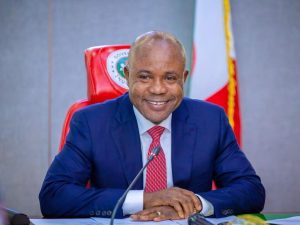
Professor Umar Danbatta, EVC of NCC
 Of all the many appointments made by President Muhammadu Buhari, two have been hailed as fitting, proper and eminently meritorious. The appointment of Dr. Ibe Kachikwu as Group Managing Director of Nigeria National Petroleum Corporation (NNPC) and that of Professor Umar Garba Danbatta as the Executive Vice Chairman (EVC) of the Nigerian Communications Commission (NCC). They both come to the job with profoundly brilliant profiles, both academic and industry experience.
Dambatta is a Professor of Electronics Engineering with a surfeit of international exposure and back-to-back knowledge of the telecoms industry. In a brave new world where techies and adjunct professionals speak the same language – dot.com, Internet of Things (IoTs), innovation, smart classrooms, smart cities, e-commerce and other terminologies that define modern geekdom, Danbatta looks the perfect breed to fly the Nigerian flag.
Last week at his maiden international press conference, he demonstrated to the media that he is the best man for the job at these times. Not that he met with the media just to prove how terrific he really is; he merely came to present himself and his vision couched into an eight-point agenda to media professionals, and by extension to the international community. It was at this momentous occasion that the real Danbatta unfurled in full effulgence. Articulate, perceptive, knowledgeable, proactive and pragmatic, the Professor evinced all these and lots more.
He showed deep understanding of the frustrations of all stakeholders in Nigeria telecoms: consumers, investors, service providers, equipment manufacturers and vendors. Unlike some public office appointees who fire broadside at their predecessors just to discredit them, Danbatta applauded his predecessors, lauded their efforts and initiatives and did not shy away from acknowledging that as a result of their exertions, NCC has become the model for regulatory excellence out of Africa. Obviously, Danbatta is not one to dwell contentedly in the tent of old successes; he wants to build new successes, conquer new heights and widen the frontiers of regulatory accomplishment. This is even more imperative at these times.
For sure, these are not the best of times for the nation’s economy. The Professor with uncommon passion for engineering and mentoring knows this. He knows he is presiding over a sector that is not just an enabler of other sectors but a job and wealth-creating sector and one to rely on as alternative source of cash for the government.
Since August 2001 when the first generation GSM service providers rolled out, telecoms has become the brightest spot in the nation’s dour and drossy socio-economic ecosystem. Success in mobile telephony, for instance, has earned Nigeria respect from international agencies including the International Telecommunications Union (ITU). The Nigeria market is ranked among the best in the world; at a time it was rated the fastest growing mobile market for five consecutive years. But this high profile is only in the realms of mobile telecoms which is grossly deficient for data and video transmission. The heavy reliance on mobile infrastructure for virtually everything has put so much strain of the GSM networks precipitating drop calls, whooshy calls, weak interconnections and sundry glitches associated with poor quality of service.
There is no magic out of this. The solution is in the deployment of broadband. The cries and frustrations of subscribers can only be assuaged by massive deployment of broadband across the nation. Doing so would require huge investments but in the long run it will amount to more revenue both for the operators and the government. It will not only ease the worries of consumers, it will also put more money in their pockets by making them achieve more.
Just for one moment, think of the boost to e-agriculture that functional broadband can bring to the economy; think of the music and movie industries; how upload and download of creative works would be made easy and put more money in the hands of the players; imagine the quantum leap it will foster in e-commerce; then add to that the millions of direct and ancillary jobs it would generate, then you would appreciate why Danbatta has premised his eight-point agenda on pervasive broadband rollout guided by the tripartite denominators of Affordability, Accessibility and Availability.
He has envisioned a five-year strategic plan (2015 to 2020) during which he hopes to actualise the creeds of his programme. And he looks well primed to do so. The reassuring thing about this Professor is that he never tried to live in denial that all is not well in the telecoms sector. There are critical challenges: fading glory of CDMA (code division multiple access) genre of telecoms, vandalisation of telecoms infrastructure, poor power supply, multiple taxation of operators all of which conduce to poor quality of service.
The Professor, who once told this writer that any time he has free time, his indulgence would be to return to the classroom and teach students free of charge, must have all this at the back of his mind when he was framing his vision and agenda. Inherent in the eight-point agenda is job-creation and maximization of the opportunities in Nigeria telecom by both consumers and operators.
His summation of the vision is: “To promote innovation, investment, competition, and consumer empowerment in and on top of the communications platforms of today and the future- maximizing the power of information and communications technology to grow our economy, create jobs and enhance national competitiveness through the deployment of broadband infrastructure to facilitate rollout of broadband services that will hold out opportunities and higher network quality of service for all Nigerians”
With dipping revenue receipts from crude oil sales, President Buhari may need to copy the American model of job-creation. Every time, an American President wants to create real jobs, he turns to information communications technology (ICT). President Obama did it and it worked at a time America badly needed to “get Americans back to work”.
In the Nigerian context, telecoms holds so much promise to creating more jobs and empowering millions of Nigerian youths to become wealth-creators through innovation. The President should pay attention to ICT sector and as much as possible insulate it from undue meddlesomeness by politicians from both the Executive and the Legislature. This highly dynamic sector is the custodian of something bigger than oil: big data. It is the President’s ace of card for job-creation; and he has a dependable ally in Professor Danbatta.
AUTHOR: KEN UGBECHIE