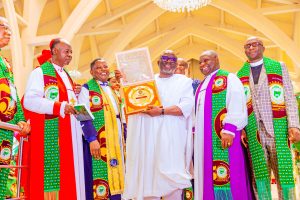
Senator Ned Nwoko
The Federal High Court in Abuja on Monday struck out a suit filed by Sen. Ned Nwoko, seeking to void the emergence of former Gov. Ifeanyi Okowa of Delta as the candidate of the All Progressives Congress (APC) for the Delta North Senatorial District.
Justice Mohammed Umar in a ruling, upheld the arguments by lawyers to the defendants, including Kehinde Ogunwumiju, SAN, that the suit was fundamentally defective and incompetent from its inception.
Justice Umar agreed with the defence argument that the originating summons could not be amended as sought by Nwoko.
The News Agency of Nigeria (NAN) reoirts that Nwoko had commenced the suit, marked: FHC/ABJ/CS/1062/2026 in his name, but through a person described in the originating processes as his attorney, Dr Mike Nwoko.
At a point, Nwoko applied to amend the originating processes to reflect the pre-election suit as being personally commenced by himself rather than through his purported attorney.
But the defendants objected to the application.
Listed as defendants in the suit are the APC, Okowa and the Independent National Electoral Commission (INEC).
Delivering the ruling, Justice after examining the originating summons, found that the suit was, indeed, commenced by Nwoko through his attorney, Nwoko.
The judge held that the form and content of the originating process showed that the suit was instituted in a representative capacity.
Relying on provision of Section 285 (14) of the 1999 Constitution and Section 88 (2) of the Electoral Act, 2026, which prescribe the category of persons entitled to commence a pre-election suit, Justice Umar held that “the provisions were clear, explicit and unambiguous in vesting the right to institute a pre-election action in an aspirant, who participated in the relevant party primary.”
The judge further held that the right created by the constitution and the Electoral Act is a personal statutory right, which belongs exclusively to the affected aspirant and not an ordinary civil right that may be freely assigned, transferred or exercised through an agent or attorney.
Justice Umar further agreed with the defendants that the right to challenge the outcome, conduct or validity of a political party’s primary election is personal to the aspirant who participated in that primary and claims to have been aggrieved by the process.
He held that such an aspirant must personally invoke the jurisdiction of the court in the manner prescribed by law and cannot transfer the right of action to another person through a power of attorney.
Justice Umar also held that if the constitution or the Electoral Act had intended to permit an aspirant to institute a pre-election action through an attorney or in a representative capacity, the relevant legislation would have expressly said so.
The judge noted that neither Section 285 (14) of the Constitution nor Section 88(2) of the Electoral Act contained any provision extending the right to commence a pre-election suit to an attorney, agent or representative of an aspirant.
He, therefore, rejected Nwoko’s application for amendment and held that an amendment could not be used to revive a suit which was incurably defective from the moment it was filed.
He stressed that in substance, no amendment could breathe life into an originating process that was already a nullity.
The judge was of the view that there must first be a competent and subsisting proceeding before the court could exercise its discretionary power to permit an amendment.
He added that the originating process itself was void and incapable of conferring jurisdiction, and an amendment cannot operate retrospectively to create a valid suit.
Justice Umar consequently dismissed Nwoko’s application for leave to amend the originating summons and proceeded to strike out the substantive suit for want of jurisdiction.(NAN)