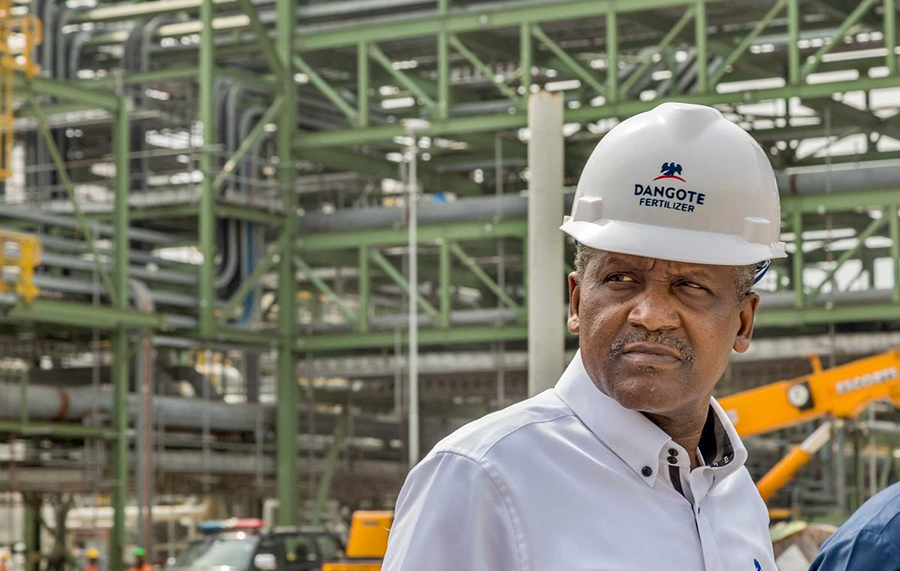
Dangote and his refinery...
Less than three years after overcoming surging costs, swampy terrain and inadequate infrastructure to launch Africa’s biggest oil refinery in Nigeria, billionaire Aliko Dangote is set on replicating that project on the continent’s opposite coast.
But the construction of his company’s planned new 700,000-barrel-per-day Lamu refinery in Kenya promises to bring a whole new set of issues not least where to secure crude supply in a country that, unlike oil-rich Nigeria, currently has no commercial output.
Plans are evolving quickly. Until April, discussions for Dangote’s East African refinery were focused on Tanzania.
A month later, Dangote told the Financial Times he was leaning towards siting the plant in the Kenyan city of Mombasa, but in July, an executive said it would be built in Lamu, a deep-water port critical to the refinery’s success.
The company will hold a groundbreaking ceremony at the end of this month, and hopes to complete the refinery by 2030. Aliko Dangote has said he expects it to cost $15 billion to $16 billion.
The project is a test of whether the model that helped turn Nigeria from a major fuel importer into a growing exporter can be repeated in a region with fewer crude supplies and less developed energy infrastructure.
Asked about potential regulatory, finance and feedstock challenges for the project, Devakumar Edwin, vice president of Dangote Industries, said there were none to overcome.
The company believes the project will enhance regional fuel supply and energy security, it has previously said.
However, “if not successfully implemented, it runs the risk of becoming a very expensive white elephant,” Brendon Verster, senior economist at Oxford Economics, said.
RAISING CAPITAL
A company executive said in July that Dangote Group plans to finance the Kenyan refinery through internal cash flow, bonds and an initial public offering.
Dangote is planning an IPO of its Lagos refinery that is slated to be Africa’s biggest ever.
If the Lagos playbook is followed, Dangote could also add in a mix of his own equity, commercial bank loans and development finance institutions such as Afreximbank.
But the company already has other big expansion plans, saying on Monday it would spend $14.3 billion to double the processing capacity of its Lagos plant.
With multiple oil-related projects already being pursued by Dangote, securing money could prove problematic, analysts say.
“Given that the group is seeking some $40 billion (including Lamu) between 2025 and 2030 for announced energy projects, raising the capital for Lamu could become a formidable challenge,” said Kaase Gbakon, a petroleum economist formerly with state-owned Nigerian oil company NNPC.
East African nations such as Rwanda, South Sudan, Tanzania and Uganda could take up a combined 30% equity stake, which would open another funding stream and tie governments to the project, Dangote has also suggested, though no details have been given on potential deals.
CRUDE SOURCES
In terms of feedstock, Kenyan President William Ruto’s chief economic adviser has said the plant could secure 600,000 barrels of crude oil supply a day from within East Africa, including South Sudan, Uganda, and Kenya itself, according to Kenyan media reports.
But none of those sources is straightforward. Kenya has proven oil reserves but has struggled for years to start producing, though small-scale output is expected later this year.
A proposed crude pipeline linking fields in South Sudan, which has seen its oil exports disrupted by insecurity in neighbouring Sudan, and Kenya’s Lokichar Basin to Lamu Port remains a distant prospect.
Uganda’s barrels are routed to Tanzania via the EACOP pipeline, while South Sudan’s exports leave through Sudan, Maximillian Ezeude, an oil and gas lawyer in Lagos, told Reuters.
“That leaves the coastal facility dependent on a volatile international seaborne market,” Ezeude said.
The nearest large source of seaborne crude imports is the Middle East, where the Iran war is disrupting exports.
The refinery will be built inside the Lamu Port-South Sudan-Ethiopia Transport (LAPSSET) special economic zone close to Lamu Port, which currently has no operational oil storage terminals.
The LAPSSET Corridor project makes provision for oil storage terminals at Lamu of 1 million to 1.5 million barrels, as well as marine loading facilities capable of handling vessels up to Suezmax class.
However, that infrastructure remains largely unbuilt.
PROJECT WILL SPUR GROWTH, PRESIDENT SAYS
There are also concerns the refinery may impact Lamu Old Town on Lamu Island, a World Heritage site 10 km (6 miles) from Lamu Port. Greenpeace Africa has also called for the project to be halted on concerns about habitat destruction and marine degradation.
Kenya’s Ruto has said the country, whose only refinery was closed by India’s Essar Energy in 2013 believes the new plant will eradicate costly fuel imports and spur growth.
It spent roughly $4 billion (511.5 billion Kenyan shillings) on petroleum products last year, the country’s top import, according to official data.
“We have to make those decisions that will change our country, that will transform our country,” Ruto said of the Lamu project.
But the challenge represented by the project “remains substantial”, said Benjamin Oluwatobi Ajayi, an energy analyst based in Lagos.
“The size of the debt requirement, ESG-related financing constraints, competition for capital across multiple projects, and the need to coordinate numerous lenders and stakeholders within a compressed timeframe all increase execution risk,” he said.
REUTERS