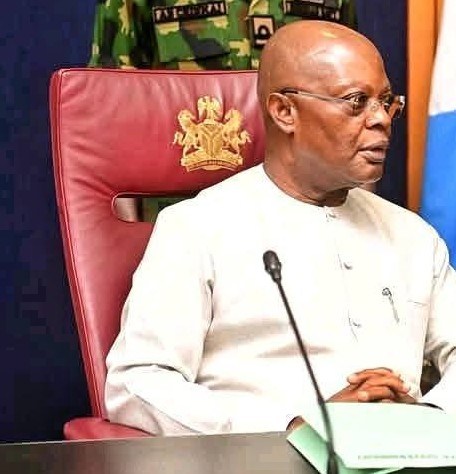
Vice Admiral Ibas

Imagine a Rivers State where President Bola Ahmed Tinubu hesitated to declare a state of emergency. The political standoff between the State Assembly and Governor Siminalayi Fubara could have continued and degenerated into violence.
Impeachment threats might have spurred attacks on lawmakers by the governor’s supporters, while militants in the creeks—primed to sabotage critical oil infrastructure—could have plunged Nigeria’s oil production back to pre-2023 lows. Sensational reporting of the crisis by journalists and opportunistic litigation would have inflamed tensions further, paralysing governance and risking lives. Schools and hospitals would shutter; investors would flee. We can only imagine the human and economic toll.
Today, thanks to the president’s intervention, Rivers State can breathe again. Political tensions have eased, banal headlines have quietened, and stakeholders—encouraged by the newly-appointed administrator—are charting a path to lasting peace. Critics who argue the crisis “did not yet warrant” emergency rule ignore a stark truth: waiting for the breakdown of law and order to escalate into anarchy before acting is like withholding firefighters until a house burns to ashes.
A responsible leader like President Tinubu, who swore an oath to protect the constitution and corporate existence of the country, can not fail to act when a constituent part of the Federation is careering towards the precipice. The political crisis in Rivers State between Governor Siminalayi Fubara and members of the State House of Assembly who owe allegiance to the Minister of Federal Capital Territory, Nyesom Wike, that blew open barely six months into the administration of the Governor has degenerated by 18 March. A chain of events since the war of attrition started 14 months ago among the combatants had indeed paralysed the government of Rivers State to the point where Fubara, copying from the bad book of former Governor Obaseki in Edo, emasculated an arm of government entirely. This reality informed the Supreme Court’s damning verdict about the absence of government in the State as enshrined in the 1999 constitution of Nigeria, as amended. The court also excoriated Fubara for acting like a despot.
Rivers was in a grave situation, as the combatants refused to allow reason to prevail, even after the Supreme Court judgment, before President Tinubu declared a state of emergency on 18 March. The President took action in the best interest of the people of the State, who had become victims of the warring politicians, the people they elected to serve them. President Tinubu needed to act. He chose prevention over cure.
Section 305 of Nigeria’s Constitution empowers the President to act when the nation faces a breakdown of law, order, and economic security —precisely the case in Rivers, a bastion of Nigeria’s oil-dependent economy. Intelligence confirmed militants, told by Fubara to await signals, were already targeting pipelines, risking a collapse in output and a Niger-Delta domino effect. Historical precedents, such as the past emergencies in Plateau and Borno and the doctrine of necessity, support the President’s proactive measures to avert disaster. The President’s oath demands he must not fail in his sacred duty to safeguard national stability, not watch idly as partisan strife strangles our democracy and the material well-being of Nigerians, whose prosperity depends on the social and economic interdependence of every part of the country. Rivers State is a significant hydrocarbon economic artery in Nigeria, and any dislocation and politically motivated disruption of the oil industry in the state will have ripple effects on the national economy.
Answering the Critics:
Critics claim the emergency rule in Rivers undermines democracy. Their position misrepresents reality. The intervention is temporary, surgical, and aimed at restoring—not replacing—democratic institutions. The suspension of political actors for six months is no power grab; it is not a permanent removal but a reset to disarm warring factions. Notably, the same critics who assailed the President’s action for suspending the political actors remain silent on Governor Fubara’s refusal to collaborate with the legislature, exposing their partisan bias. Democracy can not thrive amid lawlessness—anarchy is its antithesis.
The appointed administrator, Vice Admiral Ibok Ibas (Rtd.), has already convened a meeting with traditional leaders in the State as one of his first steps to forge lasting solutions. This intervention ensures Rivers’ people retain their democratic rights while shielding the Nigerian and Rivers State economies from collapse. It is worth repeating that President Tinubu acted within the law and his executive powers under the constitution until the Supreme Court says otherwise.
President Tinubu and the National Assembly remain committed to lifting the emergency once stability returns and also ensuring elected officials resume their duties.
The 18th-century English philosopher Edmund Burke once warned, “The only thing necessary for evil to triumph is for good men to do nothing.” President Tinubu chose courage over complacency. His action prioritised Nigeria’s interest over political expediency, averting a more profound crisis. To those who brand him a democrat turned “tyrant,” my response to them is simple: Which democracy prospers in chaos? Rivers’ newfound calm vindicates President Tinubu’s resolve. He deserves commendation, not condemnation, not calumny for his statesmanship. Rivers and Nigeria are safer for it.
–Onanuga is the Special Adviser to President Tinubu on Information and Strategy