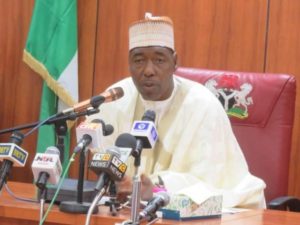

Governor Babagana Zulum
Governor Babagana Zulum of Borno State has pledged to deepen collaboration with the African Union (AU) to expand educational access for approximately 800,000 out-of-school children across the state.
Governor Zulum made the commitment on Thursday during a courtesy visit by an AU delegation led by Amb. Jainaba Jagne, the AU Chairperson’s Special Envoy for Children Affected by Armed Conflict, at the Government House in Maiduguri.
Addressing the delegation, Zulum highlighted the state’s progress, noting that the number of out-of-school children in Borno has significantly dropped from over two million seven years ago to around 800,000. However, he emphasized that sustained international support is crucial to enrolling the remaining vulnerable children into classrooms.
“Education is the bedrock for any meaningful development, and therefore one area that we need support from the African Union is to increase access for out-of-school children to be enrolled in schools,” Zulum said.
He underscored that education remains central to Borno’s broader shift from emergency humanitarian relief to long-term recovery, stabilization, and sustainable development.
Strategic Investment in Peace and Child Protection
Zulum detailed his administration’s ongoing investments in rebuilding schools, recruiting qualified teachers, and expanding learning opportunities—especially for girls and vulnerable children.
“The protection of children is not merely a humanitarian obligation. It is a strategic investment in peace, security, and sustainable development,” the governor stated, identifying education, psychosocial care, skill acquisition, and community acceptance as vital pillars for reintegrating children affected by the insurgency.
He also reaffirmed Borno’s commitment to upholding the Safe Schools Declaration to ensure secure and inclusive learning environments.

Beyond education, Governor Zulum appealed for AU support to bolster primary healthcare, combat child malnutrition, and equip local health centers with trained personnel and modern medical tools.
“Our children deserve better attention. The issue of malnutrition is also there among our own society,” he noted.
He added that safeguarding children requires empowering their families economically: “Enhancing the means of livelihood of the mothers will no doubt reduce the vulnerability of the children.”
Zulum reaffirmed the state government’s readiness to collaborate with the AU, the Federal Government, the United Nations, and other international partners on youth empowerment, peacebuilding, and child welfare.
In her remarks, Amb. Jainaba Jagne commended Governor Zulum’s administration for its proactive efforts in rehabilitating and reintegrating children impacted by armed conflict, describing Borno’s approach as a model for other African nations.
Jagne shared that after meetings with the First Lady of Borno, Associate Prof. Falmata Babagana Umara Zulum, and inspection visits to the Bulumkutu Interim Care Centre and the Muna Vocational Centre, the delegation was deeply impressed by the state’s field interventions.
“We have to take back to the African Union member states the amazing work that is being done here in Borno State,” Jagne said.
She announced that the AU delegation brought educational materials for over 1,000 children and hygiene supplies for adolescent girls undergoing reintegration, reiterating the AU’s commitment to advancing the protection and welfare of conflict-affected children across the continent.