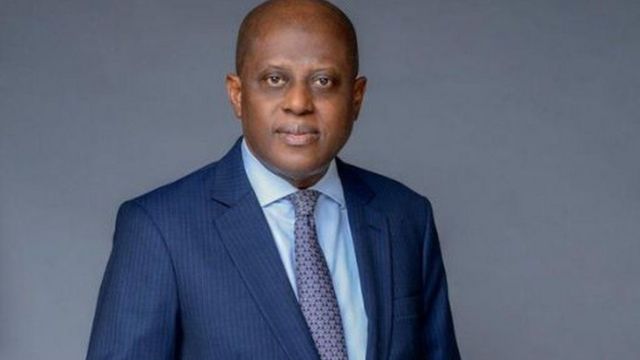
Yemi Cardoso CBN Governor
In CBN, three former and notable Governors, namely Professor Charles Chukwuma Soludo, Sanusi Lamido Sanusi, Godwin Emefiele, and the present Governor, Olayemi Cardoso set their respective agendas and policy thrusts within the stipulated framework of the CBN Act 2007.
In one of the sessions on the economy on Arise TV, and with a particular focus on the Central Bank of Nigeria ( CBN), one of the anchors of the programme, Reuben Abati queried the “underguiding philosophy” of CBN’s monetary policy under the leadership of the Governor, Olayemi Cardoso.
Abati also expressed concern on why CBN under Cardoso is not engaged in development financing or direct intervention measures and he tried to compare the former Governor, Godwin Emefiele and Cardoso in that regard in addition to other things he said some of which were inappropriate and unnecessary.
In view, it is pertinent to make some basic and necessary clarifications on the principal mandates and policy thrusts of CBN in order to clear the fog and put things in proper perspective for a better understanding and proper value perception of the operations of CBN by the public.
The CBN Act 2007 states the principal objectives of CBN as follows: 1. To ensure monetary and price stability. 2. To issue legal tender currency in Nigeria. 3. To maintain external reserves to safeguard the international value of the legal tender currency. 4. To promote a sound financial system in Nigeria. 5. To act as banker and provide economic advice to the federal government.
All the above listed objectives define the “underguiding philosophy” of the monetary policy and operations of CBN and there is nowhere it is categorically stated that the Bank must engage in development financing or direct intervention measures as Abati had wrongly emphasised and probably anticipated from the present CBN leadership.
Central banks across the world including CBN, primarily ensure price and financial system stability and they became even more committed to that primary mandate after the 2005-2008 global financial meltdown which triggered domino effects in financial markets and economies across the world.
The dominant school of thought on central banking hinges on price stability and that targeting low inflation through monetarism and other applicable monetary policy toolkits would engender growth, increase in employment generating activities and poverty reduction.
But there is also a school of thought spearheaded by Gerald Epstein, a Professor of Economics and a Co-Director of the Political Economy Research Institute( PERI) at the University of Massachussets, USA which advocates that central banks should use “direct methods” of intervention to support and promote the development of selected economic sectors, using subsidised interest rates, legal restrictions and moral suasion.
In CBN, three former and notable Governors, namely Professor Charles Chukwuma Soludo, Sanusi Lamido Sanusi, Godwin Emefiele, and the present Governor, Olayemi Cardoso set their respective agendas and policy thrusts within the stipulated framework of the CBN Act 2007.
However, Sanusi Lamido Sanusi and Godwin Emefiele engaged in direct interventions but the latter engaged more extensively in it.
Professor Soludo who was appointed CBN Governor in 2006 and served for just one tenure of five years did not engage in typical direct interventions.
He restricted his “underguiding philosophy” and operations strictly within the framework of the CBN Act 2007, and he implemented policies which equipped financial institutions to lend to the real sector of the economy.
Professor Soludo met a weak banking system when banks were not lending and he embarked on reforms which aimed to restructure, refocus and strengthen the banking and financial system.
He implemented the banks recapitalisation policy which transformed the banking landscape and other reforms which aimed to stabilise the exchange rate, reduce inflation and restructure microfinance banks among others.
Enter Sanusi Lamido Sanusi( 2009-2014) who was appointed CBN Governor during the global financial crisis which also contributed to the collapse of the Nigerian Stock market.
Sanusi’s tenure was cyclonic as he was aggressive in the banking sector cleanup and dismissed and imprisoned some bank chief executives who allegedly mismanaged customers’ deposits.
He anchored his reform agenda on four pillars, namely, enhancing the quality of banks, establishing financial system stability, enabling healthy financial sector evolution and ensuring that the financial sector contributes to the real economy.
Sanusi rejected the proposition by IMF for currency devaluation and implemented other policy measures including the establishment of Islamic banking.
He also engaged in direct interventions and provided long-term single-digit intervention funds and credit financing to real sectors like agriculture, power and aviation to stimulate the economy.
He was said to have rescued some top-tier banks with over N600 billion, but in the end, he had a brash clash with the then President Goodluck Jonathan and which led to his suspension and final exit from CBN.
His successor, Godwin Emefiele who served for two terms was an ardent disciple of Professor Gerald Epstein who advocates that central banks should use direct methods to support and promote economic growth and development.
Emefiele’s “underguiding philosophy” was what he described as a “people- centred ” central bank.
In his maiden press address he noted that his own vision drew inspiration “from our understanding of the multiple mandate of the Bank to pursue both price and financial stability as well as provide complementary developmental functions by creating an environment for Nigerians to live better and more fulfilled lives”.
Accordingly, Emefiele exceeded traditional boundaries and was aggressive in development financing and interventionist policies and reportedly, he pumped in N10 trillion into the economy through intervention funds.
And it was also said that he was into large scale deficit financing through Ways and Means and money printing. In a press report, Fitch, a global rating agency noted that the federal government’s budget deficit financing by the CBN’s Ways and Means was a risk to Nigeria’s macroeconomic stability.
The current CBN Governor, Olayemi Cardoso was appointed on September 15, 2023 and on assumption of office took a decisive and bold step and rolled back the operational frontiers of the Bank and stopped direct intervention activities.
Cardoso noted that the lines between monetary policy and fiscal policy had become blurred and that there were huge outstanding debts from the intervention funds.
He linked the high inflation rate to the “failed ” N10 trillion intervention funds and the N27trillion Ways and Means which were pumped into the economy. Excess liquidity complicates inflationary pressure and compromises the economy.
Cardoso seems to be a disciple of Milton Friedman, the great economist and exponent of the concept of monetarism.
The “underguiding philosophy” of CBN’s monetary policy under his leadership is strictly in line with the traditional mandates of CBN as stipulated in the CBN Act 2007 and the results are notably evident.
CBN under Cardoso adhered to monetarism and consistently maintained a contractionary monetary policy and mopped up excess liquidity in the economy and fought inflation aggressively and reduced it and is still on it,
Cardoso has maintained financial system stability and implemented another round of successful banks recapitalisation which will help to further drive economic growth and he is focused on strict corporate governance ethics in banks and balanced regulation.
His policy measures also attracted foreign capital inflows, closed the gap in the exchange rates and eliminated currency speculation which can be destructive to the currency and economy.
He has enhanced transparency and confidence in the autonomy and integrity of CBN, increased the foreign reserves phenomenally which has enhanced international confidence in the economy and spurred economic growth even at a rate that is higher than the population growth rate and which has been widely commended.
Nwobu, a Chartered Stockbroker and Business Journalist wrote via arizenwobu@yahoo.com Tel 08033021230.