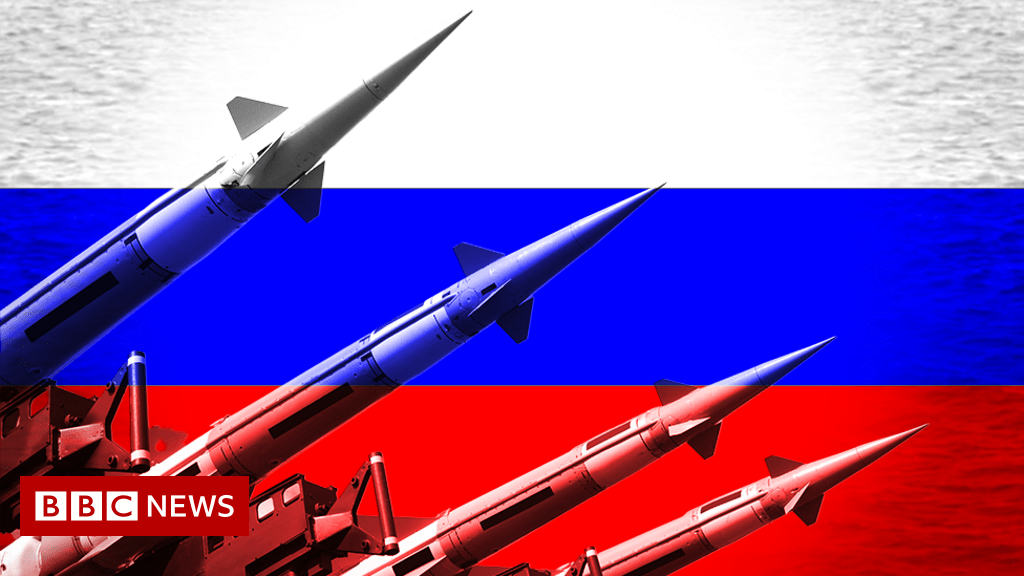
Nuclear Weapons PHOTO credit: BBC
March 14, 2022

Referencing the Russia war on Ukraine, researchers and scientists have warned that modern day nuclear weapons could cause more damage than the impact of the ones dropped on Hiroshima and Nagasaki.
Scientists hint that all continents of the earth could be affected, remotely or directly. The impact after the explosion is said to be more damaging than the explosion itself.

In addition to killing hundreds of thousands of people instantly, a nuclear explosion would create visible, infrared, and ultraviolet light waves that would combine to produce a large, very hot fireball capable of burning everything and creating third-degree burns within an even larger radius than the blast damage, reports Swissinfo.ch.
If Russia were to deploy its entire atomic arsenal, part of the planet would become uninhabitable and the world as we know it would no longer exist, says Stephen Herzog, a researcher at the Center for Security Studies at the federal technology institute ETH Zurich.
But even the deployment of just a small part of this arsenal would have devastating long-term consequences.
“The atmospheric overpressure caused by the shockwave of the nuclear explosion would be able to destroy entire buildings up to tens of kilometres away, apart from those made of hardened reinforced concrete,” he explains.
Hundreds of thousands of people could be instantly killed or injured by debris or collapsing buildings. In addition, the explosion would create visible, infrared, and ultraviolet light waves that would combine to produce a kind of large, very hot fireball capable of burning everything and creating third-degree burns within an even larger radius than the blast damage.
Contaminated populations would have to deal with subsequent radioactive fallout, which can cause tumours and birth defects.
What risks are there for the rest of the world?
Today’s atomic weapons technology makes it possible to wipe out entire metropolises even over great distances. “Every major city in the US is potentially half an hour from destruction, and every major NATO city in Europe is roughly 20 minutes from being destroyed by one of these ballistic missiles,” says Herzog.
Switzerland and Austria are less at risk because of their neutrality, but the radiation effects could be enormous over the whole of continental Europe, including in Switzerland, and would be similar to those caused by a nuclear power plant meltdown, “even if battlefield nuclear weapons were used”, he says.
How likely is a nuclear attack?
To date, the probability of Russia using nuclear weapons is still remote, but the risk is not zero. Instead, it is more likely that Putin will decide to use chemical weapons before nuclear ones. These weapons, besides being considered less taboo by the Russian president, make it easier to deny the evidence, because “in the event of an attack it is easier to blame the Ukrainian forces, whereas a nuclear attack leaves no doubt as to who is responsible,” says Herzog.
However, it should not be forgotten that the ongoing war is not just between Russia and Ukraine, but between Russia and Ukraine with Western supplies and intelligence. Escalation cannot be ruled out. That is why the nuclear threat is so scary, Herzog and Bollfrass agree.
The bomb dropped on Hiroshima in 1945 weighed around 4,500kg and killed over 100,000 Japanese. Over time, significant strides have been made in miniaturising the technology: today’s nuclear weapons are more compact and usually weigh just a few hundred kilos but have the potential to kill millions of people. These features make it possible to carry out an atomic attack using a variety of means, from ballistic to cruise missiles, reaching every part of the globe.
“Many of these weapons are much smaller, lighter and easier to deliver than they used to be. In addition, their explosive power is much greater,” explains Stephen Herzog, a researcher at the Center for Security Studies at the federal technology institute ETH Zurich. Some of the nuclear weapons Russia has at its disposal today are over 50 times more powerful than those dropped on Hiroshima and Nagasaki.
Report: Courtesy swissinfo.ch