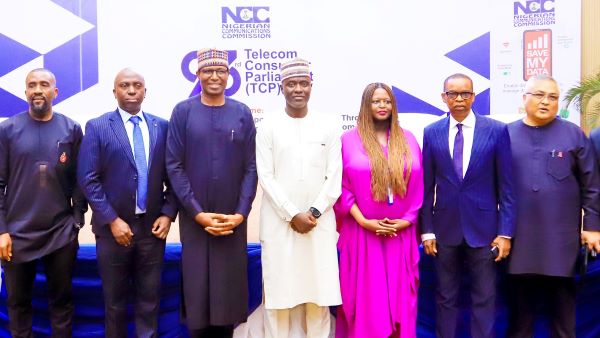
L-R: Head, Customer Operations, North, MTN, Chikaodi Ofoegbe; Chief Executive Officer, 9Mobile, Obafemi Banigbe; Chairman, Association of Licensed Telecom Operators of Nigeria, Gbenga Adebayo; Executive Vice Chairman/Chief Executive Officer, Nigerian Communications Commission (NCC), Dr. Aminu Maida; Executive Commissioner, Stakeholder Management, NCC, Rimini Makama; Director, Consumer Affairs Bureau, Dr. Ikechukwu Adinde and Chief Executive Officer, Airtel Nigeria, Carl Cruz during the 93rdedition of the Telecom Consumer Parliament hosted by the Commission in Abuja on Thursday, November 7, 2024.

It’s an honor to welcome you to the 93rd Telecoms Consumer Parliament, themed “Optimizing Data Experience: Empowering Consumers through Awareness and Transparency in a Consumer-Centric Telecom Industry.” This theme is timely, as internet use has become essential to daily life, and our role at the NCC is to not only ensure accessibility but to enhance service delivery for consumers.
Over the past two decades, the telecommunications landscape in Nigeria has transformed from basic voice services to high-speed data that connects, informs, and powers innovations. With the rollout of 3G, 4G, and now 5G, we’ve seen Nigerians adopting social media, e-commerce, online banking, and more. The introduction of 3G networks in the mid-2000s marked the beginning of this shift, enabling basic browsing and email. The leap to 4G LTE brought faster speeds, enabling video streaming, online gaming, and a myriad of digital activities. Now, with 5G promising even faster speeds and lower latency, new frontiers are opening for innovations such as smart cities, autonomous vehicles, and the Internet of Things, driving further demand for data.
Today, as data consumption grows, fueled by digital advancements, we must address consumer concerns over data depletion and billing transparency.
Globally, DataReportal notes there are now over 5 billion internet users, with Nigeria alone accounting for 132 million connections. Nigerians spend an average of 4 hours and 20 minutes on social media daily, far above the global average, underscoring how deeply embedded digital interaction is in our lives. In 2024, Nigeria’s daily data usage averaged 336 gigabytes per second, marking a 39% increase from the previous year—a clear indication of the data-driven lifestyle many Nigerians lead.
Despite this, many consumers feel their data depletes faster than expected, echoing a sentiment I hear often. Nigeria isn’t alone in this; other countries, like Eswatini, are also working to address similar consumer concerns about data usage.
Earlier this year, NCC analyzed consumer complaints, revealing data depletion and billing issues as top concerns. In response, we directed Mobile Network Operators and ISPs to conduct audits of their billing systems, which reported no major issues. However, perceptions persist due to two main factors:
(1) the impact of high-resolution devices and improved technologies on data use and
(2) the complexity of operator tariffs.
With the advent of 4G and 5G, as well as devices with ultra-high-definition screens, data consumption has naturally increased. For example, while viewing a photo on Instagram might have required only 100 kilobytes of data five years ago, today, with advanced camera resolutions, a photo can consume between two to four megabytes when opened on Instagram. According to Tech Advisor, an online resource that offers tech reviews, spending an hour on Instagram can set you off an average of 600 Megabytes of your data, while streaming platforms like YouTube would set you off by about 3.5 to 5.4 Gigabytes per hour.
Improved technologies go beyond their purchase cost to our pockets, they also come at a cost to data. Because they have better screen resolutions, they consume higher quality media that consumes more data. This is the same for our increasing digital habits: according to DataReportal, the world’s internet users are spending less time watching television; the average daily television viewing has fallen by over 8% in the past one year. These viewers are now spending more time on their telephones, tablets, and smart TVs streaming programmes that they would previously have watched on broadcast television.
Recognizing these challenges, the Commission, in collaboration with major operators, launched a Joint Industry Campaign on Consumer Awareness on Smarter Data Usage. This media campaign, spanning radio, television, newspapers, and SMS, aims to educate consumers on effective data management. I am sure many of you have encountered jingles or graphics offering tips for managing data. Our message emphasizes empowering consumers with the knowledge to optimize their data usage. For example, many smartphone users may not know that their devices can track data usage and allow them to set limits on the amount of data they want to use.
[Question to audience: How many of us are aware of this feature?]
Smartphones, even when idle, often run background applications like automatic updates and location services, which consume data. Additionally, high-definition streaming services like Netflix consume substantial data— about three gigabytes per hour in high definition, or seven gigabytes in ultra-high definition.
The Commission believes that an informed consumer is a better-equipped consumer, leading to a clearer understanding of data consumption and reducing misconceptions about data depletion.
In addition, to address tariff complexity, NCC issued a Guidance on Tariff Simplification, requiring operators to provide clear, accessible information on data plans and pricing. This transparency will empower consumers to make better-informed decisions about their data usage and billing.
In the coming months, operators will implement this guidance, presenting consumers with tables detailing their tariff plans, billing rates on each plan, and all terms and conditions related to the tariff plans they are on.
As I wrap up, I would like to stress at the heart of the Commission’s Strategic Vision is the commitment to meet the expectations of our stakeholders: the Consumers, the Industry/Licensees, and the Government.
I daresay that the government and operators thrive on satisfied consumers. To achieve this, our focus has evolved from simply demanding quality service to ensuring a holistic Quality of Experience throughout the telecom consumer’s lifecycle—from SIM registration to usage and even service disposal. Our goal is for consumers to be consistently satisfied with telecom services.
Over the past months we Our data analysis has shown that quality service delivery is not solely the responsibility of Mobile Network Operators; it requires collaboration across the value chain. Key stakeholders, such as TowerCos, which provide power and shared infrastructure, as well as those providing essential backhaul services, whether by fibre, microwave or even satellite, connecting base stations to the core networks of MNOs, all play crucial roles in ensuring high-quality telecom services.
In recognition of this, the Commission has revised its guidelines to include provisions that hold each player in the value chain accountable for quality service.
While the Commission remains committed to these goals, the industry also faces challenges such as vandalism and theft of telecom assets, which frustrate operators’ efforts to deliver quality telecom services. In July, through NCC’s advocacy and collaboration with key stakeholders, President Bola Ahmed Tinubu signed a Presidential Order designating telecom infrastructure as Critical National Information Infrastructure. This Executive Order strengthens our ability to address issues of vandalism, tampering, and unauthorized access to telecom infrastructure.
We cannot also ignore the effect of current macroeconomic challenges and the rising cost of business in the country which is impacting the ability of operators to make the necessary investments in the sector.
The Commission is mindful of this and is actively working with other arms of government and stakeholders to address these issues and ensure the industry’s sustainability.
In closing, I want to reaffirm the Commission’s commitment to transparency and accountability within the sector. The Commission is finalizing our Major Incident Reporting Guidelines, which will require operators to inform consumers of major incidents impacting their networks, with these reports also accessible on our website.
Consumers can also soon expect coverage maps detailing operators’ network strength across the country. These maps will indicate coverage gaps, service quality, and signal strength, allowing consumers to make more informed choices when selecting an operator.
Conclusion
As we deliberate at this Parliament on ways to optimize the data experience for telecom consumers, let us remember that our goal is to create a truly consumer-centric telecom industry, in which consumers feel valued, informed, empowered, and satisfied with the services they receive. As Speaker of this Parliament, I want to affirm that this occasion is a platform for open and honest dialogue—a space where consumers can speak and be heard. Our conversations here will be integral to ensuring that our consumers receive optimal Quality of Experience from the industry. With sustained commitment, we can build an ecosystem where every Nigerian enjoys the benefits of world-class telecommunications services.
Dr. Aminu Maida
Executive Vice Chairman/CEO, Nigerian Communications Commission