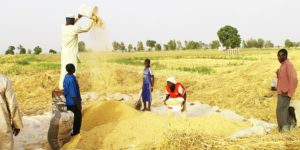

Rice farmers across Bauchi State have expressed deep concern and dismay over remarkably poor harvests and low crop yields this farming season, following a severe outbreak of rice blast disease coupled with prolonged dry spells.
Speaking in an interview with the News Agency of Nigeria (NAN) on Monday in Bauchi, a cross-section of affected farmers revealed that the compounding agricultural challenges have resulted in massive financial losses, making rice cultivation increasingly difficult and less attractive.

Mr. Kabiru Abdullahi, a local rice grower, shared how the disease outbreak ravaged his farm, directly linking the infestation to the low levels of rainfall experienced throughout the growth cycle.
“We faced a series of challenges due to the irregular rainfall. The rain sometimes stopped for several days, and when it rained, it was insufficient to nourish the plants,” Abdullahi explained. “I harvested only 15 bags of paddy this season, as opposed to 22 bags in the past.”
Corroborating Abdullahi’s experience, another farmer, Suleiman Khalid, described how the prolonged dry spell caused his crops to wilt before they could mature fully.
“Inadequate rain severely affected my farm,” Khalid lamented. “I normally harvested about 30 bags of paddy in previous years, but that dropped drastically to less than 10 bags this season.”
Climate Change Driving Disease and Drought
Reacting to the developments, Mr. Ya’u Mohammed, the Programme Manager of the Bauchi State Agricultural Development Programme (BSADP), attributed the crisis directly to the adverse impacts of climate change.
Mohammed explained that rice blast disease thrives and becomes particularly destructive when crops are stressed by high temperatures and moisture deficits.
“Farmers were confronted with drought, rice blast, and other crop diseases this season,” Mohammed noted. “The disease becomes far more pronounced when rainfall is inadequate, contributing heavily to the poor harvests recorded across several rice farms.”
To mitigate future risks and safeguard investments, the BSADP chief urged farmers to strictly adhere to expert advice provided by agricultural extension workers and stay informed through official weather advisories issued by relevant government agencies.