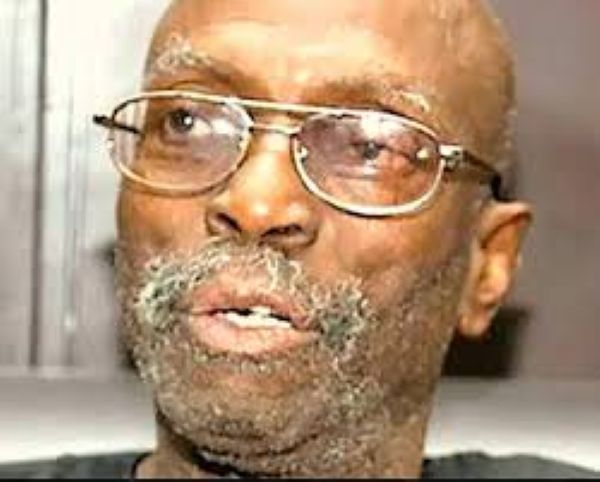
Prof Biodun Jeyifo

When news filtered in on Wednesday, February 11, about the passing of Professor Biodun Jeyifo, I found myself journeying back 35 years, to my National Youth Service days at Teachers’ College, Kagoro, in the southern part of Kaduna State.
It was 1991. We were young, idealistic, and argumentative in the best sense of that word. We believed ideas mattered. We believed debates could shape society. Kagoro, quiet and reflective, became for us a space of intellectual exchange.
It was there that I first heard the name Biodun Jeyifo. I was speaking with my fellow corps member, Adekola Adebayo, who had studied English at Obafemi Awolowo University, Ile-Ife. As corps members often do, we compared our campuses and the intellectual giants who shaped them.
I told him about the University of Calabar, about Eskor Toyo, the formidable Marxist economist whose lectures drew students from every faculty, and about Dr. Innocent Ukeje, the political scientist, whose ideological position differed sharply from Toyo’s. On that campus – whether you’re a Malabite or Malabress (as Unical students are called) – your intellectual leaning often aligned you with one or the other. I told Kola that my sympathies leaned toward Eskor Toyo’s Marxist clarity and structural critique.
Years later, Ukeje would rise to become a professor at the University of Abuja. Eskor Toyo would retire as a respected professor of economics before his passing on Monday, December 7, 2015 at 86. But 1991, their debates still animated our conversations.
Kola then smiled and said, “Let me tell you about BJ.” That was my first introduction to Biodun Jeyifo. At Ile-Ife, he said, students and lecturers affectionately called him “BJ.” He described him as a brilliant literary scholar and a committed Marxist intellectual. He also mentioned Ropo Sekoni, another respected literary scholar and close associate of BJ. Years later, I would come to appreciate how deep and enduring that friendship was.
What I did not know at the time, and what I only came to understand much later, was the depth of the connection between BJ and the Madunagus. As a student in Calabar, I encountered Professor (then Dr) Bene Madunagu a few times. I knew her as a lecturer in the Botany Department and as a passionate promoter of the Girl Power Movement. She was visible, energetic, and deeply committed to social advocacy. Yet I did not then grasp the broader ideological network of which she was part.
It was only years later that I learned that Biodun Jeyifo, Edwin Madunagu, and Bene Madunagu were bound together not merely by friendship but by shared ideological commitment, as the trio that formed the Nigerian Socialist Movement, the nucleus of what became widely known as the Nigerian Left.
That knowledge reframed my memories.
The intellectual currents I experienced in Calabar and the ones Kola described in Ile-Ife were not isolated phenomena. They were interconnected streams flowing from a larger river of radical thought and organised socialist engagement in Nigeria. BJ stood alongside Dr. Edwin Madunagu and Professor Bene Madunagu in shaping socialist thought and activism in the country. They were not armchair theorists. They were organisers, teachers, writers, and public intellectuals committed to building a socialist consciousness rooted in justice, equality, and human dignity.
Today, of that historic trio, only Dr. Edwin Madunagu remains. Professor Bene Madunagu, a formidable intellectual and activist in her own right, passed away on Tuesday, November 26, 2024, at the age of 77. (Interestingly, her death was jointly announced by Dr Edwin Madunagu and BJ). With the death of Biodun Jeyifo, another pillar of that generation has fallen.
Yet even in BJ’s final years, the bonds of friendship and shared struggle endured and were publicly celebrated. This the world saw on Monday, January 5, just last month, when an international symposium was held in Lagos to mark his 80th birthday. The event took place at the Agip Recital Hall, MUSON Centre, Onikan, and was organised by the Wole Soyinka Centre for Investigative Journalism (WSCIJ). Aptly titled ‘Who Is Afraid of Decolonisation? Pedagogy, Curriculum and Decolonisation: Then and Now,’ the gathering reflected the lifelong concerns of BJ’s scholarship namely decolonisation, pedagogy, intellectual responsibility, and the politics of knowledge production.
The symposium was moderated by no other person than Ropo Sekoni, a powerful testament to a life-long friendship forged in scholarship and ideological conviction. That moment, Sekoni anchoring a global intellectual celebration in honour of BJ, symbolised not only enduring comradeship but also the magnitude of BJ’s influence. Scholars, activists, students, and admirers gathered across generations and geographies to honour a man whose ideas travelled far beyond Nigeria’s shores.
Looking back now, I realise that the ideological conversations in Kagoro in 1991 were part of something much larger, a coordinated intellectual and political project aimed at transforming Nigerian society. BJ was central to that story.
He was a bridge – between literature and politics, between Nigeria and the diaspora, between the classroom and the public square. His scholarship travelled across continents, yet remained rooted in Africa’s realities and struggles.
His passing signals more than the loss of a distinguished professor. It marks the gradual closing of a chapter in Nigeria’s radical intellectual history, a generation that believed scholarship must confront injustice; that intellectual labour is a form of public service; that socialism was not a slogan but an ethical commitment.
For me, the news of his death reawakens memories of Kagoro, of long evenings of debate, of believing that arguments about Marxism, class, and culture were urgent and transformative.
We may not all have sat in his classroom. Some of us encountered him through students he inspired, through movements he helped shape, through ideas that travelled beyond campus walls. Yet even at a distance, he influenced us.
Professor Biodun Jeyifo has taken his final bow. But like all true teachers, he leaves behind not silence — but echoes.
And somewhere in those echoes is a young corps member in Kagoro, in 1991, hearing the name “BJ” for the first time, unaware that he was listening to the story of one of the architects of Nigeria’s socialist movement.
May his legacy endure.
- Dr Max Amuchie, a member of the Nigerian Guild of Editors, is CEO, Sundiata Post Media Ltd.