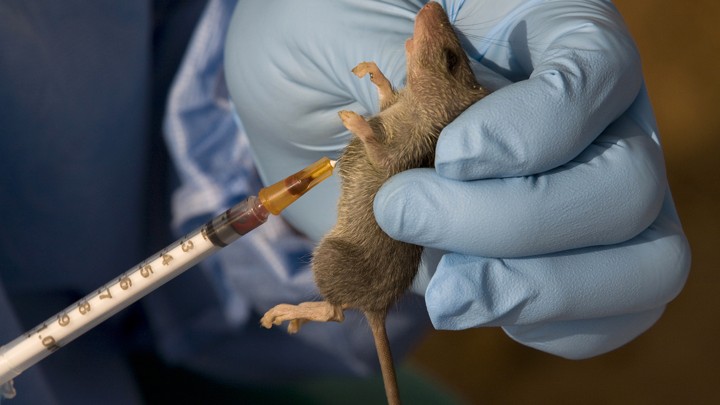
An ecologist extracts a sample of blood from a Mastomys Natalensis rodent in the village of Jormu in southeastern Sierra Leone February 8, 2011. Lassa fever, named after the Nigerian town where it was first identified in 1969, is among a U.S. list of "category A" diseases -- deemed to have the potential for major public health impact -- alongside anthrax and botulism. The disease is carried by the Mastomys Natalensis rodent, found across sub-Saharan Africa and often eaten as a source of protein. It infects an estimated 300,000-500,000 people each year, and kills about 5,000. Picture taken February 8, 2011. To match Reuters-Feature BIOTERROR-AFRICA/ REUTERS/Simon Akam (SIERRA LEONE - Tags: HEALTH SOCIETY ANIMALS) - GM1E72F07HC01
Jan. 19, 2022
The Commissioner for Health in Plateau, Dr. Nimkong Lar, says the state has recorded one confirmed case of Lassa fever in the state.
Lar said in an interview with the News Agency of Nigeria (NAN) on Wednesday in Jos that eight suspected cases were taken to the laboratory for confirmation but one one tested positive to it.
The commissioner noted that patient was responding to treatment.

He advised that people should report immediately to the nearest health facility when they have malaria fever, noting that Lassa fever presents symptoms similar to those malaria fever.
He said that prompt intervention “is key in reducing the mortality rates associated with the disease”.
He expressed concern that on many occasions, patients came to hospital late in spite of campaigns against the disease.
Lar also called on health workers to make referrals to other health facilities such as the tertiary health facilities, when they couldn’t handle such cases presented for prompt medical attention.
The commissioner advised that people should learn to keep their environment clean and rodent-free.(NAN)