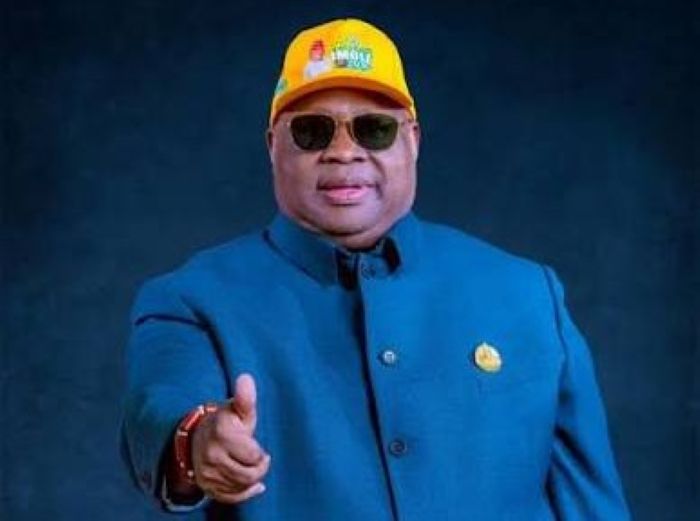
The governor ran on the Accord Party platform, polling 511,067 votes to defeat his main challenger, Asiwaju Munirudeen Bola Oyebamiji of the All Progressives Congress, who got 444,815 votes.
Osun State woke up last Sunday with the same government it went to bed with: that of Governor Ademola Adeleke. With Adeleke’s victory in the August 15 election, the opposition may be having a new talking point for 2027.
The governor ran on the Accord Party platform, polling 511,067 votes to defeat his main challenger, Asiwaju Munirudeen Bola Oyebamiji of the All Progressives Congress, who got 444,815 votes. Governor Adeleke thus earned a second term and a critical triumph in the last off-cycle poll before the January 2027 presidential election.
Besides giving the Accord Party a South-West state and the only state in the country, the result turns Osun into the opposition’s rallying cry heading into the next general elections.
For APC’s Oyebamiji, branded as AMBO, the votes he polled, representing around 40% of the total votes, are significant. However, the 66,252-vote winning margin was far more than the 28,344-vote difference between Adeleke and Alhaji Adegboyega Oyetola in the 2022 election.
Though Governor Adeleke’s re-election has sunk in, the August 15 election has continued to dominate discussions in Osun. In his usual boisterous and energetic manner, the governor was in church last Sunday for thanksgiving, during which he sang and danced to no end. The local APC, on its part, said it is still studying the results after which it will decide on its next line of action.
As some political analysts predicted, the election was decided in Accord Party strongholds like Ede North, Ede South, and Ife Central, which delivered massive margins for the party, while Osogbo, Iwo, and Ilesha East stayed competitive but could not overturn the deficit.
In all, Adeleke won 19 Local Government Areas, including Ede North, Ede South, Osogbo, Ife Central, Iwo, Ejigbo, Ifelodun, Odo-Otin, Ila and Ayedaade, while AMBO won 11 LGAs, including Ilesha East, Ife South, Boripe, Irepodun, Obokun and Olorunda.
Accord Party’s campaign focused on continuity and workers’ welfare, while the APC’s focused on a refreshing change to a dancer-governor and the benefits of aligning with the centre, the gains of which are already manifesting in Osun and South-West.
At the Arise Television Town Hall conversation on Tuesday, August 11, AMBO amply demonstrated his brilliance, regaling the audience with his deep academic background and achievements as MD of Osun Investment Company and as Commissioner for Finance in the state. He was practical, honest and pragmatic, giving granular details of what he did in office and the legacy he left behind.
Losing Osun may seem like a setback for the APC, having failed to win the state. But President Bola Tinubu snatched victory from the jaws of defeat for the APC when, at 2.00 am on Sunday, at a time the election results had yet to be formally announced, he called Governor Adeleke to congratulate him on his victory. He told the governor that the people of Osun had spoken and given him a mandate to lead them for another four years.
That call was instructive: it changed the political calculus. It portrayed the President as a dyed-in-the-wool democrat, a statesman and a father of all. It also shored up the legitimacy and credibility of the electoral process, showing that the government had allowed the electoral system to run unencumbered. Given the often acknowledged might and power of the centre in Abuja, President Tinubu could have outmuscled the governor and his political family if he had chosen that path, in the mould of former President Olusegun Obasanjo’s do-or-die politics, which reared its ugly head in the disastrous 2003 and 2007 elections.
Following his victory, an elated Governor Adeleke restated his earlier position to work for President Tinubu’s re-election in 2027. He promised to put everything into the task, including collaborating with the APC members in the state.
Governor Adeleke doubled down on this resolve on Thursday, August 20, when he visited President Tinubu at Aso Rock, Abuja, to present his certificate of return. He thanked the President for ensuring a free and fair election. President Tinubu again congratulated him, urging him to see his victory as the will of God and the resolve of the Osun people. He, however, enjoined the governor to embrace unity and reconciliation, enlarge his coast, and refrain from stigmatising anyone.
Accord Party’s seeming friends in the opposition see the Osun win as the much-needed oxygen. African Democratic Congress presidential candidate and former Vice President, Alhaji Atiku Abubakar, and some opposition chieftains described the Osun election as “proof that Nigerians are asking for an alternative in 2027.”
But an attempt by the ADC to cash in on the victory and spin it as a product of combined efforts was quickly debunked by Governor Adeleke, who said he had no working pact with any party or any coalition.
Now, will the Accord Party’s victory give the opposition any momentum to begin coalition talks, and a South-West base from which to challenge APC’s dominance in the region? I do not think so.
What does the Osun election then mean for January 2027? Three implications stand out.
One, the South-West remains competitive. With Osun in the Accord Party and Oyo State still ruled by recalcitrant Governor Seyi Makinde who has ported to the Allied People’s Movement in pursuit of an ill-advised presidential ambition, the South-West cannot be called an APC monolith. However, with Governor Adeleke’s pro-Tinubu stance and the son-of-the-soil syndrome favouring the President, a fierce battle for the region’s votes in 2027 is unlikely.
The second implication is the referendum effect. Voters in Osun somehow used this off-cycle poll to judge the centre. The opposition will frame the result as a rejection of the economic reforms that had initially proved challenging. APC will argue it was a local contest in which local issues like the “half-salary policy” that prevailed during the administration of former APC Governor Rauf Aregbesola in the state, and internal contradictions within the party, created a negative impact.
Thirdly, the Osun election would mean an early start to 2027 politicking, though the presidential election campaign officially kicked off on August 19.
For President Tinubu, with five months until January 2027, Osun’s voting outcome suggests a need to recalibrate. The countdown to 2027 has officially begun, and the opposition thinks it has got the first headline.
Rahman is Senior Special Assistant to President Tinubu on Media & Special Duties.