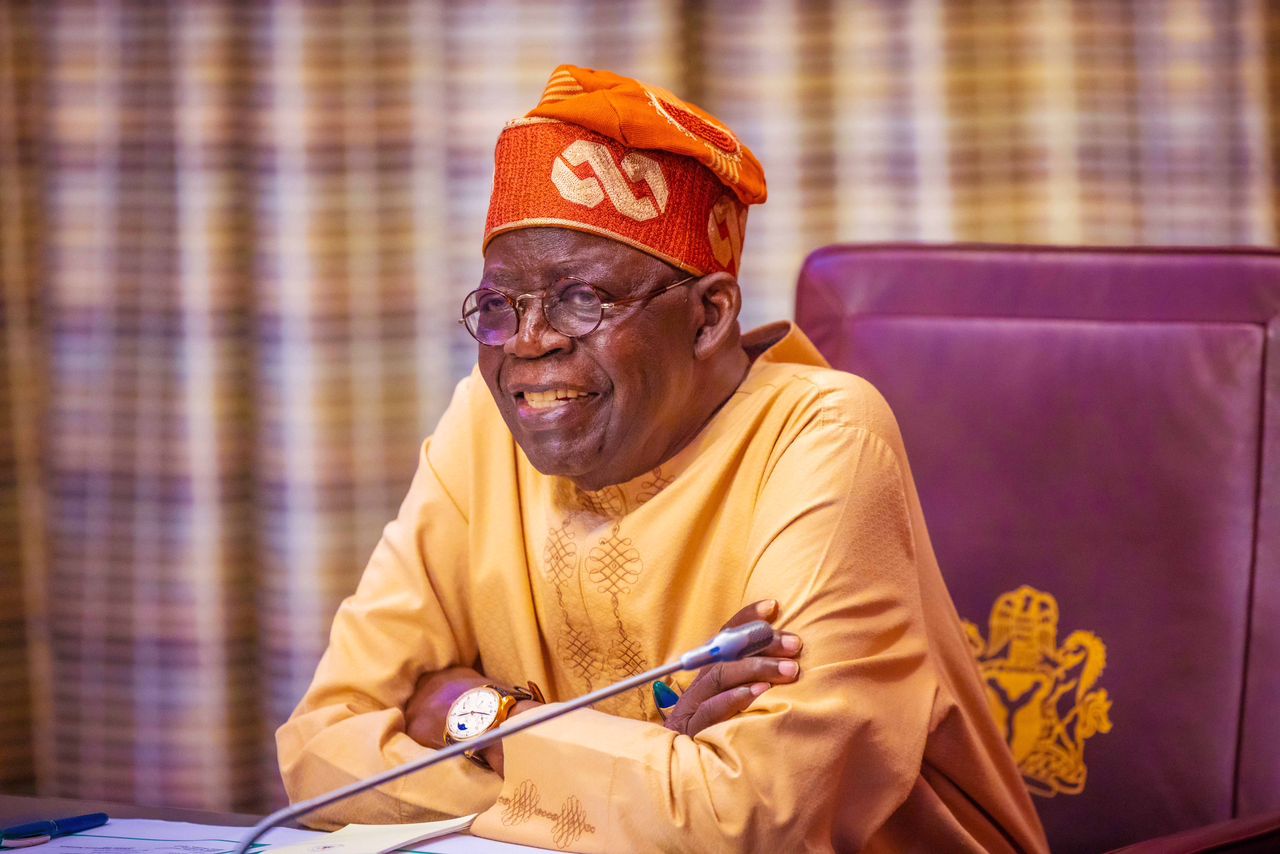
President Tinubu at the meeting
Sept 28, 2023
Nigerian President Bola Tinubu’s lightning-fast reform push after taking office in May sparked hope that his administration would be a business-friendly antidote to mounting economic troubles facing Africa’s biggest economy.
Fast forward to more than 100 days in office, and the key planks of his economic overhaul – unshackling the naira from its rigid regime, and allowing fuel prices to rise – are coming loose.
The naira hit a record low of 1,000 to the dollar on the black market this week, widening the gap with the official rate, which stood at 785 on Thursday.
Some now fear Tinubu will not be able to wean Nigeria off the costly policies that have stymied investment and throttled economic growth.
“Momentum just seems…almost in reverse,” said David Omojomolo, Africa economist at research firm Capital Economics.
Public anger is swelling as inflation spirals higher, however, and Nigeria’s two biggest workers’ unions are planning an indefinite strike next week to protest over a cost-of-living crisis.
“Sentiment towards Nigeria has been continuing to sour as the initial reform momentum under President Tinubu’s administration has faded,” said Tellimer analyst Patrick Curran.
DOLLAR DELAY
For years, Nigeria has tightly controlled the official naira rate, even amid declines in the price of oil, sales of which bring in 90% of the country’s foreign currency supply.
But providing dollars at an artificially low rate has led to a yawning gap between official and black market rates, leaving businesses and investors unable to access dollars. The central bank has also created import restrictions aimed at reducing dollar demand.
Tinubu’s decision to let the official naira rate weaken saw it briefly converge with the black market. Last week, he assured investors they could take money out, touting a “reliable, one figure exchange rate of the naira.”
But the gap has widened to nearly 30% this week, and four sources told Reuters it was virtually impossible to get dollars from the central bank on an ad hoc basis.
The incoming central bank chief said on Tuesday that policymakers faced a nearly $7 billion backlog in foreign exchange demand; foreign airlines alone had $783 million in ticket sales trapped, the International Air Transport Association said.
This is one major factor keeping investors from putting money to work in Nigeria.
Another is negative real bond yields and the slow central bank response: 10-year local government bonds yield less than 15% while inflation is running above 25%.
“What they have done so far is not enough to attract domestic debt holders or foreign investors into their domestic debt market,” said Carlos de Sousa, portfolio manager at Vontobel Asset Management.
The tattered finances left by the previous administration have also been no help.
In August, the central bank published audited accounts for the first time since 2018, revealing that its $33 billion in FX reserves included a $19 billion commitment in derivatives – slashing the liquid amount of reserves.
JPMorgan calculated net FX reserves stood at $3.7 billion as of the end of 2022, “significantly lower” than prior estimates.
That news sent Nigeria’s international bond tumbling.
“Lower net FX reserves reduce the willingness to introduce a flexible exchange rate regime in the near term,” said JPMorgan’s Gbolahan S Taiwo.
The central bank has also kept other restrictions that businesses say make life tough, including a ban on using central bank foreign exchange to import 43 items.
“The government may have intended to make it a free market, but the CBN isn’t allowing it to be one,” said a Nigerian private equity investor who did not want to be named.
The delay in scrapping fuel subsidies is exacerbating the dollar crunch. Last year, subsidies cost 2% of gross domestic product, according to Fitch.
Despite being Africa’s largest oil exporter, Nigeria imports nearly all its fuel as it does not refine nearly enough to meet the demand of its 200 million citizens. In recent years, it has swapped crude for fuel, depriving it again of a source of U.S. dollars.
It is still using oil cargoes now to pay for fuel it imported previously, and a de-facto pump price limit set by state oil company NNPC LTD’s sale price means it is again the sole petrol importer.
Tellimer said Nigeria’s gasoline prices would need to rise 73% to align with global prices.
Analyst say Tinubu, elected with the narrowest margin since Nigeria returned to democracy in 1999 and facing inflation at nearly two-decade highs, lacks the social capital and mandate to push any harder.
“There is the concern that when the going gets tough…they will walk back on the reforms,” Omojomolo said.
REUTERS ANALYSIS