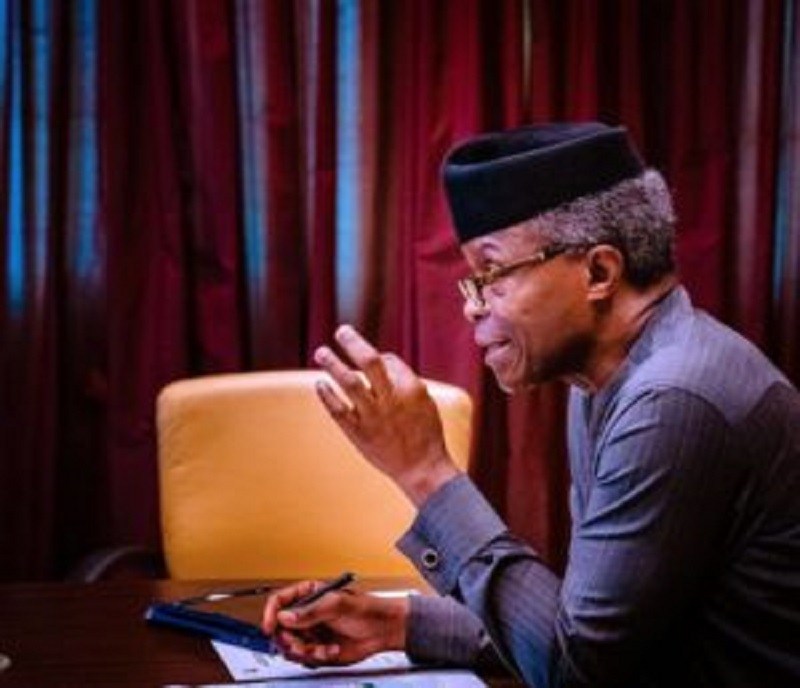
Prof. Yemi Osinbajo
Referencing statistics available in the Nigerian Integrated Infrastructure Masterplan (NIIMP) and the Economic Recovery & Growth Plan, Prof. Osinbajo noted that “Nigeria needs up to $3 trillion over the next 30 years to bridge the infrastructure gap.”
Osinbajo’s spokesman, Laolu Akande, in a statement on Thursday in Abuja, quoted the vice president as saying these while featuring at a webinar organised by the Bureau of Public Enterprises (BPE).
“It is clear that this deficit can only be made up by private investment. Private sector is 92% of GDP while the Public Sector is mere 8%. So, the synergy between the public and private sector through Public-Private Partnerships (PPP) is really the realistic solution.”
He said that adopting new models of investments for infrastructural development in the country was imperative as reliance on public expenditure alone was no longer sufficient to meet the needs.
The forum was to discuss measures to deepen Nigerian infrastructure stock through Public-Private Partnership (PPP).
Osinbajo said that in spite of government’s interventions over the years, Nigeria still faces a huge infrastructural deficit which is constraining rapid economic growth.
The vice president made reference to statistics provided in the Nigerian Integrated Infrastructure Masterplan (NIIMP) and the Economic Recovery and Growth Plan.
“The Federal Government recognises this fact which is why we are considering other approaches to complement and boost financing for the development and maintenance of infrastructure in Nigeria.
Osinbajo said that the Federal Government would have to spend the entire revised 2020 appropriation of N10.81 trillion continuously for the next 108 years or more on capital expenditure (CAPEX) to meet that target.
“The fact that only N2.49 trillion was appropriated for capital expenditure in 2020, reflects the importance of deliberate and pragmatic action to boost infrastructural spending.
“It seems to me to be quite clear that the financial outlay and management capability required for infrastructural development and service delivery outstrip the financial and technical resources available to government.
“In other words, the traditional method of building infrastructure through budgetary allocations is inadequate and set to become harder because of increasingly limited fiscal space,” he said.
On the benefits of effectively implementing PPP arrangement for Nigeria, he said if properly designed and executed, PPP models would unlock innovative infrastructure financing and management in a transparent and more efficient manner.
According to him, Nigeria using PPP frameworks will benefit immensely from huge local and foreign private sector resources.
He said that the Federal Government was leveraging on the partnership with the private sector to bridge the huge infrastructure gap.
“The Federal Government has recently issued a circular on the administration of PPP projects in the country to provide the much-needed clarity.
“The circular re-emphasises that the BPE shall be responsible for the concession of public enterprises and infrastructure already listed in the First and Second Schedules of the Public Enterprises Act.
“The circular equally stipulates that the BPE shall act on behalf of the Federal Government as the counterparty on all infrastructure projects being developed on a PPP basis,” he said.
He said the Infrastructure Concession Regulatory Commission (ICRC) would continue to act as the regulatory agency for PPP transactions with powers to inspect, supervise and monitor projects and processes in order to ensure compliance with relevant laws, policies and regulations.
” It is expected that this new policy direction would provide clarity to stakeholders and foster the improvement of PPP programmes in the country.
“Ministries, Departments and Agencies as well as the multilateral agencies and our development partners are urged to support the PPP policy objectives and institutional arrangements already put up by government,” he said.
He said that the Federal Government through the CBN, Nigerian Sovereign Investment Authority and African Finance Corporation and other financial institutions would be creating a N15 trillion Infrastructure Fund.
According to him, the fund will help to, not only unlock investment from local sources, but also attract foreign private investment in infrastructure development.