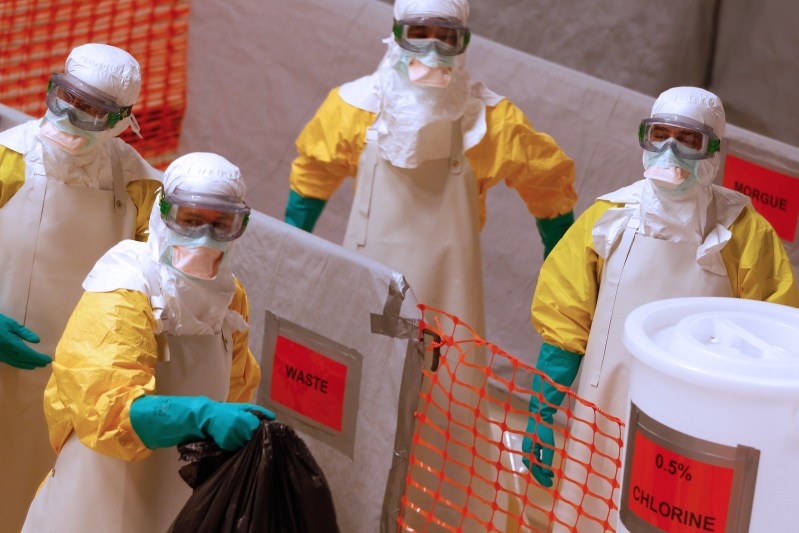
Medical workers wearing protective suits take part in a training prior to leave to countries affected by the Ebolas virus, in an empty factory warehouse in Amsterdam, on November 5, 2014 where medicals aid group Medecins Sans Frontieres (MSF) created a mock clinic. The disease has killed nearly 5,000 people, almost all of them in Sierra Leone, Liberia and Guinea. AFP PHOTO/ANP/BAS CZERWINSKI-netherlands out- (Photo credit should read BAS CZERWINSKI/AFP/Getty Images)
Feb. 2, 2025
The Nigeria Centre for Disease Control and Prevention (NCDC) has placed the country on high alert following the confirmation of an Ebola Virus Disease (EVD) outbreak in Uganda.
Dr. Jide Idris, the Director‐General, said this on Sunday in an interview with the News Agency of Nigeria (NAN) in Abuja.
Jide said that although the country has no reported any case of Ebola, the agency, in collaboration with key stakeholders, has activated heightened surveillance measures to prevent importation of the virus into the country.
He said that the outbreak, caused by the Sudan strain of the virus, was confirmed by Uganda’s Ministry of Health on January 30, 2025, with one reported case and one death in Wakiso, Mukono, and Mbale City in Mbale District.
“Ugandan health authorities are currently tracking 44 contacts to curb further spread,” he said.
He disclosed that in response to the development, the NCDC has “Updated its EVD emergency contingency plan and increased screening at points of entry, particularly international airports.
“Optimised diagnostic capacity for EVD testing in designated laboratories and mobilised Lassa fever testing laboratories, which can be scaled up for Ebola testing if needed.”
The director Director general assured Nigerians that proactive steps were being taken to mitigate any risk of an outbreak.
“While there is no immediate cause for panic, we must remain vigilant. The Ebola Sudan strain has no approved vaccine, making early detection and containment critical,” he said.
He urged Nigerians to adhere to the following preventive measures:” Practice good hand hygiene – Wash hands regularly with soap and water or use hand sanitisers.
“Refrain from consuming bush meat, especially bats and primates.
“Seek immediate medical attention if experiencing symptoms after travelling to an affected country.”
Additionally, he advised health workers to maintain a high index of suspicion, use personal protective equipment (PPE), and report suspected cases immediately.
While the World Health Organisation (WHO) has not recommended travel restrictions, he advised Nigerians to avoid non-essential travel to countries with confirmed Ebola cases.
“Travelers returning from affected countries in the last 21 days with symptoms such as fever, sore throat, vomiting, or unexplained bleeding should immediately call the NCDC toll-free number (6232) or their State Ministry of Health hotline,” he advised.
Beyond Ebola, he said that the country is currently battling outbreaks of Lassa fever, meningitis, diphtheria, Mpox, measles, and anthrax.
He reaffirmed the agency’s commitment to strengthening surveillance and response efforts across the country.
“Nigerians are encouraged to stay informed and follow official updates from the NCDC through its hotline (6232), social media platforms (@NCDCgov), and official website,” he added.
NAN recalls that the incubation period ranges from 2 to 21 days. Initial symptoms include sudden onset of fever, fatigue, muscle pain, headache, and sore throat.
As the disease progresses, individuals may experience vomiting, diarrhoea, rash, impaired kidney and liver function, and in some cases, both internal and external bleeding.
Laboratory findings often show low white blood cell and platelet counts and elevated liver enzymes.
Ebola is often fatal, with case fatality rates varying from 25 per cent to 90 per cent in past outbreaks, depending on factors such as the virus strain and the effectiveness of response efforts.
The average case fatality rate is around 50 per cent.
Effective outbreak control relies on a combination of interventions, including case management, surveillance and contact tracing, good laboratory service, safe burials, and social mobilization.
Community engagement is key to successfully controlling outbreaks.
Raising awareness of risk factors and protective measures, such as practising good hand hygiene, avoiding contact with infected individuals, and safe burial practices, are essential.
There is an FDA-approved vaccine for the prevention of the Ebola virus (species Zaire ortho-ebolavirus).
However, vaccines for other strains, such as the Sudan strain, are still under development.
Supportive care—rehydration with oral or intravenous fluids—and treatment of specific symptoms improve survival.
Early supportive care with rehydration, and symptomatic treatment improves survival.
A range of potential treatments, including blood products, immune therapies, and drug therapies, are currently being evaluated (NAN)