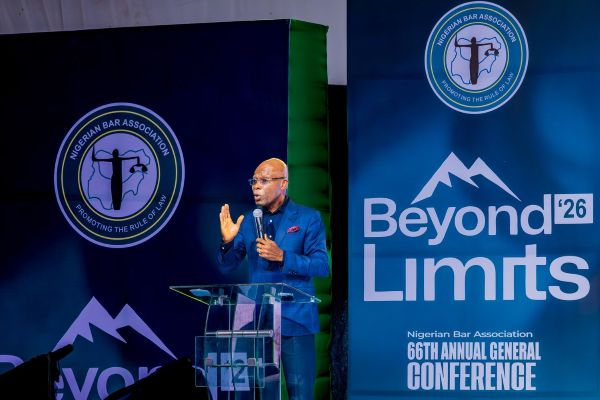
Leo Stan Ekeh making his remarks
Chairman of the Zinox Group, Leo Stan Ekeh, argued that the Nigeria First Policy represents a major protection for creatively ambitious Nigerian entrepreneurs.
At the Nigerian Bar Association’s 66th Annual General Conference, held under the theme “Beyond Limits,” the conversation around Nigeria’s economic future took a decisive turn towards local capacity, digital transformation and smarter public procurement.
During a high-level session on “E-Commerce and Procurement: Transforming Public Contracting through Digital Systems, Transparency and Local Capacity Development,” Chairman of the Zinox Group, Leo Stan Ekeh, argued that the Nigeria First Policy represents a major protection for creatively ambitious Nigerian entrepreneurs.
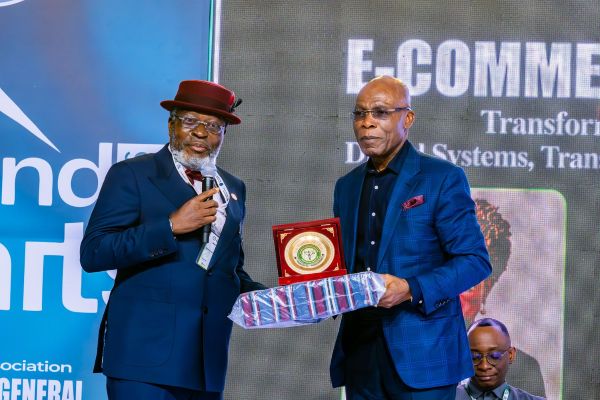
Ekeh’s position was anchored on a simple but important principle: Nigeria cannot build a sustainable digital economy if indigenous businesses are consistently pushed aside in favour of foreign alternatives. He advocated for a policy framework that requires government Ministries, Departments and Agencies to prioritise homegrown goods, services and innovations where local capacity exists, while maintaining the standards required for global competitiveness.
For Ekeh, the value of the Nigeria First Policy extends beyond protecting local companies. It can help create a dependable domestic market for Nigerian innovators, reduce excessive reliance on imported technology and channel significant economic value into the country. By giving credible indigenous businesses greater opportunities to participate in public procurement, government spending can become a powerful catalyst for investment, innovation, skills development and sustainable job creation.
The discussion also examined the evolving role of digital systems in public contracting. E-procurement platforms, government cloud infrastructure, data protection safeguards and digital audit trails are increasingly important tools for improving transparency, accountability and efficiency. These systems can reduce opportunities for manipulation while creating clearer records of procurement decisions and transactions.
The legal profession, speakers noted, has an equally important role to play in this transformation. Lawyers must increasingly understand the intersection between technology, procurement and regulation as they draft contracts, ensure compliance, manage procurement risks and navigate emerging mechanisms for resolving procurement disputes.
The session featured other prominent voices, including Dr. Adebowale Adedokun, Director General of the Bureau of Public Procurement; Kashifu Inuwa Abdullahi, DG/CEO of NITDA; Fatai Idowu Onafowote, Director General of the Lagos State Public Procurement Agency; Engr. Sanusi Aminu Yero, Director General of the Kaduna State Public Procurement Authority; and Andrew Osemedua Odom, SAN. The session was coordinated by Dr. Faith Amarachi Okpara, Vice Chair of the Data Privacy Lawyers Association of Nigeria.
A critical issue emerging from the conversation is enforcement. While policies can establish preference for local capacity, their impact ultimately depends on compliance. Ekeh therefore called for stronger enforcement, including appropriate sanctions by the Bureau of Public Procurement against entities that fail to comply with applicable procurement requirements.
The conversation was particularly fitting for the NBA’s “Beyond Limits” theme. Nigeria’s next economic frontier will not be achieved merely by consuming technology developed elsewhere. It will require the country to build, innovate, manufacture, protect intellectual property, develop talent and create an environment where ambitious entrepreneurs can compete and scale.
The Nigeria First Policy, properly implemented, could therefore become more than a procurement preference. It would serve as an economic development instrument; one that gives Nigerian businesses the confidence to invest, innovate and build for the future.
For entrepreneurs who have spent years creating solutions for Nigerian problems, that assurance matters. As Ekeh’s intervention at the NBA conference demonstrated, protecting local capacity is not necessarily a rejection of global competition. Rather, it is about ensuring that Nigerian businesses are strong enough to compete within it.