AfDB
March 28, 2023
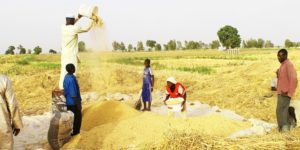
The African Development Bank (AfDB), says Nigeria can build a climate-resilient economy by adopting climate-smart agricultural practices.
The bank said this in its “Country Focus Report 2022 Nigeria: Supporting Climate Resilience and a Just Energy Transition’’, a copy of which was made available to the News Agency of Nigeria (NAN) on Tuesday in Abuja
It listed some practices to include low-cost but effective technologies such as water harvesting, small-scale irrigation techniques, land and water conservation, and management strategies.
The report said minimum or zero tillage agriculture with high net returns to farmers was part of the practice.
According to the report, the African Economic Outlook 2022 estimates of the Climate Resilience Index (CRI) show that between 2010 and 2019, Africa is the least climate-resilient region in the world.
“With the lowest median (28.6) and mean (34.6) CRI scores, well behind Europe and Central Asia, the regions most resilient to climate shocks.
“During the same period, Nigeria was moderately resilient as compared to other African countries, with a CRI score of 26.8.
“Nigeria suffers from multiple climate change effects, manifested through rising temperatures and periodic droughts and flooding though.
“But with implications for agricultural productivity, food security and electricity generation, the country has made some progress in reducing its vulnerability,” it said.
The report said between 2010 and 2019, Nigeria performed relatively better than other African countries, falling into the category of low vulnerability to climate change and high readiness to respond to climate shocks.
The report said that at the country level, climate change effects remained a major source of policy concern, given Nigeria’s dependence on traditional agriculture and fossil fuel energy sources.
“The country’s high poverty and dependence on rain fed agriculture makes adaptation efforts to climate change effects more pressing as the country strives to achieve sustainable development goals for the benefit of poor households.
“Therefore, given the above factors, Nigeria must build climate resilience. Building climate resilience involves synergies with considerable mitigation co-benefits.
“Like most African countries, Nigeria contributes marginally to global warming, yet the country continues to bear a disproportionately high burden of climate change effects.
According to the report, this is largely due to Nigeria’s economic structure, heavily dependent on climate-vulnerable production systems, fossil fuel energy resources and traditional agricultural practices.
It said the economic cost of climate change could be much higher in the coming decades unless strong adaptation measures were judiciously implemented.
“This will threaten Nigeria’s achievement of sustainable development goals (SDGs) and the country’s efforts toward poverty reduction.”
“The climate change impact on agriculture, although this varies considerably by agro-ecological zone and crop type, is projected to be substantial.
“Under a business-as-usual scenario of the updated Nationally and Determined Contributions (NDCs), agricultural productivity could decline by between 10 per cent and 25 per cent by 2080 due to climate change.
“ In some parts of the north, the decline in yield in rainfed agriculture can be as much as 50 per cent. This will in turn impact Gross Domestic Product (GDP), reducing it by as much as 4.5 per cent by 2050,” it said.
It said in spite significant spatial variability, the projected decline in yield was more pronounced in the northern part than elsewhere in the country and was relatively high for all crops.
However, the report said there was a broad consensus that rice appears more prone with yields falling as much as seven per cent in the short term (2006–2035) to 25 per cent in the long term (2050).
“Projected increases in annual maximum temperature of 3oC to 4oC from 2050 to 2070 can further impact agricultural productivity, induce water stress and reduction in the coverage of grazing pasture
“This will lead to increased incidences of animal diseases and lower livestock production.
“Climate-induced water stress, land and forest degradation have affected soil moisture retention and weakened the ecosystem, further exacerbating the effects of climate change on agriculture,” it said. (NAN)