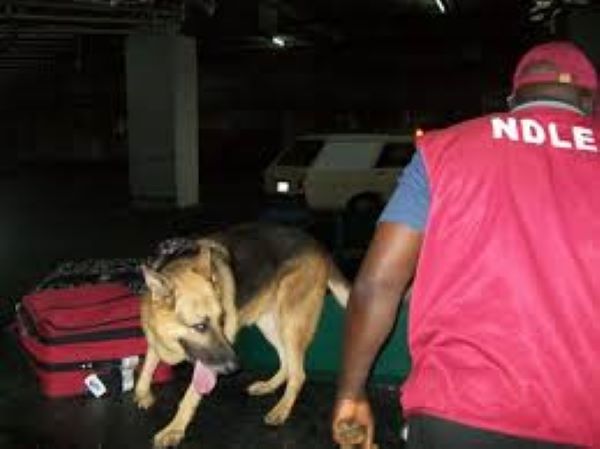
NDLEA sniffer dogs
The National Drug Law Enforcement Agency (NDLEA) has arrested 38,242 drug suspects, seized over 5.8 million kilogrammes of illicit drugs valued at more than N2.5 trillion, and secured 6,232 convictions between January 2025 and September 2026.
The Chairman/Chief Executive Officer of the NDLEA, retired Brig.-Gen. Buba Marwa, revealed these figures while presenting Nigeria’s national statement at the 81st Session of the United Nations General Assembly (UNGA) in New York.
The agency’s achievements were detailed in a statement issued on Tuesday in Abuja by the Director of Media and Advocacy, Mr. Femi Babafemi.
Speaking through the NDLEA Secretary, Mr. Shadrach Haruna, Marwa addressed a session themed, “Restoring Trust, Managing Transformation: A United Nations that Delivers for All.”
He highlighted Nigeria’s drug control reforms as a practical model for how public institutions can adapt to emerging threats, rebuild trust, and achieve measurable outcomes.
Marwa noted that the NDLEA has evolved from a purely enforcement-driven body into an integrated, intelligence-led, and people-centred agency.
The strategy now balances law enforcement with public health, advanced technology, financial investigations, alternative livelihoods, and international cooperation.
He explained that the institutional shift was driven by the growing sophistication of transnational drug cartels, which increasingly rely on modern technology and swift cross-border financial transfers.
Beyond supply reduction, the agency reported major progress in demand reduction and rehabilitation:
Over 16,303 individuals received counselling, treatment, or rehabilitation services during the period.
Sensitisation and prevention programmes reached millions of citizens nationwide.
“The agency’s performance should not be measured solely by arrests and seizures, but increasingly by its ability to dismantle major trafficking networks, organised criminal structures, and the financial systems sustaining the illicit drug trade,” Marwa stated.
To address the root causes of illicit drug production, Marwa highlighted the NDLEA’s pilot Alternative Development Initiative in three Ondo State communities.
The programme supports farmers transitioning from illegal cannabis cultivation to sustainable food crop agriculture, fostering community resilience and food security.
The NDLEA boss also showcased digital innovations, including the Drug Integrity Test and the Visa E-Administration System, as tools that have enhanced transparency, efficiency, and integrity in public service delivery.
He added that these initiatives are being institutionalised under the National Drug Control Master Plan (NDCMP) 2026–2030, which operates across six primary pillars:
Drug supply reduction
Drug demand reduction
Access to controlled medicines for medical use
Governance and coordination
Alternative development
Disruption of the illicit drug economy
Concluding his address, Marwa called on UN member states and international partners to deepen global collaboration to combat complex drug networks effectively.
He urged the international community to:
Strengthen real-time intelligence-sharing to close operational loopholes across jurisdictions.
Intensify financial tracking, asset tracing, and recovery to choke off the criminal economy.
Expand investment in law enforcement capacity, forensic capabilities, and modern technology particularly in developing countries.
Broaden support for rehabilitation infrastructure and sustainable alternative development programs.
Marwa reaffirmed Nigeria’s commitment to sharing operational lessons, learning from global counterparts, and working with international allies to turn commitments into collective action.