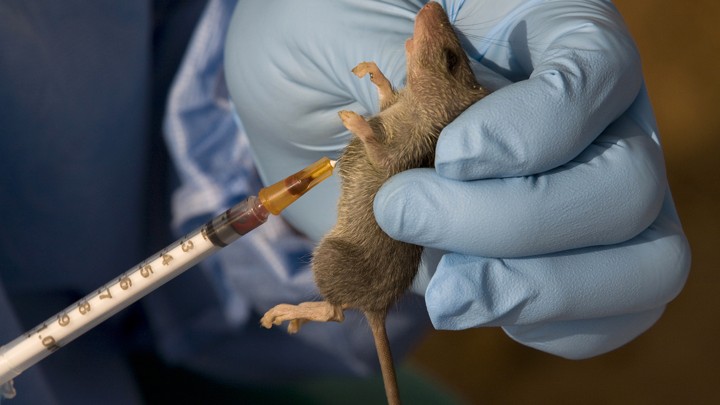
An ecologist extracts a sample of blood from a Mastomys Natalensis rodent in the village of Jormu in southeastern Sierra Leone February 8, 2011. Lassa fever, named after the Nigerian town where it was first identified in 1969, is among a U.S. list of "category A" diseases -- deemed to have the potential for major public health impact -- alongside anthrax and botulism. The disease is carried by the Mastomys Natalensis rodent, found across sub-Saharan Africa and often eaten as a source of protein. It infects an estimated 300,000-500,000 people each year, and kills about 5,000. Picture taken February 8, 2011. To match Reuters-Feature BIOTERROR-AFRICA/ REUTERS/Simon Akam (SIERRA LEONE - Tags: HEALTH SOCIETY ANIMALS) - GM1E72F07HC01
The National Association of Resident Doctors (NARD), on Saturday, called on the federal government to declare Lassa fever as a national health emergency.
The doctors described the current preventive and control measures as “weak”, after the end of their National Executive Council (NEC) meeting in Abuja.
“It has become a yearly occurrence for Nigeria to lose health care workers to the disease. We have already lost some of our members in this year’s outbreak,” the doctors said.
“As at January 26, a total of 689 suspected cases with 258 confirmed cases were reported, with 41 deaths. Five health workers were among the 41 deaths recorded”.
The doctors also asked the government to re-evaluate hazard allowances for health workers due to the increased risk of dealing with Lassa fever.
“The association has deemed it fit to call on the government to get serious on finding a lasting solution to combating the disease,” they added.
Speaking at the end of the annual conference of its National Executive Council, the president of the association, Aliyu Sokomba, said the decision to declare a national emergency on the disease will boost preparedness of health institutions in the country.
“NARD calls on the Federal Government to declare a national emergency on Lassa Fever and also to evaluate hazard allowance paid to health workers considering the increased risk faced by health workers”.
“Declaring an emergency is owing to the poor preparedness in response of our health institution in handling cases of Lassa fever”.