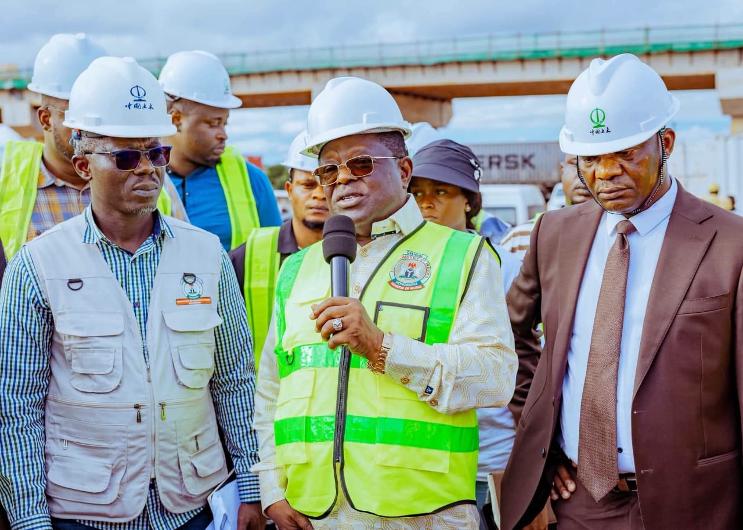
File: Umahi briefing the press
Umahi cast a pitiable mien trying to explain to Nigerians why the Benin by-pass became a symbol of utter neglect.
To his credit, David Umahi, Minister of Works, was on hand to see the nightmare motorists are going through in the Benin axis of the main artery that connects the entire country. Edo and Delta states occupy a unique position in Nigeria’s road networks. From the two states, virtually all the zones in the country can be accessed.
Umahi cast a pitiable mien trying to explain to Nigerians why the Benin by-pass became a symbol of utter neglect.
In one breath, Umahi, blamed the Benin-Asaba Expressway Concession Company (BAECC) for the severe road collapse and multi-day gridlock along the Benin-Agbor-Asaba highway while his directors of highway attributed the nightmare motorists are going through to the rains they claim has halted work on the road. In another breath, he stated that the company lacked the technical competence and proper track record to handle the large-scale project.
The Federal Government had concessioned the Benin-Asaba highway to BAECC in 2025, with the superhighway project officially launched and construction commencing in March 2025. The 125-kilometer road was expected to be converted into a superhighway of 10 lanes stretching from the AIF Roundabout in Benin City, Edo State, to Summit Junction in Asaba, Delta State.
The transformation into a 10-lane superhighway was to be executed under a Public-Private Partnership (PPP) model and scheduled for a 30-month completion period, targeting September 2027.
Umahi’s verdict on the technical competence of the concessionaire or lack of it brings to the fore how road contracts and the arrangement with BAECC was sealed.
Under extant rules, the Federal Government issues road construction contracts through a regulated public procurement process managed by the Federal Ministry of Works and supervised by the Bureau of Public Procurement (BPP). The Ministry prepares engineering designs, plans, scopes, and cost estimates for the road.
Afterwards, the project is supposed to be advertised in the Federal Tenders Journal, national newspapers, and procurement portals with interested construction firms submitting technical and financial proposals demonstrating their equipment, financial capability, and past experience. That is when due process is adhered to. Was the inter-state project subjected to competitive bidding and evaluation or was it handled like the Lagos-Calabar coastal road where the beneficiary was merely announced under circumstances where experts doubted an Environmental Impact Assessment was conducted? There is no indication of a competitive bid prior to BAECC getting the nod. And nothing suggests that due diligence was carried out on its competence – financial capacity and technical wherewithal. But they got the job it is just emerging that its has no established credentials in a job of such magnitude.
At the Benin by-pass, Umahi berated the concessionaire for removing over 30 kilometers of asphalt without building proper drainage channels first, making major sections of the road dug up earlier a long stretch of deeply muddy with the advent of heavy rains.
When the minister toured another site on the stretch of road in Asaba, Delta State , he met another nightmare scenario.
At the 11-kilometre Asaba-Onitsha road for which N14 billion has been paid to the contractor, only 40 percent of the project had been completed. I live in Asaba and I think the estimate of the area completed is much.
Umahi’s lamentations on the plight of motorists in Benin by-pass illustrates the absence of effective oversight not just in the execution of contracts but in the choice of contracting firms. Construction stretches should feature dedicated signboards at both ends to track accountability, display project details, and show execution progress.
The contractor, Hartland Nigeria Limited, abandoned the road more than six months ago, leaving commuters and motorists in the Delta State capital to daily harrowing experience within the city. Umahi, in line with his approach to errant contractors, ordered the arrest of the managing director for its failure.
The state of the Benin–Agbor–Asaba Expressway is the perfect picture of other federal roads in Delta State. Other critical federal highways in the state have fallen into severe disrepair, causing major traffic gridlocks, economic losses, and safety hazards for travelers. The Benin–Sapele–Warri Highway, Sapele–Amukpe–Eku–Abraka–Obiaruku, Warri–Effurun–Sapele–Oghara–Benin Road, East-West Road, as well as the Onitcha Ugbo federal road that connects Auchi and thence to Abuja are virtually impassable.
Umahi receives mixed reviews for his approach to managing and maintaining federal roads, characterised by aggressive site inspections and strict contract terminations balanced against persistent national highway decay. He has cancelled several non-performing or delayed major road contracts, including revoking the contract for the Benin–Sapele–Warri highway due to contractor inaction.
He strongly advocates replacing failing asphalt with rigid concrete pavement, arguing it can handle heavy truck traffic and withstand the local soil conditions better. The minister drew eye brows when he dubbed himself a professor of roads in a back and forth with the media when he was taken to task on the cost of the roads he has been superintending.
Many major federal arteries remain in deplorable condition, causing severe travel delays and economic hardship for commuters. Critics and some lawmakers accuse him of focusing disproportionate attention or funding on specific flagship projects (like the Lagos–Calabar coastal highway) while critical roads in other zones face severe neglect.
At a Senate plenary session, Adams Oshiomhole representing Edo North Senatorial District, pointedly accused Umahi of neglecting critical federal highways linking Edo and Delta states while prioritizing new road projects.
He stated that major transport corridors—including routes from Benin to Warri, Benin to Asaba, Benin to Auchi, and Auchi to Okene—remain in terrible, unsafe condition, alleging that Umahi’s Ministry of Works deliberately omitted these crucial interstate borders from the national budget allocations over the past three years.
He questioned the approval of numerous new road projects while existing, heavily utilized federal highways across the region continue to deteriorate without proper rehabilitation.
Oshiomhole urged the Senate leadership to compel the Ministry of Works to adopt a balanced, equitable, and truly national approach to infrastructure funding.
Commuters and local residents in the South-South region backed the senator’s remarks, citing daily hardships and demanding urgent federal action on the failed highway segments.
As the Yuletide season draws near, the traditional journey from Lagos to other regions by families may herald an unprecedented nightmare for road users. That is unless the emergency palliatives ordered by the Federal Government on some roads are diligently carried out and survive till the end of the year.