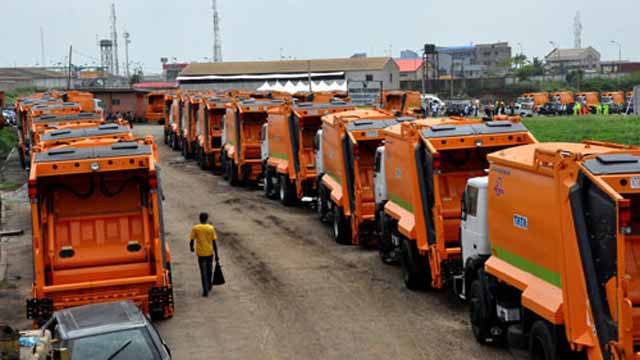
The Lagos Waste Management Authority (LAWMA) says it is strengthening waste management to cope with 13,000 to 16,000 metric tonnes generated daily.
The waste is generated by more than 24 million residents across Lagos State.
The Managing Director/CEO of LAWMA, Dr. Muyiwa Gbadegesin, disclosed this at the agency’s 2026 Mid-Year Media Parley in Lagos.
Gbadegesin said the scale of waste generation in the megacity required sustained investment in infrastructure, logistics, enforcement and citizen participation.
According to him, the authority was implementing operational interventions, infrastructure investments, enforcement measures and public engagement to improve waste management across Lagos.
He said the strategy was also designed to prepare the state for a future beyond dependence on conventional dumpsites.
Gbadegesin said recent heavy rainfall affected access to parts of the Olusosun disposal facility, slowing truck movement and increasing turnaround time.
He said the development temporarily affected waste evacuation, but the government responded with engineering interventions to restore operational efficiency.
Among the immediate measures, he listed rehabilitation of Road E, construction of new disposal platforms, improved truck circulation and expanded operational access.
Gbadegesin said the interventions had transformed Road E from an operational bottleneck into an opportunity to improve access and waste disposal efficiency.
He said the rehabilitation restored access, created additional disposal platforms and improved operational efficiency at the facility.
The LAWMA chief also highlighted ongoing investment in Transfer Loading Stations (TLS), saying two major facilities were being developed at Olusosun and Solus III dumpsites.
He said the facilities were being developed in partnership with Zoomlion Nigeria Ltd. and each was designed to handle about 2,500 metric tonnes daily.
Gbadegesin said the facilities would strengthen waste logistics and reduce pressure on disposal facilities by improving waste movement from collection points.
He said Material Recovery Facilities were also being developed in Ikorodu and Badagry to receive processed waste from the TLS facilities.
He added that material recovery hubs were also being created in each of the 57 Local Government Areas and Local Council Development Areas.
The development, he said, formed part of LAWMA’s broader strategy to move Lagos towards a circular economy.
Under the model, he said, waste would increasingly be treated as a resource rather than simply discarded.
Gbadegesin said LAWMA was also intensifying enforcement against indiscriminate waste disposal through Project WISE operations.
He listed illegal dumping enforcement, market closures for persistent violations, arrests and prosecution of environmental offenders among measures being deployed to improve compliance.
He said the authority maintained a zero-tolerance position toward indiscriminate waste disposal, stressing that infrastructure alone could not solve the challenge.
According to him, behavioural change among residents remained essential to achieving effective waste management across the state.
Gbadegesin said LAWMA was therefore expanding advocacy and public engagement programmes across schools, markets, estates and communities.
He said the programmes focused on encouraging behavioural change, waste sorting and recycling education.
The managing director said effective waste management required active participation by residents and stakeholders, noting that citizen behaviour remained a critical component.
He also identified strategic partnerships as central to LAWMA’s efforts to achieve sustainable waste management.
He said such partnerships involved Zoomlion Nigeria Ltd., Private Sector Participation operators, the Association of Waste Managers of Nigeria, LGAs and LCDAs.
Gbadegesin said the partnerships would help strengthen operational capacity and improve the sustainability of waste management in Lagos.
He said LAWMA’s medium- and long-term direction focused on preparing Lagos for “life after dumpsites” through a circular economy roadmap.
He said under the emerging model, waste management would increasingly involve recovery, recycling and conversion of waste into useful resources.
The strategy combines immediate interventions to improve waste evacuation with investments to transform waste management.
These investments are intended to change how waste is collected, transferred, recovered and ultimately disposed of across Lagos.
With Lagos generating as much as 16,000 metric tonnes of waste daily, the scale of the challenge remains enormous.
The development of TLS facilities capable of handling about 5,000 tonnes daily collectively represents a significant infrastructure component of LAWMA’s response.
The MRFs and recovery hubs being developed across the state are also expected to support waste recovery and recycling.
The agency says the ultimate direction is a transition from dependence on dumpsites toward a circular economy.
Under the model, waste would be recovered, processed and reused while reducing environmental pressure associated with conventional disposal.(NAN)