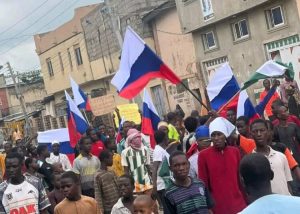

Protesters raise Russian flag in Kano
Russian Foreign Minister Sergey Lavrov has strongly refuted claims that the Russian government sponsored Nigerian youths who flew Russian flags during the August 2024 #EndBadGovernance protests.
Speaking on the sidelines of the Third Russia-Africa Summit in Moscow, Lavrov clarified that individuals who displayed the Russian flag acted entirely in their personal capacity, stressing that Moscow had no intention or involvement in undermining Nigeria’s national sovereignty.
Addressing a question from the News Agency of Nigeria (NAN), the foreign minister drew a parallel to international political demonstrations.
“Anyone who donned the Russian flag did so in his or her personal capacity. It does not mean that Russia was in support of this kind of action,” Lavrov said. “A lot of citizens sympathetic to Palestinians wave Palestinian flags to express solidarity. It does not mean the Palestinian government is behind them.”
The nationwide #EndBadGovernance demonstrations, held between August 1 and August 10, 2024, were driven by public discontent over economic hardship and the rising cost of living.
During the demonstrations, groups of protesters primarily youths and minors across Kano, Kaduna, Zamfara, and Abuja were spotted holding Russian flags and chanting slogans urging military intervention.
The Nigerian Federal Government subsequently condemned the display as a treasonable act and a threat to national security, leading to the arrest of several demonstrators alongside tailors accused of producing the flags. At the time, the Russian Embassy in Abuja had similarly denied any involvement.
Highlighting the long-standing diplomatic relationship between both nations—which dates back to the Soviet era—Lavrov reiterated Moscow’s commitment to expanding ties with Abuja.
He noted that bilateral cooperation has led to an increase in educational opportunities, with Russian academic scholarships for Nigerian students reaching a peak of 220 in 2026. He also recalled his productive visit to Abuja in 2024, where he met his Nigerian counterpart to bolster bilateral ties.
Addressing defense engagements in the Sahel region, Lavrov stated that Russia remains focused on helping eliminate security threats. He accused Western powers of deploying Ukrainian mercenaries to destabilize the region, likening the situation to past interventions in Libya.
Additionally, Lavrov commented on Russia’s recent diesel supply deal with the United States, describing it as a strictly commercial transaction aimed at addressing global energy costs rather than a shift in geopolitical alliances.
“The diesel agreement with the U.S. is purely a business decision by two world leaders who are concerned by the rising cost of energy,” he added.