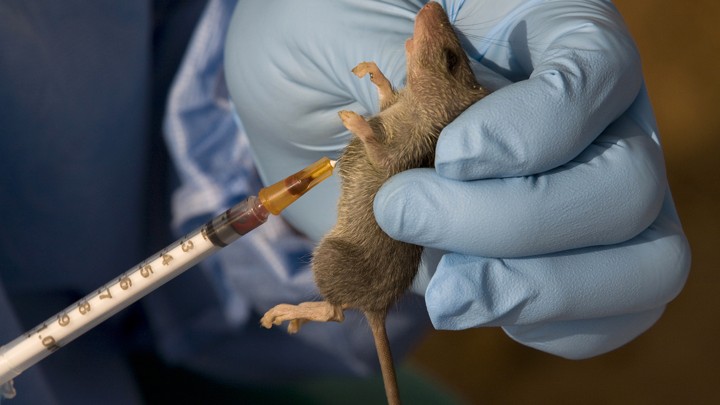
An ecologist extracts a sample of blood from a Mastomys Natalensis rodent in the village of Jormu in southeastern Sierra Leone February 8, 2011. Lassa fever, named after the Nigerian town where it was first identified in 1969, is among a U.S. list of "category A" diseases -- deemed to have the potential for major public health impact -- alongside anthrax and botulism. The disease is carried by the Mastomys Natalensis rodent, found across sub-Saharan Africa and often eaten as a source of protein. It infects an estimated 300,000-500,000 people each year, and kills about 5,000. Picture taken February 8, 2011. To match Reuters-Feature BIOTERROR-AFRICA/ REUTERS/Simon Akam (SIERRA LEONE - Tags: HEALTH SOCIETY ANIMALS) - GM1E72F07HC01
Some survivors of Lassa fever in Bauchi State have embarked on public sensitisation activities to create awareness on the disease.
The survivors recovered after their treatment at the Lassa Treatment Centre (LTC), Abubakar Tafawa Balewa University Teaching Hospital (ATBU-TH), Bauchi.
One of the survivors, Abubakar Hassan, said that he engaged in community health promotion to create awareness on the disease, to encourage early presentation in health facilities.
Hassan, 22, said this during an engagement with a medical team of the Médecins Sans Frontières (MSF), on Wednesday in Bauchi.
He said the LTC centre provided prompt care to patients as well as trained them on prevention, control and safety to safeguard public health.
According to Hassan, public sensitisation against the disease is a collective responsibility, and early presentation at health facilities saves lives.
“I was brought to the centre unconscious. I undergone three dialysis sessions before regaining consciousness during the fourth session.
“I was fed and well taken care of by the health workers. After discharge, I received new clothes and transport fare back home,” he said.
Hassan commended health workers at the centre for their professionalism and pledged to assist people in his community to refer suspected cases of Lassa fever and other infectious diseases to the centre for prompt attention.
Another survivor, Ms Nafi Sani, promised to mobilise her community members on the signs, symptoms, prevention and referral pathways of the disease.
She recalled that she received counselling on the signs, symptoms, prevention and referral pathways as well mental health support at the centre.
Shirley Samsom, Infection Prevention and Control Manager, MSF, said the centre was being run in collaboration with the ATBU-TH.
She said the centre was designed with Infection Prevention and Control unit, kitchen, Water, Sanitation and Hygiene (WASH) facilities, health promotion, mental health support and clinical services.
“The centre has separate wards for suspected and confirmed cases with designated entry and exit points.
“The suspected cases ward has a 24-bed capacity, while the confirmed cases ward has a 73-bed capacity with separate sections for male and female patients,” she said.
The Centre Coordinator, Dr Ibrahim Maigari, said ATBU-TH molecular laboratory was equipped to confirm suspected Lassa fever cases within 12 hours of sample collection.
Maigari noted that intensified community outreach and awareness campaigns contributed to the increase in the number of reported cases.
Maigari said the hospital expanded the centre to 77-bed capacity with the support of the MSF, which provided logistical support, including transportation of suspected cases from communities to the centre, and transport stipends to survivors after discharge.
“MSF is supporting ATBU-TH to conduct research on Lassa fever to strengthen evidence-based response to the disease. (NAN)