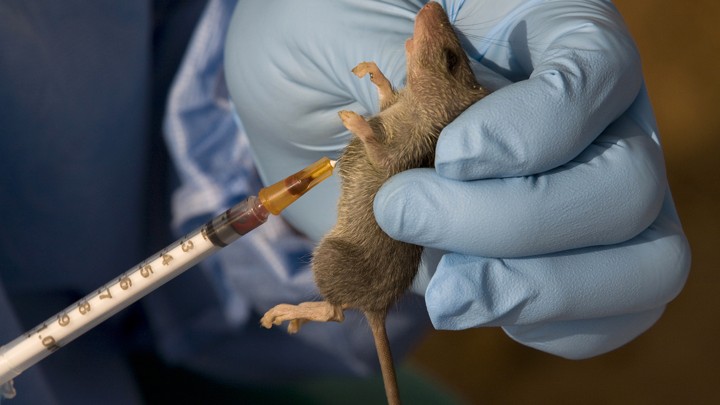
An ecologist extracts a sample of blood from a Mastomys Natalensis rodent in the village of Jormu in southeastern Sierra Leone February 8, 2011. Lassa fever, named after the Nigerian town where it was first identified in 1969, is among a U.S. list of "category A" diseases -- deemed to have the potential for major public health impact -- alongside anthrax and botulism. The disease is carried by the Mastomys Natalensis rodent, found across sub-Saharan Africa and often eaten as a source of protein. It infects an estimated 300,000-500,000 people each year, and kills about 5,000. Picture taken February 8, 2011. To match Reuters-Feature BIOTERROR-AFRICA/ REUTERS/Simon Akam (SIERRA LEONE - Tags: HEALTH SOCIETY ANIMALS) - GM1E72F07HC01
April 24, 2022
Ondo State government, says a total of 34 persons have died of Lassa Fever in the state from January to date.
Prof. Francis Faduyile, Special Adviser to the state governor on Health, made the disclosure in an interview with the News Agency of Nigeria (NAN) in Akure on Sunday.
Faduyile said the state recorded 227 confirmed cases in six Local Government Areas (LGAs) during the period.
According to him, the local governments are Owo, Ose, Akure South, Akoko South-West, Akure North and Ondo West.
Faduyile said there were three confirmed cases among health workers in the state.
“None of the health workers died, because they reported early as a result of high index of suspicions and early presentations. They did well and recover quickly,” he said.
He explained that the prevalent period of the disease was during the dry season, noting that “although there could still be one or two cases during the rainy season.”
“Ondo State, in the last epidemic, was the epicenter of Lassa Fever in Nigeria, and the state government looked into the cause and ways to prevent the disease.
“The first way to prevent Lassa is to stop bush burning, and we have sensitised against this. Besides, don’t put your food where rats have access.
“There is also ‘deratification’, that is to kill all the rats which the state government has done and was successful.
“Then we had index of suspicion so that people can start testing for Lassa early.
“A lot of our health workers have been put on high awareness because those that are positive should have prompt treatment.
“Ondo State government has also improved the Infectious Disease Hospital, Akure, to a standard that can take care of Lassa Fever.
“Also, the Federal Medical Centre in Owo has an area that can treat Lassa. We have also seen that the sanitation of the area is important,” he said.
Faduyile, who explained that the state government was working on the refuse dump site in Owo, said a new dump site would be created, while more vehicles would be used to get refuse to the site.
He also said the area would be treated so that the rodents would not leave their habitats inside the forest for the city.
Faduyile noted that the Lassa Fever cases in the state, in the last couple of weeks, had reduced drastically.
He also spoke on the legacy of the present administration, which he claimed, would be known for its sustainable healthcare management.
“Ondo State tarries high amongst the committee of states in this country with our health insurance, and that is what can sustain health.
“Whatever model you wish to adopt, the most important thing is sustainability. We are taking the bull by the horns,” the former President of Nigerian Medical Association (NMA) said. (NAN)