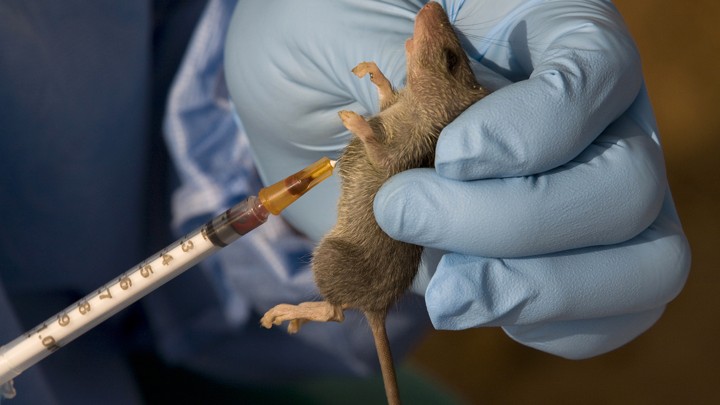
An ecologist extracts a sample of blood from a Mastomys Natalensis rodent in the village of Jormu in southeastern Sierra Leone February 8, 2011. Lassa fever, named after the Nigerian town where it was first identified in 1969, is among a U.S. list of "category A" diseases -- deemed to have the potential for major public health impact -- alongside anthrax and botulism. The disease is carried by the Mastomys Natalensis rodent, found across sub-Saharan Africa and often eaten as a source of protein. It infects an estimated 300,000-500,000 people each year, and kills about 5,000. Picture taken February 8, 2011. To match Reuters-Feature BIOTERROR-AFRICA/ REUTERS/Simon Akam (SIERRA LEONE - Tags: HEALTH SOCIETY ANIMALS) - GM1E72F07HC01
March 28, 2023
The Nigeria Centre for Disease and Control and Prevention (NCDC) says in less than three months, the country has registered 784 confirmed cases of Lassa fever with 142 deaths across 23 states.
The NCDC said on Tuesday that the infections were recorded from Jan. 1 till date.
The agency said that the cases were reported from Edo, Ondo, Ebonyi, Bauchi, Taraba, Benue, Rivers, Plateau, and Nasarawa States.
NCDC said that cumulatively from Epidemiological Week 1 to Week 11, 2023, 142 deaths had been reported with Case Fatality Rate (CFR) of 18.1 per cent which was lower than the 18.7 per cent CFR for the same period in 2022.
The NCDC said that, in total for 2023, 23 states had recorded at least one confirmed case across 97 local government areas.
The public health institution said that 71 per cent of all new confirmed Lassa fever cases were reported from Ondo, Edo and Bauchi while 29 per cent came from six states.
It said that of the 71 per cent, Ondo reported 32 per cent, Edo, 29 and Bauchi, 10.
According to the NCDC, the predominant age group affected is 21-30 years with the median age as 32 years.
It said that the male-to-female ratio for confirmed cases was 1:0.9.
The agency said that the number of suspected cases increased compared to the number reported for the same period in 2022.
The NCDC said that a healthcare worker was affected in Week 11.
It said that the National Lassa fever multi-partner, multi-sectoral Emergency Operations Centre was activated to coordinate response activities at all levels.
The person-to-person transmission of Lassa fever can occur through contact with blood, urine, faeces, vomitus and other body fluids of an infected person.
Lassa fever initially presents like other commonplace illnesses accompanied by fever, such as malaria.
In severe cases, the symptoms include bleeding from ears, eyes, nose, mouth and other body openings.
The time between infection and the appearance of symptoms of the disease is three to 21 days.
Early diagnosis and treatment of the diseases greatly increase the chances of patient’s survival. (NAN)