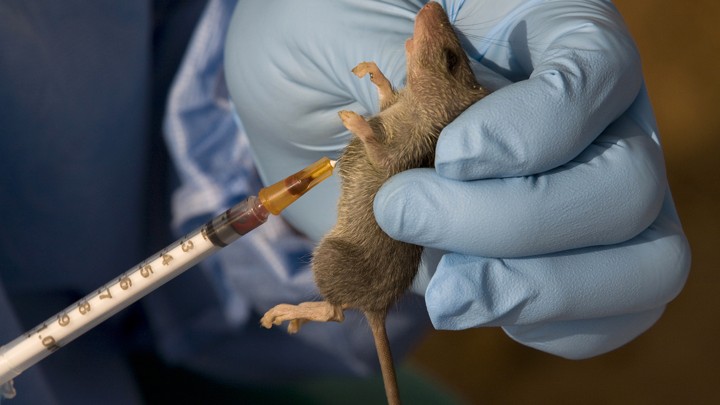
An ecologist extracts a sample of blood from a Mastomys Natalensis rodent in the village of Jormu in southeastern Sierra Leone February 8, 2011. Lassa fever, named after the Nigerian town where it was first identified in 1969, is among a U.S. list of "category A" diseases -- deemed to have the potential for major public health impact -- alongside anthrax and botulism. The disease is carried by the Mastomys Natalensis rodent, found across sub-Saharan Africa and often eaten as a source of protein. It infects an estimated 300,000-500,000 people each year, and kills about 5,000. Picture taken February 8, 2011. To match Reuters-Feature BIOTERROR-AFRICA/ REUTERS/Simon Akam (SIERRA LEONE - Tags: HEALTH SOCIETY ANIMALS) - GM1E72F07HC01
Jan. 17, 2022
The Nigeria Centre for Disease Control (NCDC) says Nigeria recorded 222 new Lassa fever cases and two new deaths in one week across 15 states and the Federal Capital Territory (FCT) .
According to the centre in its weekly situation report on Monday, 69 persons are currently undergoing medical care in treatment centres.
“There is an increase in the number of recorded confirmed cases of Lassa fever across the country”.
“The number of suspected cases has increased compared to that reported for the same period in 2021.
“The predominant group affected is 31 to 40 years. The male to female ratio for confirmed cases is 1:0.9. One new health worker affected from Benue state in the reporting week,” it added.
According to the report, two deaths were reported from Benue and Taraba.
It noted that 51 new cases were recorded in Bauchi; 76 in Edo; 46 in Ondo; three in Benue; nine in Taraba; 11 in Kaduna; six in Plateau; three in Kogi; one in Cross River; four in Ebonyi; two in Gombe; one in Katsina; four in the Federal Capital Territory FCT; two in Nasarawa; one in Rivers; and two in Enugu.
The agency noted that it has deployed national response teams to Nasarawa and FCT, distributed response commodities to states and treatment centres, and implementation of Lassa fever environmental response campaign in high burden states by the Federal Ministry of Environment.