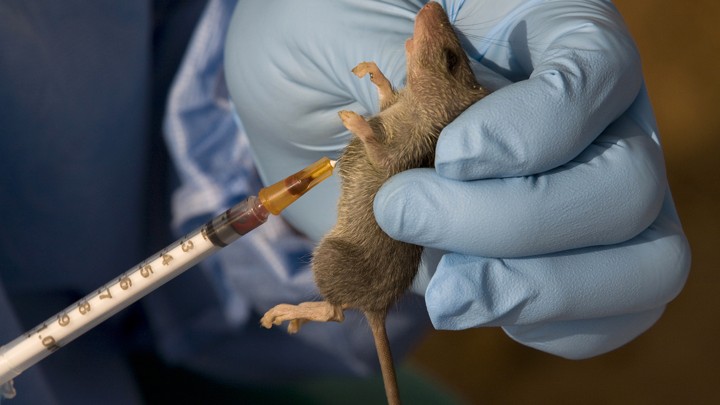
An ecologist extracts a sample of blood from a Mastomys Natalensis rodent in the village of Jormu in southeastern Sierra Leone February 8, 2011. Lassa fever, named after the Nigerian town where it was first identified in 1969, is among a U.S. list of "category A" diseases -- deemed to have the potential for major public health impact -- alongside anthrax and botulism. The disease is carried by the Mastomys Natalensis rodent, found across sub-Saharan Africa and often eaten as a source of protein. It infects an estimated 300,000-500,000 people each year, and kills about 5,000. Picture taken February 8, 2011. To match Reuters-Feature BIOTERROR-AFRICA/ REUTERS/Simon Akam (SIERRA LEONE - Tags: HEALTH SOCIETY ANIMALS) - GM1E72F07HC01
March 11, 2025
The Edo Government has confirmed 15 deaths from Lassa fever since the outbreak of the disease in the state in December 2024.
The Director of Public Health, Edo State Ministry of Health, Dr Stephenson Ojeifo, disclosed this on Tuesday in Benin while responding to concerns on social media regarding the government’s efforts in tackling the outbreak.
“As of today, Edo State has recorded over 1,000 suspected cases of Lassa fever. Out of these, 103 have tested positive
“From the 103 confirmed cases, we have recorded 15 deaths, while others have been treated and discharged,” he said.
Ojeifo asserted that Gov. Monday Okpebholo had strengthened surveillance and contact tracing efforts, ensuring that all necessary resources were available to contain the outbreak.
He, however, attributed the high mortality rate to late referrals, noting that many patients arrive at the Irrua Specialist Teaching Hospital (ISTH) in critical condition.
“The problem is that patients are only referred to ISTH when their condition has deteriorated.
“We have been sensitising residents to seek medical attention if they experience persistent fever that does not resolve, so that samples can be tested and treatment can commence early if needed,” he said.
The director urged healthcare providers to avoid delays in referring suspected cases to designated treatment centres.
He warned that any hospital found treating Lassa fever patients without proper authorisation would face sanctions.
He, however, said that no deaths were recorded, as all affected individuals received timely medical attention. (NAN)